Gold Up 6% After Import Duty Hike: New Triggers For The Bitcoin Price


Hard-Asset Rotation Lag: Data Reveals What's Next For Bitcoin Price
Gold spiked 6.15% on MCX today. Silver followed at 6.50%. Both in a single session.
The trigger was India's Finance Ministry doubled the gold and silver import duty overnight, raising it from 6% to 15%, effective May 13, 2026. 
Prime Minister Narendra Modi had already made a rare public appeal on Sunday urging Indians to avoid buying gold for a year.
The government is clearly under pressure on its foreign exchange reserves.
Markets reacted instantly.
MCX Gold futures hit ₹164,000 before pulling back to ₹162,576. Silver touched ₹297,200. Both are sitting on massive single-day gains right now.
And the Bitcoin price? Still at $81,190. Barely moved.
But here is what most people are missing—that gap between gold moving and Bitcoin not moving yet has a name.
It has data behind it. And historically, it has been one of the more reliable setups in the hard-asset space.
Why India's Gold Import Duty Hike Is a Bigger Macro Signal Than It Looks
The import duty hike is not just a jewellery industry story.
India is the world's second-largest gold consumer and meets almost all of its consumption through imports.
When the government more than doubles the import cost—10% basic customs duty plus 5% agriculture infrastructure and development cess—it is signalling genuine stress on the country's foreign exchange position.
Gold ETF inflows in India jumped 186% year-on-year in the March quarter to a record 20 metric tonnes, according to the World Gold Council.
That kind of demand surge from one of the world's biggest gold markets does not disappear because of a duty hike. It redirects.
Indian investors who cannot access gold cheaply through official channels — and who have already been told by the Prime Minister to avoid buying it — will look elsewhere.
Some go to real estate. Some wait. And historically, a measurable portion rotates into crypto.
That rotation is not speculation.
It is documented behavior from 2013 and 2019, both times India tightened gold import rules.
The Bitcoin price saw meaningful inflows from Indian retail in the weeks following both episodes.
Gold Leads Bitcoin by 4 to 7 Months — The Data Behind It
André Dragosch of Bitwise Europe ran Granger causality tests on gold and Bitcoin price data and found a consistent pattern — gold tends to lead Bitcoin by approximately four to seven months.
The mechanism is straightforward.
Institutional capital floods into gold as a safe haven first. Then, as risk appetite adjusts within the hard-asset framework, a portion of that capital rotates into Bitcoin.
The numbers from 2026 make this pattern impossible to ignore.
Gold hit an all-time high of $5,595 per ounce in late January 2026—up 65% on a full-year basis.
Bitcoin peaked at $126,000 in October 2025, then retreated to the mid-$70,000s through early 2026.
The Bitcoin-to-gold correlation coefficient fell to -0.88, one of its most negative readings since the 2022 bear market.
That extreme negative correlation is not a permanent decoupling. It is a compression.
The last three times this correlation dropped below -0.48, Bitcoin staged a sharp recovery.
In September 2025, when the coefficient hit -0.486, Bitcoin responded by rallying from $112,000 to $126,000 within weeks.
The spring is loaded again. And today's gold move just tightened it further.
Bitcoin Price Chart Reading: What the 4H Structure Is Saying Right Now
Bitcoin is currently trading at $81,190 on the 4H chart. The structure is more constructive than the flat price suggests.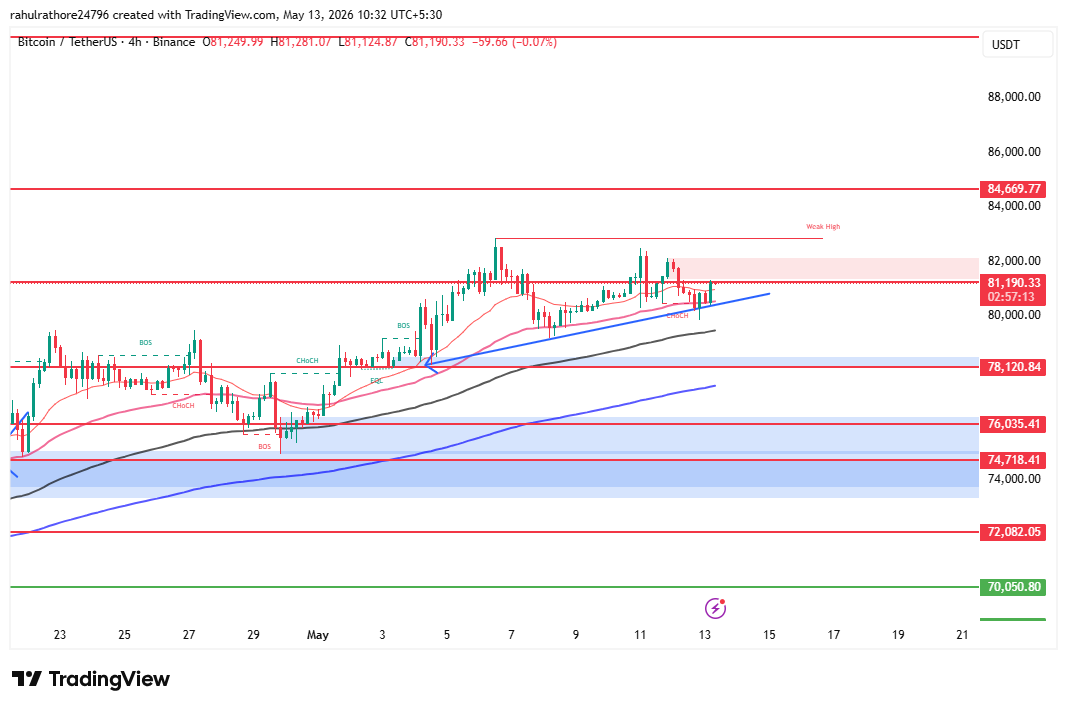
What the chart shows:
An ascending trendline from the late April lows is still intact.
Price has been making higher lows consistently—from $74,718 support to $78,120 and now holding above $80,000.
The moving averages are curling upward, and BTC is trading above both the short-term EMAs on the 4H timeframe.
The chart marked a CHoCH—Change of Character—near the $78,000 zone, which confirmed the shift from bearish to bullish structure.
The BOS — Break of Structure — above $81,000 was the next confirmation.
Key levels to watch:
-
Strong Support: $78,120 — the last significant higher low. A close below this would weaken the bullish case.
-
Demand Zone: $74,718 to $76,035 — strong accumulation zone marked on the chart. This is the invalidation level for any near-term bull thesis.
-
Immediate Resistance: $84,669 — the next major resistance level clearly marked. A 4H close above this opens the door to $88,000.
-
Weak High: $82,000 zone — price needs to break and hold above this before targeting $84,669.
-
Bull Target: $88,000 and above—if the gold rotation thesis plays out over the next 4 to 8 weeks.
The structure is bullish as long as $78,120 holds. Bitcoin's price is currently consolidating just above $81,000—compressing before the next directional move.
Bitcoin Price Prediction 2026: Three Scenarios
Bear Case — $72,000 to $74,000
The gold rotation thesis fails to materialize. Indian retail does not rotate into crypto. Global risk-off sentiment accelerates.
BTC breaks below $78,120 support and loses the ascending trendline. The $74,718 demand zone becomes the next test.
Below that, $72,082 is the last major support before a deeper correction. Invalidation: weekly close below $70,050.
Base Case — $84,000 to $92,000
The gold-to-Bitcoin rotation plays out over 4 to 8 weeks.
Indian retail flows into crypto as gold becomes inaccessible through official channels.
BTC breaks above $84,669 resistance on strong volume. ETF inflows remain steady.
Price targets $88,000 to $92,000 by the end of June 2026. This is the most likely scenario if gold holds its gains above the ₹160,000 zone on MCX.
Bull Case — $100,000 to $110,000
Gold stays elevated, the dollar continues weakening, and a major institutional rotation into Bitcoin accelerates.
The 4- to 7-month lag from gold's January 2026 ATH of $5,595 resolves exactly on schedule—putting a BTC breakout in the May to July 2026 window.
Combined with any positive macro catalyst—Fed rate cut signal, geopolitical de-escalation, or ETF inflow surge—BTC reclaims $100,000 and pushes toward the $110,000 zone. This is not a base case, but it is structurally supported.
Ethereum Price Prediction 2026: Follows BTC, Usually Harder
Ethereum price tends to follow Bitcoin's directional move with amplified volatility.
When Bitcoin rallied from $112,000 to $126,000 in late 2025, Ethereum outperformed on a percentage basis.
In the current context, if Bitcoin breaks above $84,669 and gold rotation flows accelerate, Ethereum is positioned to move faster.
ETH Key Levels:
-
Support: $1,800 — must hold for any bull scenario
-
Resistance: $2,200 — first target on a BTC breakout
-
Bull Target: $2,800 to $3,200 by Q3 2026 if macro tailwinds persist
-
Institutional view: Tom Lee forecasts $20,000 ETH by end of 2026—aggressive but reflects how undervalued ETH is relative to its utility at current levels
The Macro Picture Connecting Gold and Bitcoin Right Now
Three forces are converging simultaneously.
Dollar weakness: The US dollar reserve share has dropped to approximately 57%, a 25-year low.
Countries are settling trade in yuan, rupees, and bilateral arrangements. When the dollar weakens structurally, hard assets—both gold and Bitcoin—benefit.
Central bank gold buying: Central banks purchased more than 1,000 tonnes of gold in each of the past three consecutive years.
JPMorgan projects this pace will remain elevated at around 755 tonnes in 2026. Sovereign reserve diversification away from USD assets is not slowing down — it is accelerating.
India demands suppression: When the world's second-largest gold consumer is officially told not to buy gold, that pent-up demand for a store of value does not evaporate.
It finds another outlet. Bitcoin, with its fixed supply of 21 million coins and 24/7 global accessibility, is the most obvious candidate.
All three point in the same direction. Not all at once, not in a straight line—but the structural setup for Bitcoin's price in 2026 is building quietly while everyone watches gold make headlines.
Expert View
Coingabbar market analysts tracking the gold-to-Bitcoin rotation pattern note that today's MCX gold spike is the kind of event-driven catalyst that historically accelerates the lag timeline.
When gold moves sharply on a policy shock—rather than gradual accumulation—the psychological urgency for capital reallocation increases.
Bitcoin's current chart structure supports the thesis.
The ascending trendline from late April, the CHoCH confirmation at $78,000, and the consolidation above $81,000 all suggest accumulation rather than distribution at current levels.
The $84,669 resistance is the key level.
A weekly close above that, combined with sustained gold elevation and continued India duty restriction, would confirm the rotation is underway.
Traders watching Bitcoin price in 2026 should have that level marked.
Gold moved today. Bitcoin is sitting still. That gap has historically not lasted long.
Disclaimer: This article is for informational and educational purposes only and does not constitute financial or investment advice. Bitcoin and Ethereum price predictions are analyst estimates based on technical analysis, historical correlation data, and publicly available macro information—not guaranteed outcomes. Cryptocurrency and commodity investments carry significant risk, including total loss of capital. Always conduct your own independent research before making any financial decision. Do not invest more than you can afford to lose.