Is Ethereum Dead? Why ETH Crashed and Ethereum Price Prediction


Vitalik Sells and Institutions Exit: The End of an Era?
The crypto market is once again under heavy pressure, and sentiment has slipped into what many are calling “Extreme Fear.”
As a result, the 2026 Ethereum price prediction now stands at a sensitive crossroads.
ETH is hovering near key support zones, and every dip is triggering the same unsettling question across social media—is Ethereum dead?
This kind of panic is not new for the broader market.
The “Bitcoin is dead” narrative tends to resurface during every major correction.
But this phase feels sharper.
Liquidity appears thinner, momentum is fading, and reports suggest some institutional players are reducing exposure. That combination is amplifying doubt.
Is ETH gradually losing dominance to faster, cheaper rivals?
Or is this simply another deep shakeout designed to reset the market before the next expansion phase?
Vitalik Selling Again: On-Chain Data Raises Questions
As per the recent on-chain data shared by Lookonchain, the wallet linked to Vitalik Buterin has reportedly sold 1,869 ETH worth approximately $3.67 million over the past two days. 
During the same period, ETH declined from $1,988 to $1,875, a drop of about 5.7%.
This is not the first instance.
According to the same data source, a previous sale of 6,958 ETH worth $14.78 million was followed by a sharper correction, with ETH falling from $2,360 to $1,825—nearly a 22.7% decline.
While correlation does not automatically imply causation, large founder-linked transactions often amplify market sensitivity.
In a fragile environment already driven by fear, such movements tend to accelerate bearish sentiment and intensify the “Is Ethereum dead?” narrative circulating across social media.
Ethereum ETF Outflows Increase Selling Pressure
According to recent ETF data from SosoValue, Ethereum spot ETFs have recorded consistent weekly net outflows throughout February.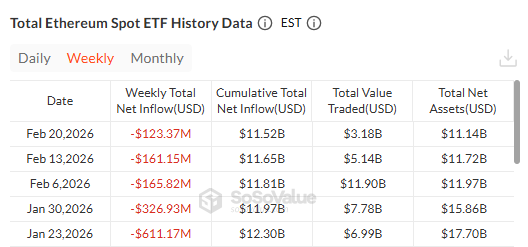
Recent figures show withdrawals of approximately -$123M, -$161M, and -$165M, with one week seeing a deeper outflow of over -$326M.
When institutional flows move negative for multiple consecutive weeks, it weakens structural demand.
In a market already under pressure, sustained ETF outflows can amplify downside momentum rather than provide support.
Why Is Ethereum Down Today?
On the 1-hour chart, price was moving inside a clear falling channel before breaking down to the downside.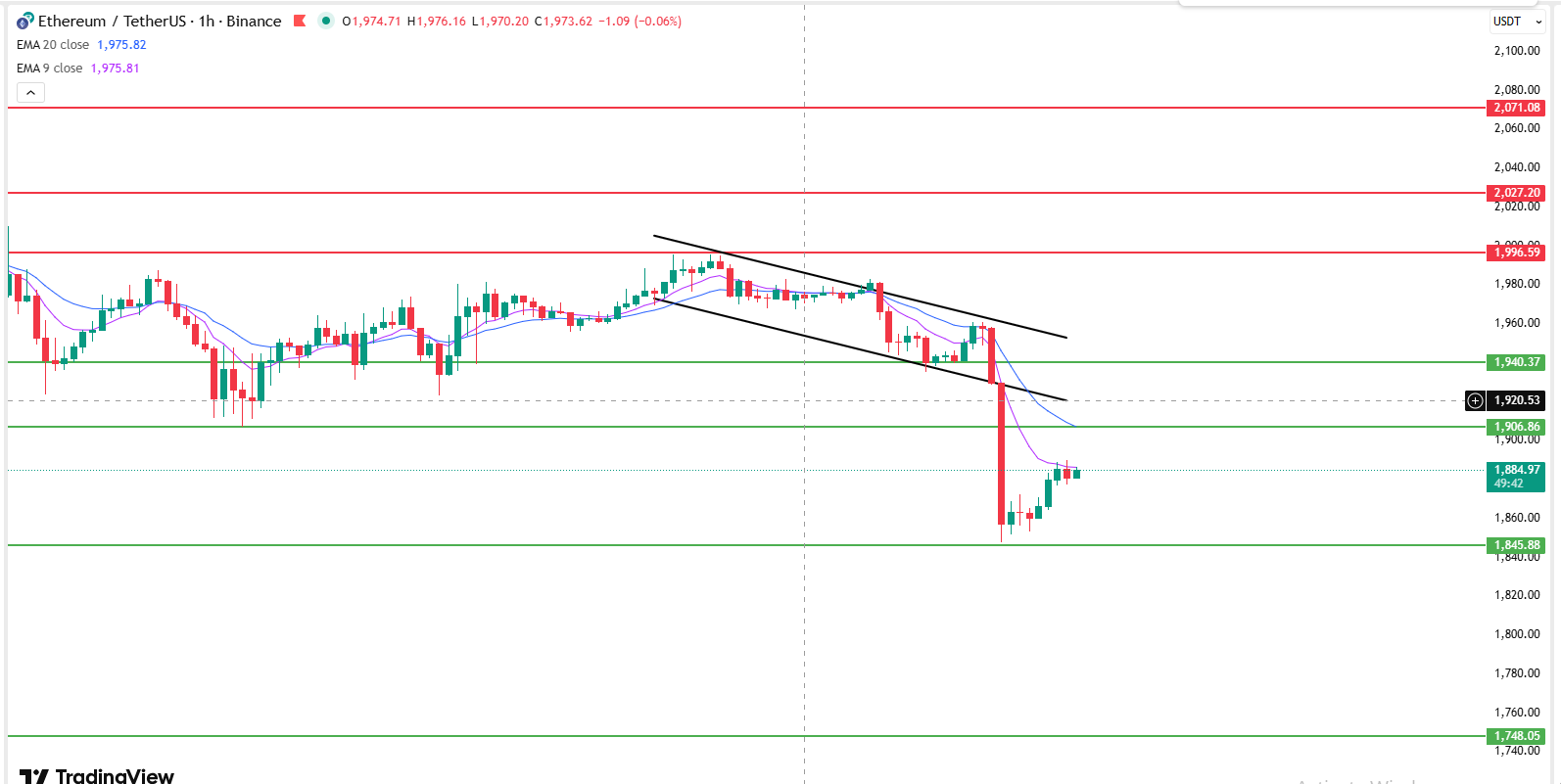
The breakdown accelerated once the key $1,900 support level gave way.
Price dropped toward the $1,845 zone and saw a short-term bounce from that level. Currently, ETH is holding near the 9 EMA, but the recent 9 and 21 EMA bearish crossover suggests short-term momentum remains weak.
Unless price reclaims higher resistance levels quickly, the structure continues to favor sellers in the near term.
Key Support Levels
$1,845
$1,748
Key Resistance Levels
$1,906
$1,940
$1,996
In the short term, if price fails to reclaim $1,906, price may revisit the $1,845 support zone again.
A sustained move above $1,940 would be needed to reduce immediate bearish pressure and open room toward $1,996.
Daily Chart Outlook: Bearish Flag Breakdown
On the daily timeframe, ETH was forming a bearish flag pattern, which has now broken to the downside.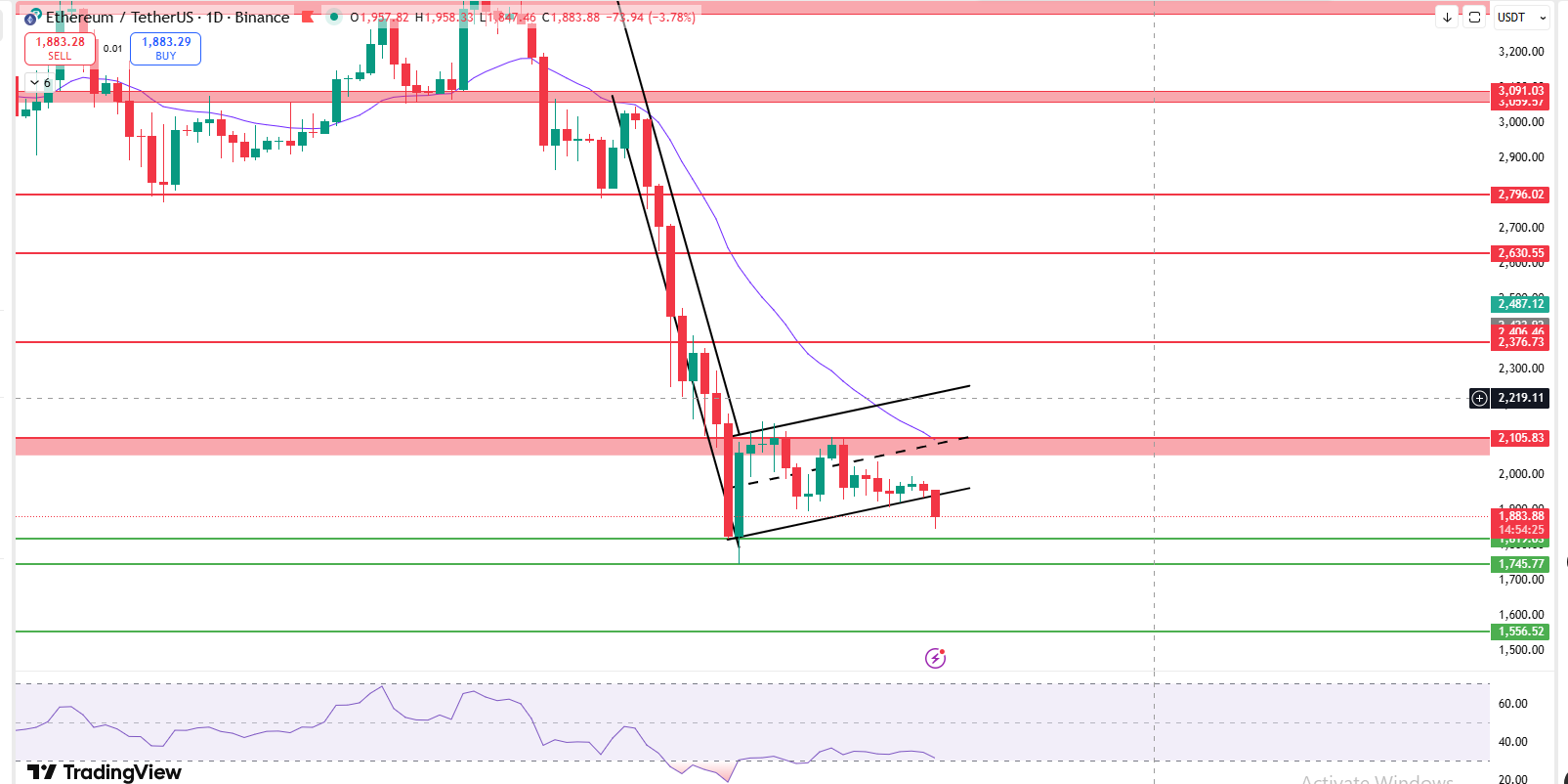
This breakdown confirms continuation pressure within the broader downtrend structure.
RSI is hovering near 29, entering oversold territory, but not yet showing a strong reversal signal.
Meanwhile, the 21 EMA remains positioned above price and is acting as dynamic resistance, keeping recovery attempts capped.
Unless ETH reclaims higher resistance zones, the daily structure continues to favor sellers.
Key Support Levels: $1,845, $1,745, $1,556
Key Resistance Levels: $1,906, $2,105, $2,376
Short-term rebounds are possible due to the oversold RSI, but the trend structure remains weak below the 21 EMA.
Is Ethereum Repeating the Q4 Fractal Pattern?
A recent chart shared by crypto analyst Ted Pillows suggests that ETH may be repeating a similar fractal structure seen in Q4 2025.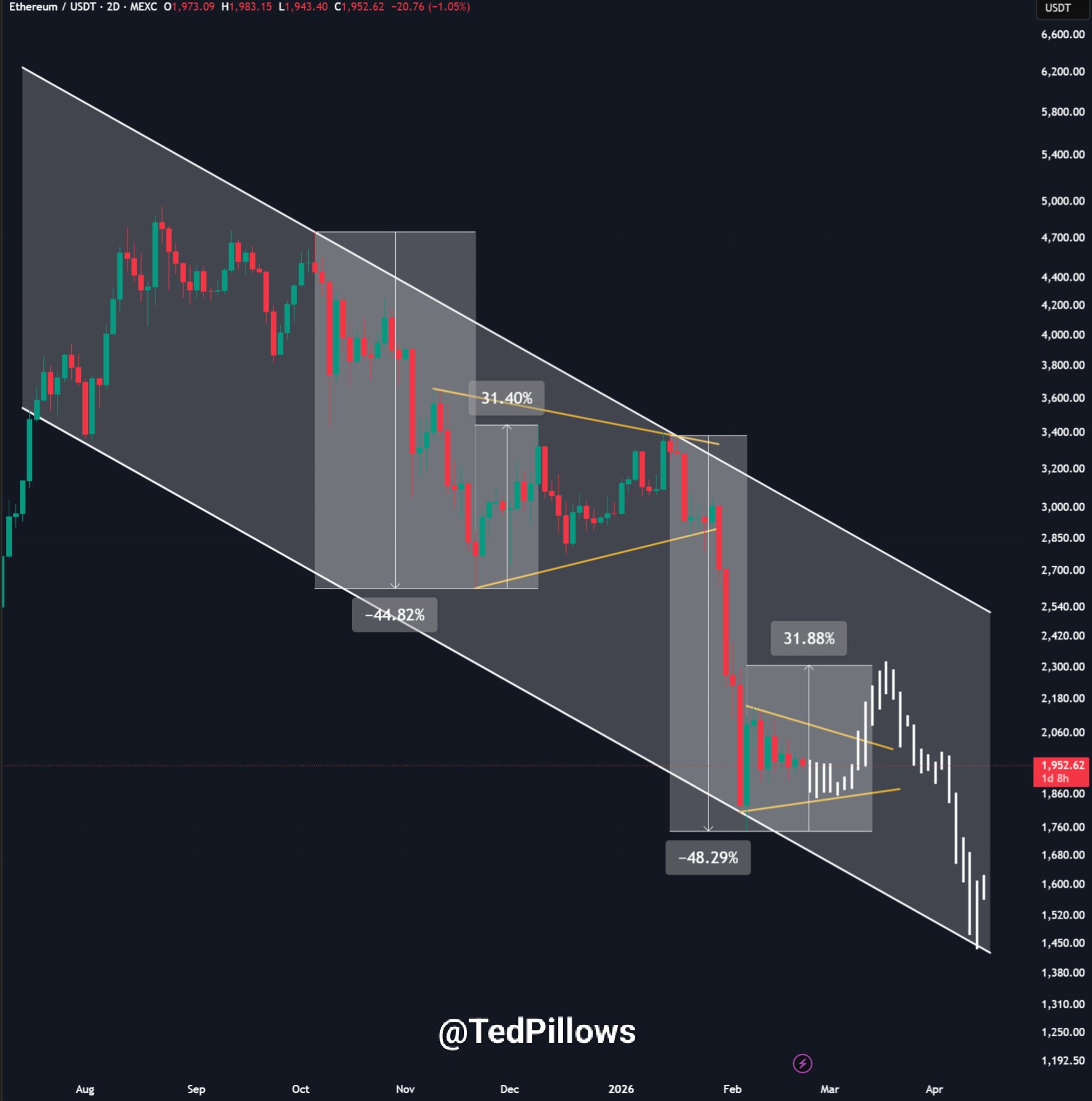
In both cases, price formed a temporary rising structure inside a broader descending channel before breaking down sharply.
Previously, that breakdown led to an extended decline of over 40%.
The current setup shows a comparable lower high formation followed by renewed selling pressure within the same descending channel framework.
If this fractal continues to play out, the next major downside level to watch sits near the $1,380 zone, aligning with the lower boundary of the broader channel and historical demand area.
For now, the pattern remains a projection, not a confirmation.
But as long as Ethereum trades inside the descending channel structure, downside risks remain elevated toward the $1,380 region.
Conclusion: Ethereum Price Prediction Outlook
The current Ethereum Price Prediction remains fragile as price trades below key resistance zones and institutional flows stay negative.
As long as ETH remains below $1,906–$1,940, downside pressure could extend toward $1,845 and potentially $1,380 if broader weakness continues.
The bearish outlook would start to weaken only if ETH reclaims $2,105 with strength. Until then, the Ethereum Price Prediction structure remains cautious with elevated downside risk.
YMYL Disclaimer: This article is strictly informational in nature and does not constitute an investment recommendation. Investment in cryptocurrencies is extremely volatile, and market conditions can change quickly based on macro data. High volatility can result in significant capital loss. It is always essential to do your own research before making any investment.