Is Bitcoin Dead? A Bold Bitcoin Price Prediction 2026 Analysis


Why BTC Is Down Today: Is Bitcoin Going to Zero in 2026?
Is this really the end?
That is the question sitting in the mind of every investor waking up to red charts today.
BTC has lost the $65,000 support.
The total crypto market cap has slipped to $2.23 trillion.
A 4.31% drop in just 24 hours.
The fall feels sudden, heavy, and uncomfortable for this 2026 Bitcoin price prediction.
People are rushing to Google and typing one anxious question—is Bitcoin dead?
But this panic is not only about numbers.
It is about “Extreme Fear” spreading across the entire crypto market.
That feeling when traders stop thinking long-term and start reacting emotionally.
Right now, the chaos feels bigger than the charts.
Are we watching a Bitcoin-going-to-zero story unfold?
Or is this turning into the biggest bear trap of 2026?
Before jumping to indicators and patterns, it makes sense to understand the psychology behind this fear.
Because BTC Price Prediction 2026 now stands at a very sensitive turning point.
$230 Million Liquidation Shock in 60 Minutes
The fear intensified after a recent tweet by renowned macro market channel The Kobeissi Letter, which has over 1.3 million followers on X.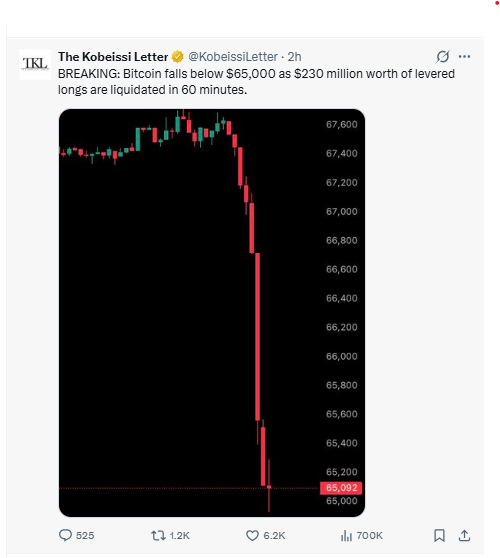
The channel reported that BTC fell below $65,000 as 230 million dollars in leveraged long positions were liquidated within just 60 minutes.
This was not ordinary selling.
It was a rapid leverage wipeout, and that kind of forced liquidation tends to accelerate panic across the market.
Satoshi-Era Whale Dumps 11,300 BTC
Another wave of fear hit the market after a tweet by crypto commentator 0xPepesso, who reported that a Satoshi-era whale sold 11,300 BTC worth roughly 750 million dollars after holding for nearly 15 years. 
Moves like this quickly fuel the “Bitcoin is dead” narrative.
The moment old Satoshi-era coins start moving, social media fills with posts asking if Bitcoin is zero or if this is the final exit before collapse.
Even if the broader structure has not completely broken, the psychology changes fast.
Early-era wallets selling creates the impression that long-term holders are stepping out.
In a weak market, that perception alone is enough to amplify the "Bitcoin is dead" and "Bitcoin is zero" trend across the space.
Bitcoin Spot ETF Outflows Add Pressure
As per the recent ETF inflow data from SosoValue, Bitcoin spot ETFs have seen consistent net outflows, including weekly withdrawals in February of around -$315M, -$359M, and -$318.07M.
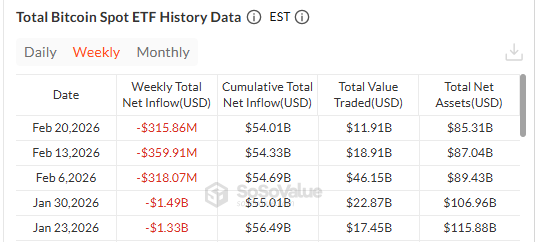
When institutional money begins exiting instead of entering, it weakens structural demand.
In a market already struggling below $65,000, these outflows add another layer of pressure and reinforce the growing “Bitcoin is dead” narrative that traders are talking about.
Wave 4 Done: $60K in Focus
A fresh warning has come from ElliottWaveStrategy, which claims Wave 4 has completed its triangle correction and Wave 5 is now starting.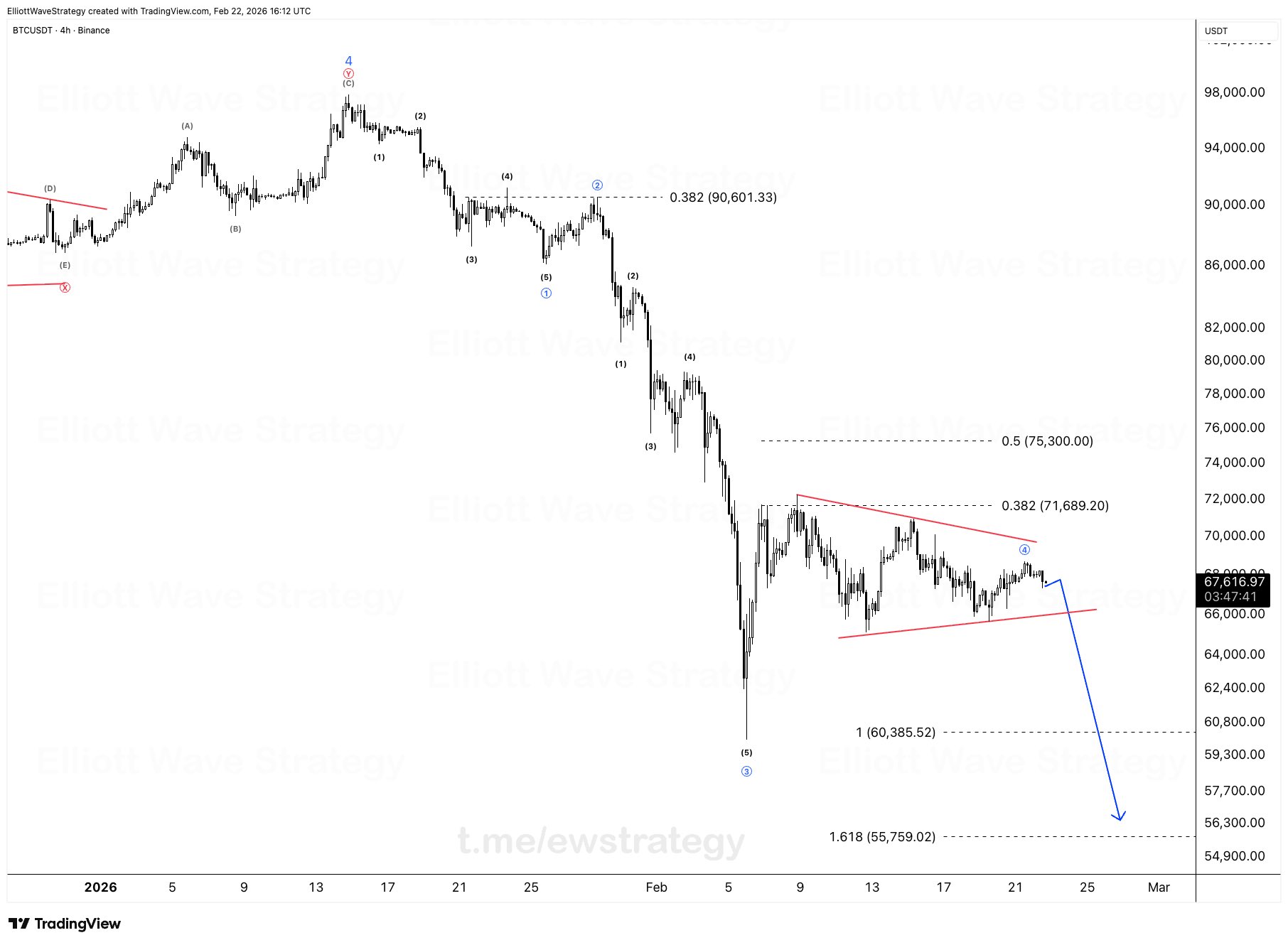
Their projection points toward a possible drop into the $55,700 to $60,300 zone.
Right now, $60,000 is the key psychological level. If the price continues holding below $67,000 to $68,000 and selling pressure builds, the path toward $60K opens up quickly.
A clean break below $64,800 could accelerate that move.
This is why fear is rising again.
The moment traders hear “final wave down,” the Bitcoin is dead narrative spreads faster. For now, $60K remains the immediate magnet.
Why BTC Is Down Today: Technical Outlook
On the 1-day chart, price has been in a clear downtrend for weeks. The structure was forming a bearish flag, a temporary relief pattern inside a broader decline.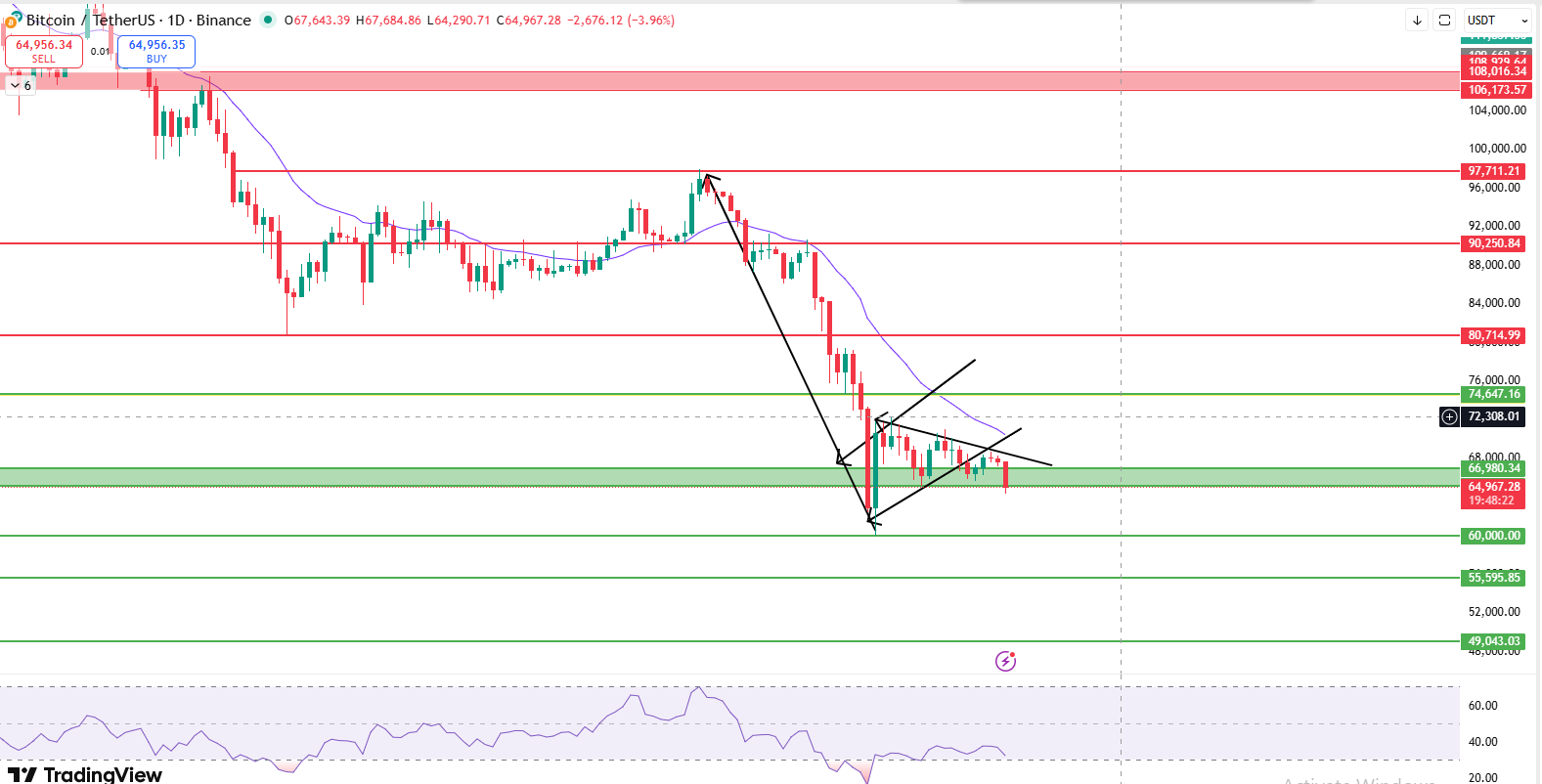
As discussed in the previous article, that flag has now broken to the downside.
More importantly, the crucial $65,000 support zone has been lost.
This level was acting as a base for multiple sessions. Once it gave way, selling pressure increased.
Inside the bearish flag, price was already respecting a falling trendline. Every bounce was getting capped lower.
On top of that, the 21 EMA is standing above the price as dynamic resistance, rejecting recovery attempts. That shows short-term momentum is still weak.
RSI is currently around 32. It is near oversold territory but not fully there yet. This means there is still room for further downside if pressure continues.
If price sustains below $65,000, the next major support comes near $60,000. Below that, the $55,595 zone becomes the next downside target.
Key Support Levels
$60,000
$55,595
Key Resistance Levels
$65,000
$67,000
$72,300
For now, structure favors sellers unless price reclaims $67,000 with strong volume.
Is This Just the Beginning of the Crash?
A recent chart shared by crypto analyst Borg Cryptos shows that in previous cycles, BTC corrected nearly 70% to 80% from its peak before forming a major bottom.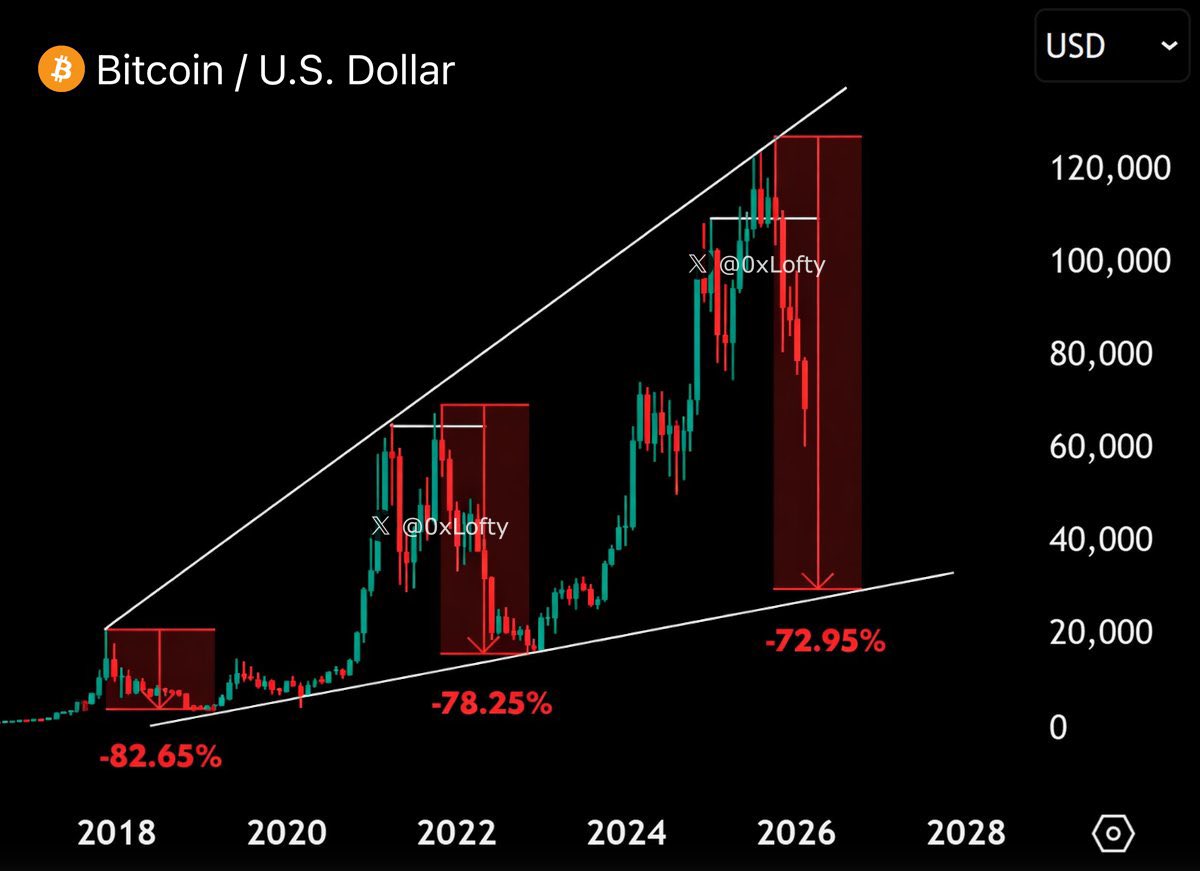
If a similar 70% to 75% drawdown plays out from the recent high near $120,000, the projected downside zone falls between $30,000 and $25,000.
This does not guarantee a drop to that level. But historically, deep cycle corrections have pushed price into that range. If fear continues to build and selling pressure expands, the $30,000 to $25,000 zone becomes a realistic long-term downside scenario.
Expert View
From a structural view, Bitcoin Price Prediction 2026 is at a sensitive point.
The breakdown below $65,000, rising liquidation pressure, and repeated rejection under the 21 EMA are keeping sellers in control.
In the short term, if price stays below $65,000-$67,000, the next targets remain $60,000 and then $55,595.
A deeper breakdown could open space toward $48,000.
Cycle-wise, if a 70% to 75% correction plays out from the top, the $30,000 to $25,000 zone becomes a long-term risk area.
The “Bitcoin is dead” and “Bitcoin is zero” narrative is growing, but structurally Bitcoin is not zero.
Panic is high, but confirmation of a full collapse would require much deeper breakdowns. For now, pressure remains bearish unless $67,000 to $72,000 is reclaimed strongly.
YMYL Disclaimer: This article is strictly informational in nature and does not constitute an investment recommendation. Investment in cryptocurrencies is extremely volatile, and market conditions can change quickly based on macro data. High volatility can result in significant capital loss. It is always essential to do your own research before making any investment.
Also read: