10 Ways to Improve Portfolio Diversification Before a Correction

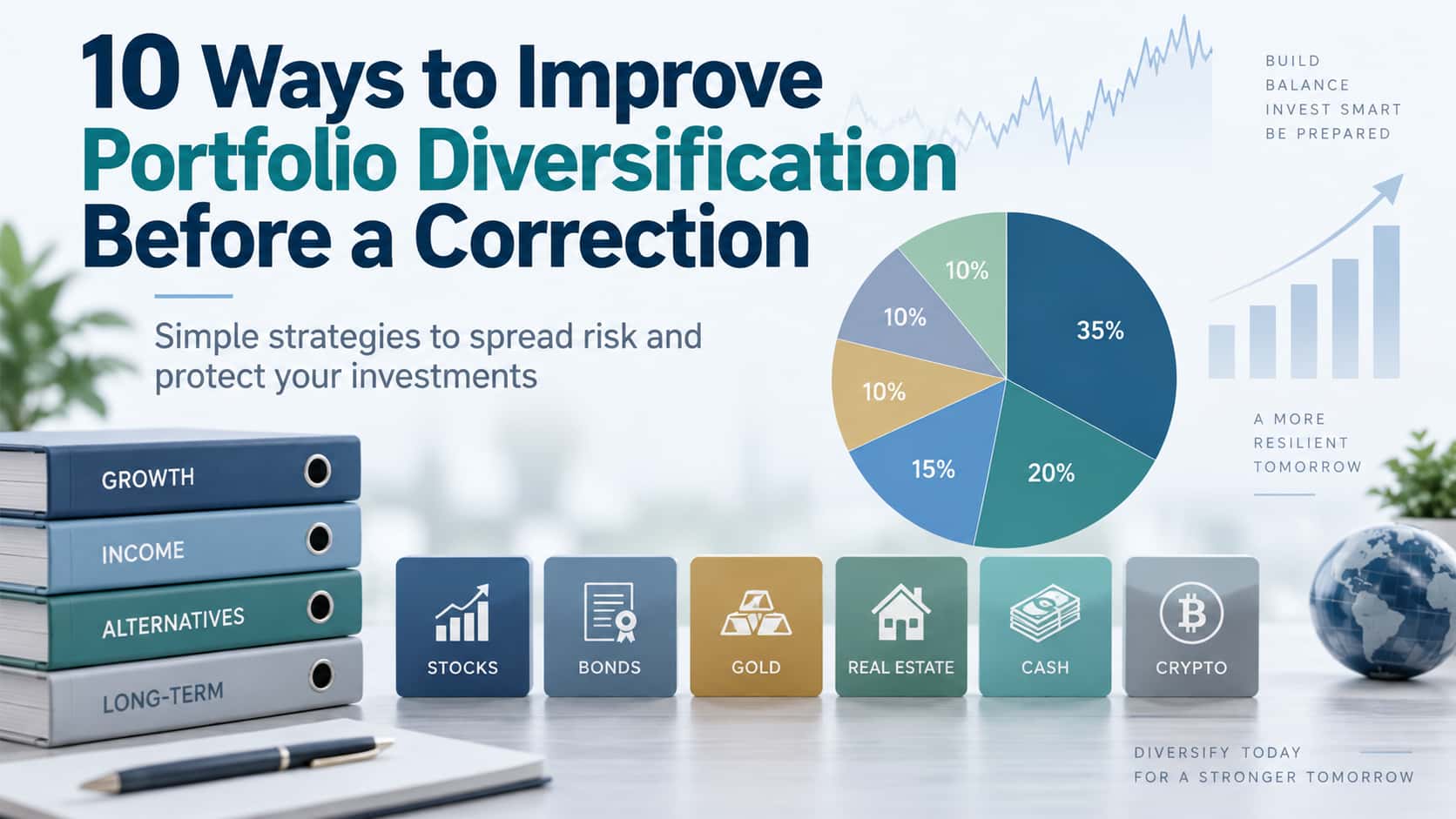
Equities are subject to market corrections, which are a normal part of investing. Economic conditions, disappointing corporate earnings, changing interest rates and a lack of investor confidence can cause prices to fall. Though it is not always possible to know when the next correction will happen, individuals can prepare their portfolios for more volatile times.
Diversification is one of the most useful methods to handle concentration risk. Diversifying investments within and across companies, asset classes, and styles can lower reliance on any one source of return.
But diversification does not assure that losses won't occur or that a portfolio will be profitable during the market's down days. Its purpose is to create a more balanced portfolio that is not excessively exposed to one particular risk.
1. Spread investments across different sectors
How the economy performs can affect various sectors in varying ways. Some companies will be more affected by economic downturns, for instance, cyclical companies, while others will have more stable demand, such as those that offer essential goods and services.
Thus, having businesses in various industries can minimise the effect of any single industry's weakness. But investors should target substantial diversification, not just more holdings.
2. Diversify across companies and market capitalisations
Raising capital in large-cap, mid-cap, and small-cap stocks can provide exposure to companies at different stages of growth. There is no guarantee that larger companies are superior in terms of growth, and smaller companies can have varied growth characteristics and volatility.
Investors should also strive to avoid investing heavily in a few companies. Diversification is best when the businesses being diversified have distinct risk and earnings drivers.
3. Add different asset classes to the portfolio
Diversification can extend beyond equities. Investors may consider other investment forms in addition to stocks, such as debt investments, gold, and other appropriate investments based on their goals.
These assets may have varying risk and return profiles, which may help diversify the portfolio. The distribution is, however, only suitable if certain investment objectives, risk tolerance or time horizon, among others, are taken into account.
4. Look beyond one investment style
Various investment characteristics can be used to classify stocks, such as growth and value stocks and dividend stocks. Highly invested portfolios can be susceptible to losses when the market shifts.
Mixing up investment attributes can also diversify a portfolio's exposure to aspecific market theme to offer a wider range of investment choices.
5. Include businesses with different earnings drivers
Many people own multiple stocks, but their portfolios are not well diversified. Companies in different sectors, with diverse customers or geographic markets, can offer better diversification.
For example, if the same economic factor is critical to five businesses and that factor declines, all the businesses decline.
6. Consider companies with strong fundamentals
Don't sacrifice quality for diversification. Investors can analyse individual businesses on various factors like revenue growth, profitability, debt, cash-flow generation and competitive position.
Firms with strong financial health could be more resilient, but even well-run companies are vulnerable to market and economic risks.
7. Review your exposure to individual stocks
If a stock has a long history of market-share growth, it can eventually become an oversized position in the portfolio. This can put the investor at risk of concentration without making any extra investment.
For instance, an investor with L&T stocks may want to consider the overall weight of L&T in the portfolio, rather than viewing it as a single holding. Reviewing position sizes can help investors identify concentrations that may otherwise go unnoticed.
8. Use mutual funds or ETFs for broader exposure
Mutual funds and exchange-traded funds allow you to gain access to a number of securities with a single purchase.
This can make diversification more manageable, especially for those who may not wish to choose and oversee a diversified portfolio of individual stocks. Investors should still review the underlying holdings, as funds can overlap significantly.
9. Keep some liquidity for financial flexibility
Not all of the rupees have to be invested in market-linked assets. Reserve enough cash for emergencies and short-term needs, and do not plough money into retirement or investment vehicles that cannot be accessed in a short period of time.
This can also help to lower the risk of having to sell investments when the market corrects itself just to get some cash.
10. Review and rebalance your portfolio periodically
Portfolio allocations can vary as markets move over time. A strong sector or stock may end up making up a much larger portion of the portfolio than originally planned. Periodic reviews can help investors catch this.
Rebalancing is the process of adjusting the portfolio to re-align it with the desired allocation. It is generally more useful to follow a planned process than to make drastic changes based on predictions about the next correction.
Conclusion
Diversification is not a forecast of the next market crash or a way to eliminate all risk. It is a matter of minimising over-concentration in single stocks, industries, asset classes or investment approaches. As investors review their portfolio concentration, they can diversify and rebalance as needed to better suit their financial objectives, investment time horizon, and risk tolerance.