Aster Grid 2.0 Launch Adds Copy, Reverse and Grid Marketplace Features


Aster Grid 2.0 and Marketplace Launch Adds New Perpetual Trading Tools
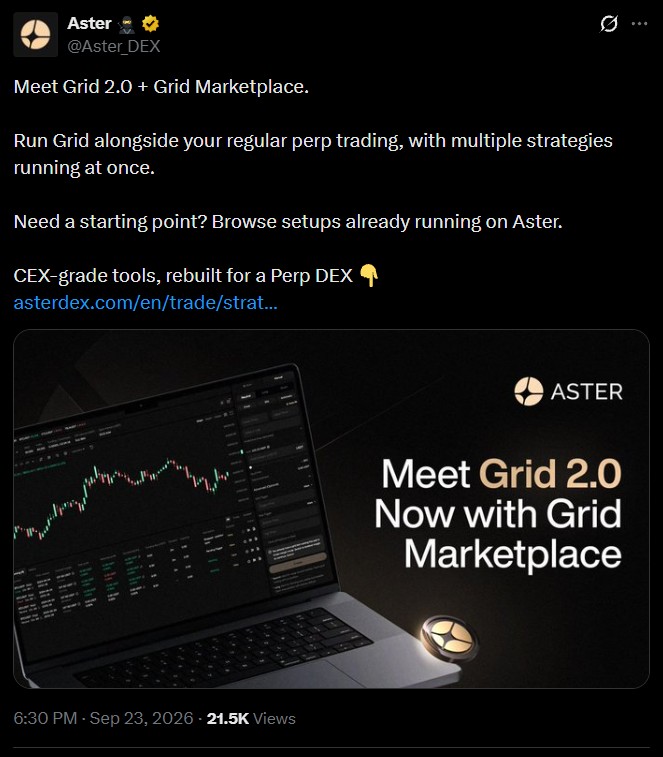
On September 24, 2026, Aster, the perpetual DEX, announced an upgrade to its automated trading tools. Aster launches Grid 2.0 and Marketplace so traders can run automated strategies alongside manual trades and borrow setups already running on the platform. The details come from Aster's announcement on X and its product documentation.
At a Glance
-
Launch date: September 24, 2026
-
Platform: Aster
-
New tools: Grid 2.0 and Grid Marketplace
-
Key change: Automated and manual trading can run on the same perpetual contract
-
Capacity: Up to 50 Isolated Grid strategies per account
-
Funding: Initial margin moves from the Perpetual account to the Grid Bot account
-
Availability: Main Accounts only
Aster Launches Grid 2.0 and Grid Marketplace for Perpetual Trading
Aster says the update removes an old trade-off. Traders no longer have to choose between running an automated strategy and trading the same market by hand. The Marketplace adds a discovery layer, allowing users to start from setups that are already live instead of building one from scratch. It describes the package as centralized-exchange-grade tooling rebuilt for a perpetual DEX.
Grid 2.0 Separates Automated and Manual Perpetual Trading
Under this launch, a trader can keep a BTCUSDT strategy running while placing manual BTCUSDT trades. Automated orders and positions are managed independently from regular Futures orders and positions. Each strategy operates through a dedicated Bot subaccount.
Two margin modes are available. Cross Margin shares one pool among Cross strategies that use the same settlement asset. Isolated Margin gives each strategy its own allocation.
Source: Aster Announcement on X
Up to 50 Isolated Grid Strategies Can Run Across an Account
Isolated Margin users can run up to 50 strategies across the account, with no per-pair limit. That means several setups can operate on one trading pair, each with its own allocation and liquidation risk.
Cross Margin is stricter. Only one Cross strategy can run per trading pair. Because these positions share a common pool, a liquidation event can affect other strategies using the same settlement asset.
Grid Marketplace Lets Traders Browse and Copy Existing Strategies
Marketplace shows eligible running strategies as cards. Users can sort by highest or lowest PnL and ROI and filter by trading pair. Each card lists direction, leverage, price range, runtime, minimum investment, and matched trades.
The data comes from periodic snapshots, and the page shows when the information was last updated.
| Feature | What Users Can See/Do |
| Trading Pair | Filter strategies by market |
| PnL | Compare current strategies profit/loss |
| ROI | Compare return on initial allocation |
| Runtime | See how long it has been running |
| Trading Activity | Review 24H and total matched trades |
| Copy | Use an existing setup as a starting point |
| Reverse | Flip Long to Short or Short to Long |
| Parameters | Adjust settings before creating a new strategy |
Copied Strategies Remain Independent From the Original
Copy carries over the price range, number of grids, grid mode, direction, leverage, margin mode, trigger, and stop trigger. Every setting stays editable before the new strategy is created, and the user enters their own initial allocation.
Reverse flips a Long setup to Short, or a Short setup to Long, and mirrors the stop-loss boundaries. It is not available for Neutral strategies. A copied setup is a parameter snapshot. It does not follow or synchronize with the original strategy
Source: Official X
Grid Margin Is Moved From the Perpetual Account When a Strategy Starts
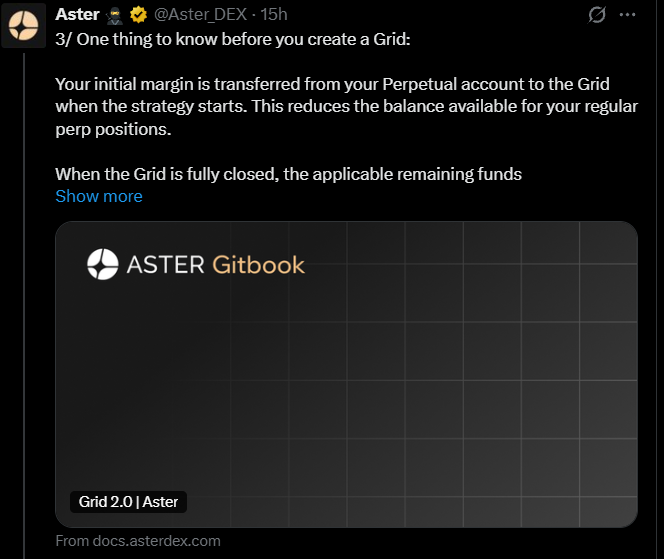
Creating a strategy moves the initial margin from the Perpetual account to the Bot account. The transfer appears in transaction history as "Trading bot transfer." The required funds must be held in the market's settlement asset, such as USDT. Aster does not automatically convert other assets.
The transfer also lowers the balance available for other perpetual positions, which can affect their risk. Once the strategy is fully closed, the applicable remaining funds return to the Futures account automatically.
What Happens When a Strategy Is Stopped or Closed?
Users have two exit options. Close Positions Immediately cancels open orders, closes positions at market price, and returns the applicable funds. Keep Positions Open cancels the automated orders but leaves the position running under a "Stopped - position open" status.
That remaining position can still be liquidated if its support becomes insufficient. Users can close it partially or fully from the Details page using a Market or Limit order. Funds supporting an active strategy can also be added or removed, although reducing them can increase liquidation risk.
Aster Grid 2.0 Launch Timeline
-
September 24, 2026: Aster announces Grid 2.0 and Marketplace.
-
Initial margin moves from the Perpetual account to the Bot account.
-
Applicable remaining funds return to the Futures account.
Aster Warns Users About Performance and Market Risk
Aster updates stress that Marketplace figures are for reference only. A strategy's PnL and ROI do not guarantee the same results for anyone who copies it. Crypto Prices can also move outside a copied range after the snapshot, and Aster displays a warning when the current price is outside it.
Privacy is covered as well. Traders with Account Privacy enabled do not appear in Marketplace, while the cards do not show wallet addresses, usernames, or profile pictures. Running an automated perpetual strategies carries trading risk, including the potential loss of invested funds.
Conclusion
The key changes in this update are same-pair manual trading, up to 50 Isolated strategies, and copying. Since Aster launches with real fund transfers involved, traders should check their available balance, price range, and leverage before creating a strategy.
Disclaimer: This article is for informational purposes only and is not financial, investment, or trading advice. Cryptocurrency and perpetual futures trading carry a high risk of loss, and you can lose your entire margin. Do your own research and consult a licensed financial advisor before making any decision.