Avalanche News: $807B Giant Takes Its First Fund On-Chain


Avalanche News: How Two Big Deals Are Expanding Institutional Reach
Two major institutional wins just landed for Avalanche within the same news cycle.
This round of Avalanche News covers a tokenized high-yield bond fund from an $807 billion asset manager going live on the network, plus a regulated infrastructure integration that opens Avalanche access to over 650 institutions and hundreds of millions of end users.
Together, they paint a clear picture of how deep institutional interest in the network has gotten.
New York Life Brings Its First Tokenized Fund to Avalanche
New York Life Investment Management, which manages roughly $807 billion in assets, has launched its very first tokenized fund, and it's landing directly on Avalanche.
The fund is called HYB, built through the tokenization platform Centrifuge, and it brings NYLIM's actively managed U.S. high-yield corporate bond strategy fully on-chain.
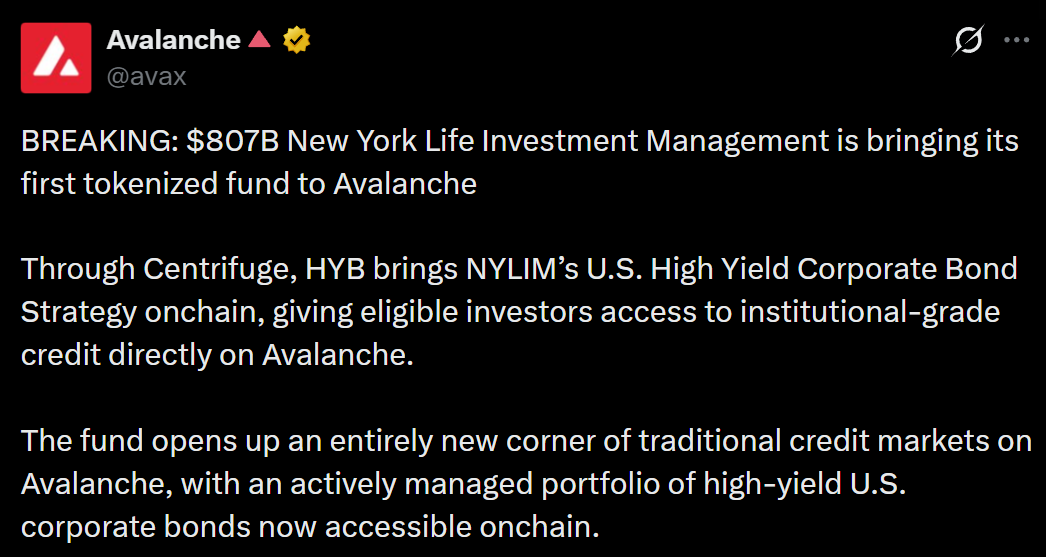
Source: Avalanche's own announcement
Here's what makes this launch stand out:
-
It's NYLIM's first tokenized product ever, a meaningful milestone for a firm of this size
-
Subscriptions and redemptions settle in USDC rather than traditional fund administration rails
-
The underlying portfolio, investment process, and risk management stay entirely under NYLIM's own control, with Centrifuge handling just the tokenization layer
-
High-yield corporate bonds, sometimes called junk bonds, carry more credit risk than government debt but offer higher yields in exchange
This matters for Avalanche specifically because most tokenized products on the network so far have leaned toward Treasuries and short-duration instruments.
HYB pushes into genuinely different territory, actively managing corporate credit, broadening what kind of institutional-grade assets are actually accessible on-chain.
Paxos Adds Avalanche to Its Regulated Infrastructure
The second piece of this Avalanche News update comes from Paxos, a major regulated infrastructure provider.
Avalanche is now live across Paxos's full regulated platform, expanding institutional access to both AVAX and Avalanche-native USDC.
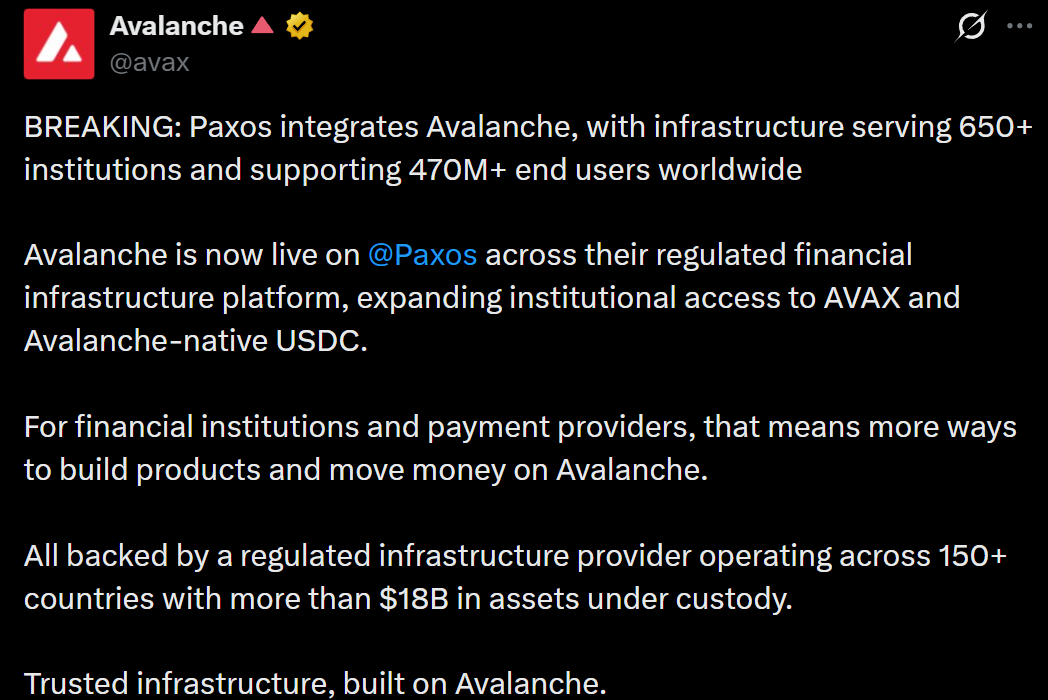
Source: Avalanche's announcement
The scale here is genuinely large:
| Detail | Figure |
| Institutions served by Paxos | 650+ |
| End users reachable | 470M+ |
| Countries covered | 150+ |
| Assets under custody | $18B+ |
Practically, this means any financial institution or payment provider already using Paxos as its compliance and custody partner can now build Avalanche-based products without setting up a separate blockchain integration from scratch.
Why Both Announcements Landing Together Matters
Seeing a major tokenized fund launch and a regulated custody integration arrive in the same stretch isn't a coincidence in terms of what it signals.
One story shows institutional-grade assets moving onto Avalanche; the other shows the regulated plumbing needed to actually access and custody AVAX expanding dramatically.
A network needs both pieces working together for real institutional adoption to stick, real products to hold, and trusted infrastructure to access them through.
What This Means for Avalanche's Institutional Push
Avalanche has spent the past couple of years actively courting exactly this kind of activity, and these two developments fit squarely into that pattern.
A few points worth noting about where this leaves the network:
-
Tokenized real-world assets on Avalanche now span a wider risk spectrum, from Treasuries to actively managed corporate credit
-
Paxos's reach through partners already serving hundreds of millions of users gives AVAX and Avalanche-native USDC a genuinely massive addressable audience
-
Both moves reduce friction for traditional finance players who want exposure to Avalanche without building custom blockchain infrastructure themselves
Conclusion
This wave of Avalanche News reflects two very different but complementary kinds of institutional validation landing at once.
NYLIM's $807 billion in assets backing a first-ever tokenized fund shows real capital moving onchain, while Paxos's integration opens a regulated door for over 650 institutions and 470 million potential end users to actually access AVAX and Avalanche-native USDC.
Between deeper asset variety and dramatically wider regulated access, Avalanche's institutional footprint just expanded on two fronts simultaneously.
Disclaimer
This article is for educational and informational purposes only and should not be considered financial or investment advice. Always conduct your own research before making investment decisions.










