Best RWA Tokens October 2026: Leading Projects and Market Trends

Why Are the Best RWA Tokens October 2026 Gaining Attention?
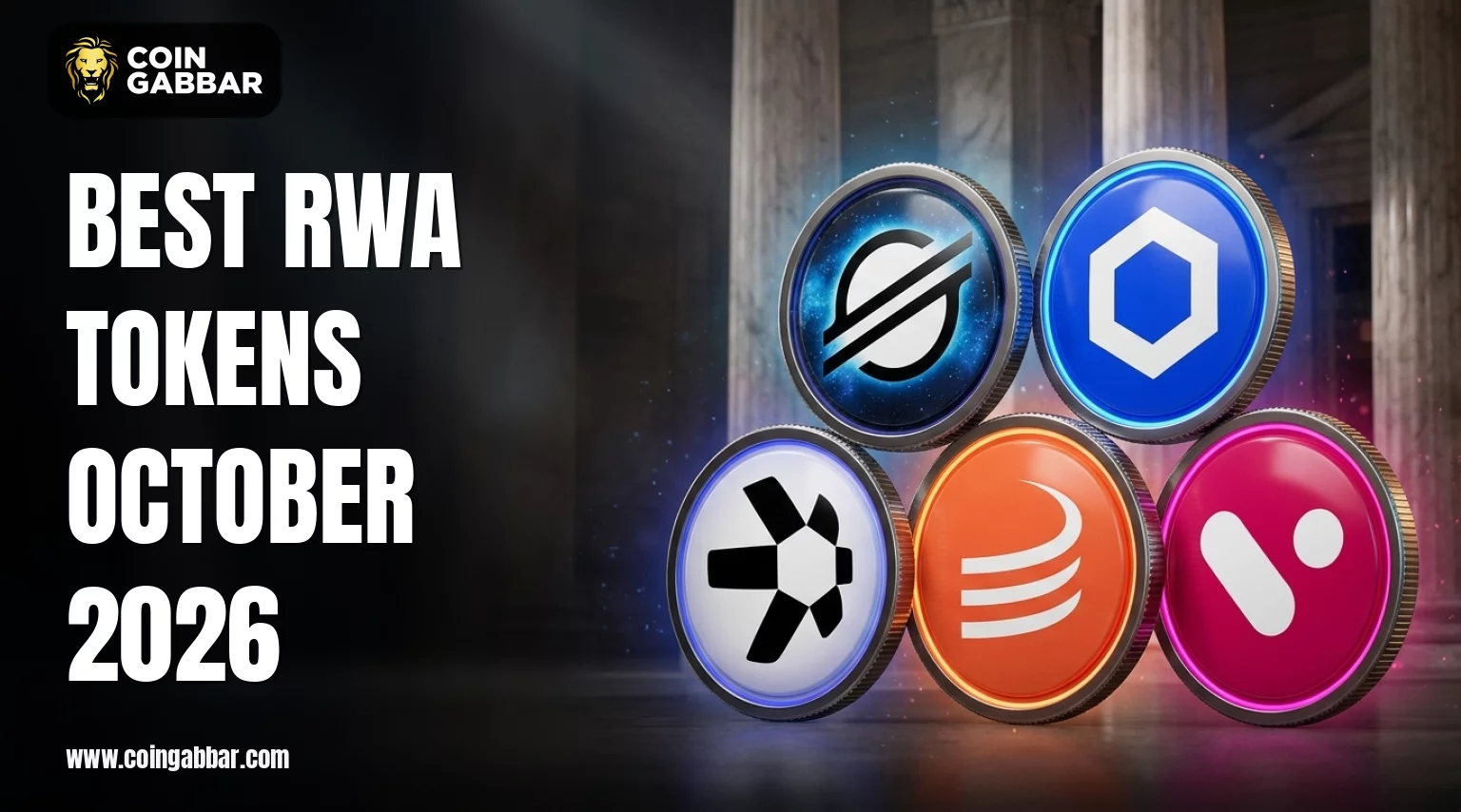
The best RWA tokens October 2026 list covers projects that connect traditional finance with blockchain. Bonds, funds and loans can now exist as digital tokens. This guide explains the best RWA crypto projects to watch, how each token works and where the main risks sit.
Key Takeaways
RWA tokenization puts real assets on blockchain rails.
Utility and adoption matter more than hype.
Every RWA project carries legal, custody and market risk. Readers should do their own research.
What Are RWA Crypto Projects?
RWA stands for real world assets. RWA crypto projects turn things like treasury bills, loans or property into digital tokens. Each token points to an asset that exists off-chain.
In simple terms, what are RWA crypto projects? They are the link between traditional finance and blockchain. Some projects issue the tokens. Others build the data, messaging or payment layers that make real world asset crypto possible.
Best RWA Tokens in October 2026
These are the top RWA crypto projects on the radar this month. Figures come from market data at the time of writing.
1. Chainlink (LINK)
Overview
Chainlink is a decentralized oracle network. A blockchain cannot see the outside world on its own. It does not know the price of gold, a bond or a currency. Chainlink solves this by delivering trusted real-world data to smart contracts. Without that data, most tokenized assets could not function, which makes LINK one of the leading RWA projects in crypto.
How It Works
Independent nodes collect data from many outside sources
The network checks the data and sends it to smart contracts
Cross-chain tools move data and tokens between networks
Proof of reserves feeds help confirm that assets are fully backed
Use Cases
Price feeds keep tokenized assets like bonds and funds valued correctly, so contracts can settle and pay out fairly.
Cross-chain transfers let a tokenized fund move between networks without leaving its secure setup.
Reserve checks let stablecoins and RWA tokens prove that real assets sit behind them.
Price and Market Performance
Rank: 13
Price: $14.41
Market cap: $10.78B
24h volume: about $651.7M
Short-term chart trends upward at the time of writing
Source: CoinGecko official
RWA Adoption and Partnerships
Widely used across DeFi and tokenization projects
Has run pilots with large banks and financial infrastructure firms
Often seen as core plumbing for the RWA sector
2. Stellar (XLM)
Overview
Stellar is a blockchain built for fast, low-cost payments and asset issuance. It was designed with finance in mind from the start. Institutions can issue tokens on it that represent money, funds or other assets. Transfers settle in seconds and cost very little, which suits real world assets blockchain use.
How It Works
Issuers create tokens that represent real assets
Transactions settle in a few seconds
Built-in tools let issuers control who can hold a token
Fees stay very low
Use Cases
Tokenized funds and money market products can be issued and traded on the network, with holder controls for regulated issuers.
Stablecoin payments run on Stellar because of its speed and low cost.
Cross-border transfers become cheaper and faster than many traditional routes.
Price and Market Performance
Rank: 20
Price: $0.223
Market cap: $7.81B
24h volume: about $412.8M
Short-term chart looks mixed at the time of writing
RWA Adoption and Partnerships
Large asset managers have issued tokenized funds on Stellar
Payment and stablecoin firms use the network
Compliance tools make it friendly to regulated issuers
3. Quant (QNT)
Overview
Quant builds Overledger, a system that connects different blockchains and older bank networks. Banks run on legacy systems, and each blockchain works separately. Overledger acts as a bridge across all of them. Quant targets institutions more than retail users, which makes it one of the more promising RWA crypto projects for enterprise use.
How It Works
Overledger sits on top of existing blockchains
Developers build apps that run across several networks at once
Banks can link old systems to blockchain without a full rebuild
QNT is needed to license the software
Use Cases
Banks can connect tokenized assets across several chains through a single system instead of building separate links.
Central bank digital currency testing uses the network to link new digital money with existing bank systems.
Enterprise apps can move data and value between public and private blockchains.
Price and Market Performance
Rank: 33
Price: $286.95
Market cap: $4.18B
24h volume: about $933.2M
High per-token price, so market cap matters more than price alone
Short-term chart trends upward at the time of writing
RWA Adoption and Partnerships
Works mainly with banks and financial institutions
Involved in central bank and payment pilots
Adoption is enterprise-led, so growth can be slow and steady
4. Maple Finance (SYRUP)
Overview
Maple is an on-chain lending platform for institutions. In traditional finance, businesses borrow from banks and private lenders. Maple moves that model onto blockchain. Depositors supply funds, approved borrowers take loans, and interest flows back to lenders. It is a clear example of private credit becoming one of the RWA projects with real utility.
How It Works
Depositors add funds to lending pools
Approved borrowers take loans from those pools
Pool delegates review borrowers and manage risk
Interest goes back to depositors
Use Cases
Institutional credit gives crypto firms and other borrowers access to loans without a traditional bank.
Yield products let crypto holders earn returns linked to lending activity.
Loans backed by digital and real assets bring private credit to on-chain markets.
Price and Market Performance
Price: $0.2337
Market cap: $272.8M
24h volume: about $26.9M
Mid-size project, so moves can be sharper than the large names
Source: CoinGecko data
RWA Adoption and Partnerships
Focus is on institutional borrowers and yield products
Its yield tokens are used in wider DeFi
Borrower default is the key risk to watch
5. Velo (VELO)
Overview
Velo is a payments and liquidity network built for cross-border transfers. Sending money across countries often requires companies to lock up cash in advance in many places. Velo uses digital assets to reduce that need. It is the smallest project on this list, and its RWA link is indirect, through payments and settlement.
How It Works
Uses digital assets to move value across borders
Aims to cut the need for pre-funded accounts
Works with payment firms to settle transfers
Use Cases
Cross-border payments become faster because value moves without waiting for pre-funded accounts.
Remittance firms can free up cash that would otherwise sit idle in foreign accounts.
Digital asset settlement gives payment companies a way to close transfers on-chain.
Price and Market Performance
Price: $0.0051
Market cap: $89.6M
24h volume: about $4.4M
Low volume means thinner liquidity
Short-term chart trends upward at the time of writing
RWA Adoption and Partnerships
Adoption is still early
Growth depends on payment firms joining the network
Better suited to close monitoring than blind buying
RWA Crypto Projects Comparison
Project | Main Role | Approx. Price | Market Cap |
Chainlink (LINK) | Oracles, cross-chain | $14.41 | $10.78B |
Stellar (XLM) | Payments, tokenized funds | $0.223 | $7.81B |
Quant (QNT) | Interoperability | $286.95 | $4.18B |
Maple (SYRUP) | Institutional credit | $0.2337 | $272.8M |
Velo (VELO) | Cross-border liquidity | $0.0051 | $89.6M |
Bigger market caps usually mean deeper liquidity. Smaller ones move faster.
Types of Real-World Assets Being Tokenized
Government bonds and treasury bills
Private credit and business loans
Money market funds
Real estate
Commodities like gold
Invoices and trade finance
Treasuries and private credit lead today because their rules and cash flows are easy to model.
How Does RWA Tokenization Work?
Here is how real world assets work on blockchain:
An issuer picks an asset and holds it with a custodian.
A legal structure links that asset to tokens.
Smart contracts create the tokens.
Oracles feed in prices and proof of reserves.
Investors buy, hold or trade, often after identity checks.
The token is only as strong as the legal claim behind it.
Benefits of RWA Tokenization
Benefit | What It Means for Investors |
Faster settlement | Minutes instead of days |
Lower minimums | Smaller amounts can buy in |
24/7 trading | No waiting for market hours |
Transparency | Every transaction is traceable |
Programmable payouts | Interest can flow automatically |
Wider access | Assets once reserved for big players open up |
Risks of RWA Crypto Projects
Are RWA tokens safe? Not automatically. The main risks of RWA crypto are:
Legal risk: Rules differ by country and keep changing.
Custody risk: If the custodian fails, the token may lose backing.
Smart contract risk: Bugs and hacks can drain funds.
Liquidity risk: Some tokens trade thinly.
Counterparty risk: Borrowers can default.
How to Evaluate an RWA Crypto Project
Team: Are the founders public with a real track record?
Partners: Do regulated firms or banks work with them?
Audits: Are contracts audited by known firms?
Transparency: Is proof of reserves verifiable?
Usage: Look for RWA crypto projects with high adoption, not just promises.
Liquidity: Check volume and market cap first.
For those wondering how to invest in RWA tokens, the usual route is a trusted exchange. Position sizes should stay small, and money that cannot be lost should stay out.
RWA Crypto vs Traditional Assets
Factor | RWA Crypto | Traditional Assets |
Trading hours | 24/7 | Market hours |
Settlement | Minutes | Days |
Minimum entry | Often low | Often high |
Regulation | Still developing | Well established |
Volatility | Higher | Usually lower |
Future of RWA Crypto and Asset Tokenization
Tokenization is still early, but the direction is clear. These are the RWA market trends to watch in October 2026:
More tokenized treasuries and private credit
Stronger cross-chain links between networks
Clearer rules for issuers and custodians
Higher demand for proof of reserves
Banks and asset managers testing more on-chain funds
Are RWA Tokens Worth Watching in October 2026?
Yes, for most crypto watchers. Here is why:
Real use case: They connect crypto to real finance.
Institutional interest: Banks and asset managers keep testing them.
Clear demand: Tokenized treasuries and credit keep growing.
Utility over hype: Top RWA projects now have real users and partners.
But a few points need care:
Prices can swing sharply in a week.
Regulation is still changing.
Watching is not the same as buying.
Tracking the data, following the news and staying patient works better than chasing hype.
Conclusion
The best RWA crypto projects share three traits: real utility, transparent operations and steady adoption. Chainlink, Stellar, Quant, Maple Finance and Velo each play a different role in the space. Comparing them and understanding the risks helps readers decide at their own pace.
Disclaimer: This article is for information only and is not financial advice. Crypto is volatile and money can be lost. Prices change quickly. Readers should do their own research or speak to a licensed advisor before investing.




.webp)