6 Canadian Banks Tokenized Deposit Alliance To Power 24/7 Payments


Canada's Big Six Banks Launch Canadian Banks Tokenized Deposit Push
Six of Canada's largest banks have jointly confirmed a Canadian banks tokenized deposit project built to enable 24/7 blockchain payments nationwide, marking a major step for Canadian banks tokenized deposit adoption.
The move, confirmed through an official BMO Newsroom release dated September 22, 2026, is one of the largest coordinated tokenized deposit efforts to date.
As of September 23, 2026, this remains an exploratory initiative, not a live consumer product, though it is already one of the most discussed items in crypto news today and across broader
What Is Canada's Tokenized Deposit Project?
This Canadian banks tokenized deposit initiative explores Canadian dollar based digital money solutions, starting with a tokenized deposit solution wide.
According to the official statement, the project seeks faster, more efficient, and programmable payments for Canadian customers while preserving safety, stability, and effective regulatory oversight.
Which Canadian Banks Joined Tokenized Deposit Project?
The Canadian banks blockchain project brings together six deposit taking institutions:
Bank of Montreal (BMO)
Royal Bank of Canada (RBC)
Toronto Dominion Bank (TD)
The Bank of Nova Scotia (Scotiabank)
National Bank of Canada
Canadian Imperial Bank of Commerce (CIBC)
The BMO RBC TD tokenized deposit collaboration, joined by Scotiabank CIBC tokenized deposit participation and National Bank of Canada, reflects a shared industry view that Canada payments infrastructure must stay competitive as digital money advances worldwide.
Six Canadian Banks Blockchain Payments Explained
Together, this Canadian banks tokenized deposit alliance represents a rare instance of direct competitors coordinating on shared blockchain payments rails rather than building separate, incompatible systems.
Why Is This CAD Tokenized Deposit Solution Happening Now?
This push follows a key regulatory clarification. On September 10, 2026, the Office of the Superintendent of Financial Institutions (OSFI) confirmed that tokenized deposits are not legally distinct from traditional deposits, adopting a technology neutral stance.
That clarity around a CAD tokenized deposit framework appears to have paved the way for this joint announcement twelve days later.
Canadian Banks CAD Digital Money Project 2026: What It Aims To Deliver
Phase | Objective |
Phase 1 | Move tokenized deposits efficiently across Canadian financial institutions blockchain rails |
Long Term | Connect with other digital asset ecosystem Canada initiatives |
This tokenized deposits initiative and its programmable payments design could allow near instant settlement, a shift from today's batch based transfers, without altering deposit insurance protections under the Deposit Insurance Corporation.
Canada Tokenized Deposit vs CBDC: What Is The Difference?
Unlike a central bank digital currency, a tokenized deposit stays a direct liability of the issuing bank.
Analysts suggest this Canada digital money 2026 approach may be easier to deploy since it works within existing banking law.
Watcher Guru also covered this news on X shortly after the official release, amplifying visibility around the story.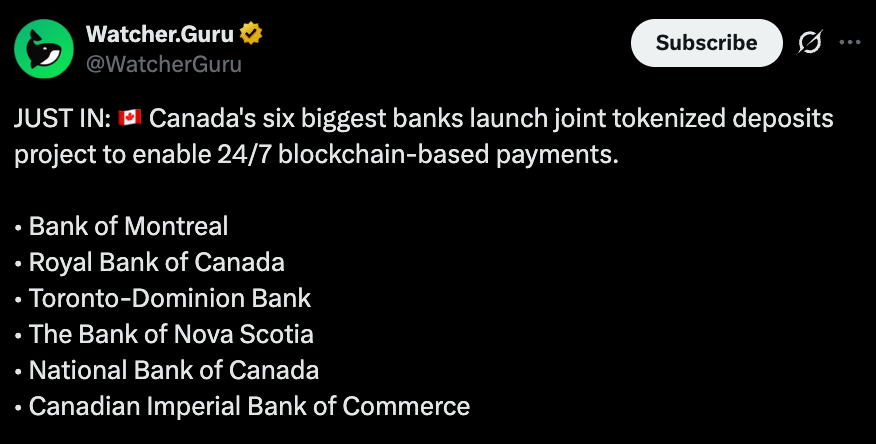
Expert Opinion
Market analysts view the joint move as a signal that traditional finance is preparing digital money Canada infrastructure without waiting for a central bank issued alternative.
All six banks acting together, rather than one institution alone, points to industry wide coordination on Canada payments infrastructure standards.
Analysts tracking crypto news this week note that traditional banks entering blockchain infrastructure is becoming a recurring theme across recent announcements.
Disclaimer: This article is for informational purposes only and does not constitute financial advice. The tokenized deposit products discussed remain under exploration and may change before public rollout.