CLARITY Act News: 1 Day Left. What Changed in Bill Before Senate Vote?


CLARITY Act News: Senate Issue Final Offer, Tuesday Cloture Vote Nears
Crypto policy in Washington reached a critical juncture this weekend. With a Senate cloture vote scheduled for September 15, Republican sponsors of the Digital Asset Market Clarity Act unveiled revised text on September 14, framing it as a final compromise aimed at winning over holdout Democrats.
The core sticking point, as it has been for months, involves ethics rules tied to President Trump's family crypto ventures. This piece walks through what changed in the new text, why Democrats remain divided, and what's at stake heading into the vote.
At a Glance
Senate Republicans released revised legislative text on September 14, calling it their last offer to Democrats before a September 15 cloture vote.
The updated draft narrows liability protections under the Blockchain Regulatory Certainty Act, adds a Trump-endorsed ethics framework, introduces a stablecoin "circuit breaker," and tightens conflict-of-interest guardrails for digital commodity markets.
Senate Minority Leader Chuck Schumer called a Democratic caucus meeting for Sunday evening to decide the party's position.
Two related crypto tax bills are scheduled for a House Ways and Means Committee markup on September 16.
A failed cloture vote would be a procedural setback, not necessarily the end of the bill.
CLARITY Act News Today: Senate Republicans Release Final Offer Before Vote
Senate Banking Digital Assets Subcommittee Chair Cynthia Lummis, alongside Senators John Boozman and Tim Scott, released a finalized draft of the bill on September 14, describing it as reflecting more than a year of negotiation and over 120 changes requested by Democrats.
Republican staff and allies, including White House Digital Asset Advisory Council executive director Patrick Witt, have pushed for swift passage, arguing the administration and GOP negotiators have consistently accommodated Democratic priorities throughout the process.
Meanwhile, Schumer scheduled a Sunday evening caucus meeting so Democratic senators could align on their approach ahead of Tuesday's floor action.
The central question remains whether enough Democrats will vote to advance the bill procedurally, even if disagreements on specific provisions persist.
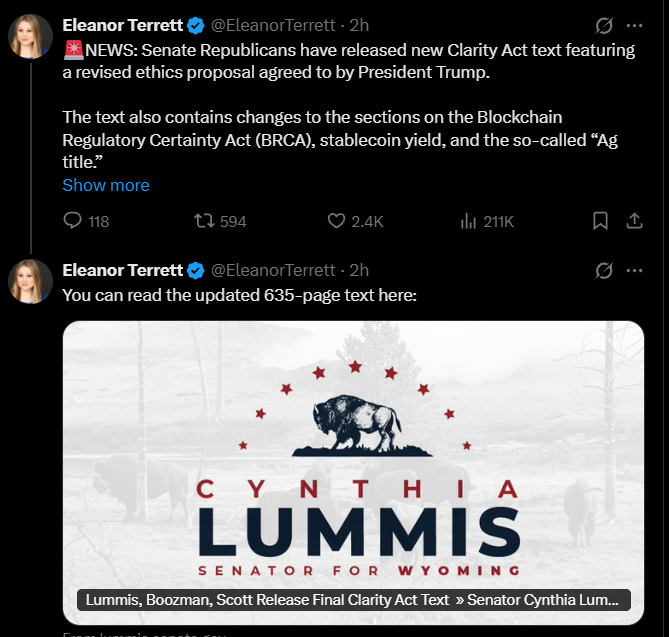
Source: Eleanor Terrett
What Changed in the New CLARITY Act Text?
The revised draft touches four major areas. First, the Blockchain Regulatory Certainty Act (BRCA) provisions were narrowed to cover the Bank Secrecy Act and civil enforcement only, with earlier language shielding developers from criminal prosecution, including under Section 1960, stripped out.
Second, an ethics framework described by a Republican aide as capturing roughly 80% of the earlier Tillis-Gallego proposal, now requires officials to divest significant crypto holdings or place them in blind trusts.
Third, a stablecoin yield "circuit breaker" gives regulators authority to step in if deposits move sharply out of community banks into stablecoins. Fourth, digital commodity market rules add tighter restrictions on vertical integration and affiliate trading.
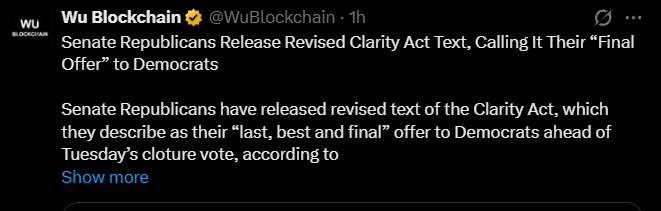
Source: Wu Blockchain
CLARITY Act Ethics Rules Put Trump's Crypto Interests Under Focus
Ethics provisions remain the toughest hurdle. President Trump reportedly agreed to divest substantial crypto-related financial interests or place them in a blind trust, and to let state attorneys general help enforce the rules, a role the White House had previously resisted.
Lummis has argued the ethics language represents some of the strictest restrictions ever voluntarily accepted by a sitting president, applying to elected officials, judges, and their spouses.
Democrats, however, have spent months pushing for stronger guardrails specifically addressing the Trump family's crypto businesses, and it's this unresolved tension that continues to threaten bipartisan support.
Senate Democrats to Meet Before Tuesday's CLARITY Act Vote
About a dozen Democratic senators have participated in months of negotiations, but three categories of issues reportedly remain unresolved, with ethics provisions considered the most contentious.
Republicans have urged Democrats to support advancing the bill procedurally and continue refining details once it reaches the Senate floor. It's worth noting that a cloture vote is a procedural step governing debate, not a final vote on passage. So even a successful vote Tuesday wouldn't immediately enact the legislation.
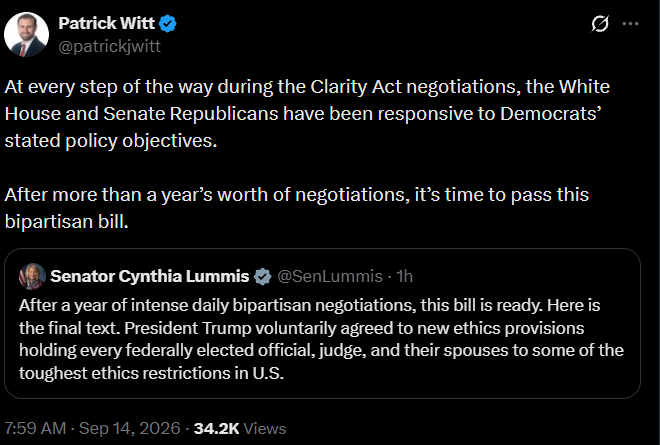
Source: Patrick Witt
What the BRCA and Stablecoin Yield Changes Mean
BRCA changes: By limiting protections to the Bank Secrecy Act and civil enforcement while removing criminal safe harbors, the revised text offers blockchain developers narrower but still meaningful legal certainty around money-transmission rules.
Stablecoin circuit breaker: The new mechanism would let federal regulators intervene if evidence emerges of large-scale deposit flight from community banks into stablecoins, with Treasury Secretary Scott Bessent positioned as the key decision-maker. Supporters say this protects small banks and the businesses that depend on them.
New CLARITY Act Guardrails Target Digital Asset Market Conflicts
The agriculture-related provisions add restrictions on vertical integration, affiliate trading, and conflicts of interest at digital commodity exchanges, brokers, and dealers.
The text also clarifies that state consumer protection laws continue to apply, that developer protections don't create exemptions from derivatives law or affect existing CFTC authority, and that prediction markets are unaffected by the changes.
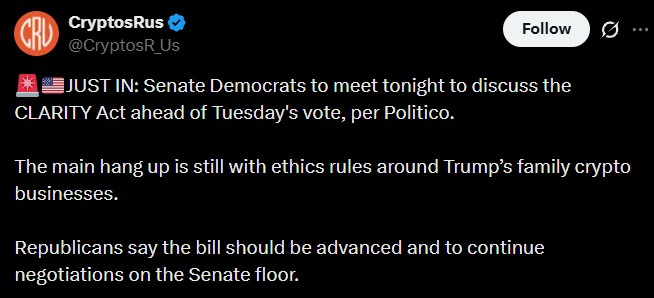
Source: CryptoRus
CLARITY Act Vote: What Happens If the Senate Says Yes or No?
Scenario | What It Could Mean |
60+ votes | Senate can proceed with debate; negotiations continue on the floor |
Below 60 votes | Major procedural setback; bill likely needs further revision |
Democrats support advancing | Path toward eventual floor passage improves |
Democratic opposition holds | Ethics and other disputes could keep stalling progress |
A failed cloture vote wouldn't necessarily kill the bill outright, but it would represent a significant delay after more than a year of negotiation.
CLARITY Act Timeline: From Bipartisan Negotiations to September 15 Vote
2022: Lummis and Gillibrand introduce the Responsible Financial Innovation Act.
2023: The bipartisan digital-asset framework is reintroduced.
July 2025: Senate lawmakers release a discussion draft.
May 2026: The Clarity Act clears the Senate Banking Committee 15–9.
July 2026: Trump agrees to voluntary ethics restrictions.
September 14, 2026: Republicans release "final" revised text; Democrats prepare to caucus.
September 15, 2026: Scheduled Senate cloture vote.
US Crypto Tax Bills Move Ahead as CLARITY Act Vote Nears
Separately, the House Ways and Means Committee is set to mark up two crypto tax bills on September 16. The Mining and Staking Tax Clarity Act (HR9175) would let miners and stakers defer taxation on newly generated tokens until sale, though lawmakers are reportedly weighing whether to remove that deferral or cap it at five years.
The Applying Current Tax Law Anti-Abuse Rules to Digital Assets Act (HR9172) would extend wash-sale rules to digital assets, while exempting mining and staking rewards and qualifying dollar-pegged stablecoins. Both bills would head to the full House if approved in committee.
What the CLARITY Act Vote Means for US Crypto Regulation
Beyond the immediate procedural drama, the Clarity Act's fate carries broader implications for how the United States regulates digital assets, from SEC and CFTC jurisdictional boundaries to protections for exchanges, developers, and stablecoin issuers.
Backers argue the bill would cement U.S. competitiveness in digital asset markets against foreign jurisdictions racing to set clearer rules. For now, all eyes are on whether the Senate can clear the 60-vote threshold on September 15, a result that will shape the next phase of America's crypto policy debate.
Conclusion
The Clarity Act's journey toward a Senate vote reflects over a year of negotiation, hundreds of technical revisions, and an unusually direct ethics commitment from a sitting president.
Whether that's enough to bring skeptical Democrats on board remains uncertain heading into Tuesday. Regardless of the outcome, the debate underscores how central digital asset regulation has become to Washington's legislative agenda and how much market participants have riding on the result.
Disclaimer: This article is for informational purposes only and does not constitute financial, legal, tax, or investment advice. Cryptocurrency markets and related legislation are subject to rapid change; readers should conduct their own research and consult qualified professionals before making financial decisions. This content should not be treated as a recommendation to buy, sell, or hold any digital asset.