Coinbase News: Stablecore Deal Opens Crypto Access to 3,000+ Banks


Coinbase News: How Does Coinbase Supply the Crypto Infrastructure?
Today's Coinbase news centers on a partnership with Stablecore that could bring crypto trading, custody, and stablecoin payments into the everyday banking apps of thousands of smaller U.S. financial institutions. Announced September 16, the deal gives community banks and credit unions a path to offer digital asset services without replacing their existing technology and without customers ever having to leave their bank's own app.
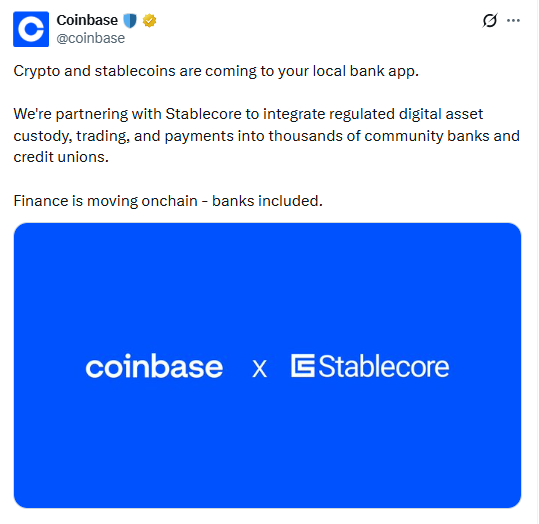
What the Coinbase-Stablecore Deal Actually Does
Per Coinbase's own announcement, the partnership splits responsibility across three layers:
Layer | Role |
Bank or credit union | Owns the customer relationship; offers services under its own brand |
Stablecore | Manages integration across core banking, digital banking, and compliance systems |
Coinbase | Supplies the regulated custody and exchange infrastructure underneath |
Through this structure, a participating bank's customers could eventually buy, sell, hold, stake, and pay with digital assets inside their normal banking app no separate crypto exchange account required. Stablecore describes its platform as white-label software: banks keep their own branding and customer interface while the digital asset functionality runs on outside infrastructure behind the scenes.
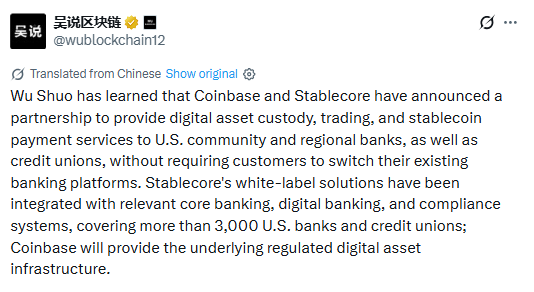 Source: X (formerly Twitter)
The 3,000-Bank Figure, Explained Carefully
This is worth being precise about, since it's the headline number driving most of today's Coinbase news coverage. Stablecore's existing technology integrations reach more than 3,000 U.S. banks and credit unions that's a reach figure, not a signed-customer count. It does not mean 3,000 institutions have contracted with Coinbase, and it doesn't mean all 3,000 will automatically switch on these new digital asset features. Each institution will independently decide which products, if any, to activate based on its own technology, business model, and regulatory posture.
What is confirmed as actively underway: Amarillo National Bank in Texas is named by both companies as an early integration partner. Neither company has disclosed how many institutions have completed deployment, any transaction volume from early rollouts, or a general customer launch date.
Executive Statements
Both companies framed the deal around keeping smaller lenders competitive against larger banks and fintech apps:
Alec Lovett, Coinbase's Head of Infrastructure Business: "Community banks and credit unions shouldn't have to choose between staying local and staying current." He added that the partnership delivers "cheaper, faster money movement" to these institutions.
Alex Treece, Stablecore CEO and co-founder: "We built Stablecore to bring together all of the pieces so they don't have to," adding that banks "should not have to move to completely new technology platforms" to support digital assets.
William Ware, President of Amarillo National Bank: "Our customers want access to emerging payment methods," while noting the bank wants to maintain visibility across both traditional and digital asset activity.
Compliance Layer: Stablecore Adds Verafin Monitoring
A day before the Coinbase announcement, Stablecore separately confirmed a partnership with Nasdaq Verafin, a financial-crime monitoring platform serving more than 2,800 financial institutions. Under that arrangement:
Stablecore holds digital asset transaction and position data, without storing personally identifiable information
The bank keeps customer and account records in its own core system
Both data sets flow into Verafin for investigation and risk assessment
Amarillo National Bank is among the beta testers for this integration
Broader rollout is planned for Q4 2026 and Q1 2027, with real-time sanctions screening for digital asset transfer recipients planned afterward
The Regulatory Backdrop
This kind of bank-embedded crypto model is possible because of a series of federal banking clarifications over the past year and a half:
The OCC confirmed in May 2025 that national banks and federal savings associations may provide crypto custody and execute customer-directed buy/sell orders, and may outsource permissible crypto activities to third parties with proper risk controls
The OCC removed its supervisory non-objection requirement for crypto custody and stablecoin activities in March 2025
The Federal Reserve withdrew its separate advance-notification expectation for state member banks in April 2025
December 2025 OCC guidance confirmed national banks may conduct riskless-principal crypto trades
None of this means every community bank can flip on every feature automatically charter type, state rules, and individual bank policy still shape what each institution actually offers.
Coinbase's Second Community Bank Deal This Month
Today's Coinbase news is actually the second community-banking distribution deal Coinbase has struck in September alone. On September 10, Coinbase partnered with Moov to bring stablecoin payment acceptance, merchant settlement, and real-time funding to Moov's network of 1,000+ community banks and credit unions. That deal focused narrowly on payments infrastructure; the Stablecore deal goes further, covering trading, custody, and staking as well.
Notably, the Stablecore announcement landed just one day after the CLARITY Act failed a Senate cloture vote on September 15, falling short of the 60 votes needed to advance. Community bank deposit competition specifically concern that stablecoin yield could pull deposits away from local lenders was central to that legislative fight. Today's partnership offers a different path: rather than compete with stablecoins, a local bank can offer them directly and keep the underlying account relationship.
Conclusion
Today's Coinbase news reflects a broader pattern in 2026: Coinbase positioning itself as infrastructure sitting beneath thousands of local financial institutions, rather than a competitor pulling their customers away. Between the Moov and Stablecore deals, Coinbase now has entry points into both the payments stack and the core banking stack of small U.S. lenders. Whether that translates into real customer-facing crypto access anytime soon depends on how many of Stablecore's 3,000-plus connected institutions actually choose to switch these services on.
Disclaimer
This article is for informational purposes only and does not constitute financial or investment advice. Details are based on official statements from Coinbase and Stablecore, publicly available regulatory guidance from the OCC and Federal Reserve, current as of September 18, 2026. Product availability, fees, and launch timelines vary by institution and have not been fully disclosed by either company. Always verify current details directly through your own bank or credit union before assuming any specific digital asset service is available to you.