Canton Network Ecosystem 2026: Wall Street's Quiet Onchain Move

Canton Network Ecosystem 2026: Banks Run Validators
Wall Street rarely moves fast, but something shifted this year. Societe Generale, Franklin Templeton, HSBC, Citadel, and CME all quietly plugged their infrastructure into the same blockchain, and DTCC settled its first live production trades on it in mid-July.
None of this happened by accident. The Canton Network Ecosystem 2026 shows a rare case of regulated finance building real infrastructure on-chain, not just talking about it.
The pattern underneath: custodians, clearinghouses, and global banks choosing to run validator infrastructure themselves, rather than outsourcing that role to a crypto-native intermediary.
Numbers Behind the Canton Network Ecosystem 2026 Growth
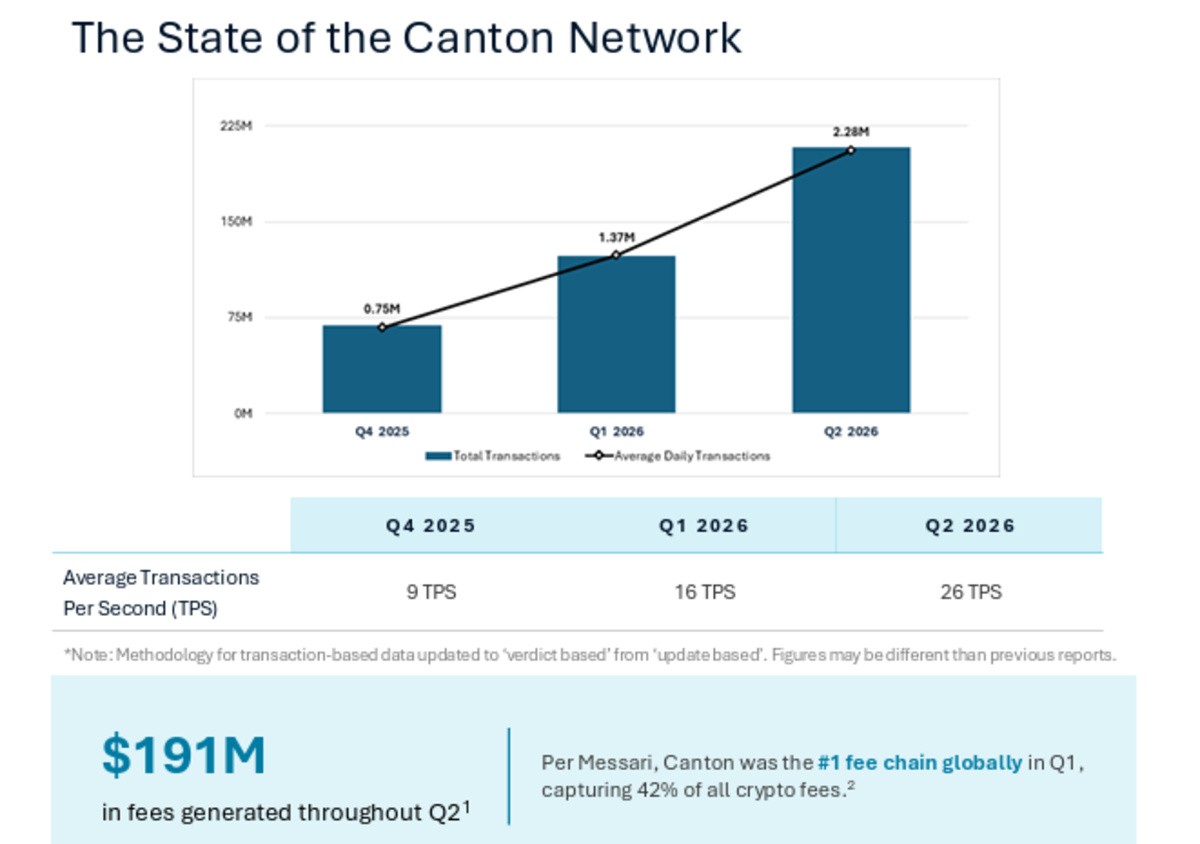
Raw activity data backs up the institutional headlines. Average daily transactions climbed from 0.75 million in Q4 2025 to 2.28 million by the second quarter of this year, pushing throughput from 9 transactions per second to 26.
Metric | Q4 2025 | Q1 2026 | Q2 2026 |
Avg. Daily Transactions | 0.75M | 1.37M | 2.28M |
Transactions Per Second | 9 TPS | 16 TPS | 26 TPS |
Fee generation reached $191 million for the quarter, and per Messari's Q1 2026 report, the chain captured 42% of all fees paid across crypto that period, ranking it first globally.
Tokenomics also tightened: the burn-to-mint ratio rose from 0.596 to 0.662, and roughly 4 billion $CC (about 10% of circulating supply) has now been burned.
Source: Official Report
Taken together, these figures are the clearest quantitative backbone of the Canton Network Ecosystem 2026 growth story, since transaction counts alone can be inflated by test activity, while fee revenue and burn rates are harder to manufacture artificially.
Banks Are Becoming Validators, Not Just Customers
Franklin Templeton followed in June, having already completed the first onchain U.S. Treasury sale on the network through its Benji platform.
Institution | Role Taken On |
Northern Trust | Custody services for clients |
Citadel Securities & CME | Trading infrastructure |
U.S. Bank, HSBC, Deutsche Bank | Node operations, settlement rails |
LSEG, Clearing Corporation of India | Regional market infrastructure |
This matters because becoming a validator isn't a marketing exercise. It requires legal, compliance, and operational sign-off well before any system goes live, so each new name represents a genuine internal decision to build on this rail rather than around it.
Regionally, Further Asset Management also joined as a Super Validator in April, taking on the role of aggregating sovereign-aligned capital and settlement workflows across the United Arab Emirates and the wider Gulf Cooperation Council, a detail that hints at how far the Canton Network Ecosystem 2026 footprint now reaches beyond the U.S. and Europe.
DTCC's July 15 Trade Was the Real Starting Gun
On July 15, 2026, DTCC processed its first live production trades using tokenized, DTC-custodied U.S. Treasuries, a milestone independently confirmed by Tradeweb's newsroom. More than 30 firms took part, spanning custodians, asset managers, brokers, and trading venues.
Supporting infrastructure came together fast:
Wallet & node support: BitGo, Blockdaemon, Fireblocks
Execution venue: Talos
Broader rollout target: October 2026; this summer's trades were the dress rehearsal
Other proof points landed the same quarter:
Franklin Templeton and Virtu Financial real-time on-chain Treasury trades via Tradeweb, with pricing support from SocGen
HSBC controlled pilot linking tokenized deposits to atomic settlement
Repo transaction Tradeweb's multi-dealer protocol, HiFi on the cash leg against DRW Treasuries, Marex as prime broker
Individually, each trade is minor. Together, they show repo, deposits, and Treasury settlement all being tested in parallel, which is why the Canton Network Ecosystem 2026 narrative has shifted from "interesting pilot" to "infrastructure institutions are actually using."
Where the Application Layer Is Actually Being Used
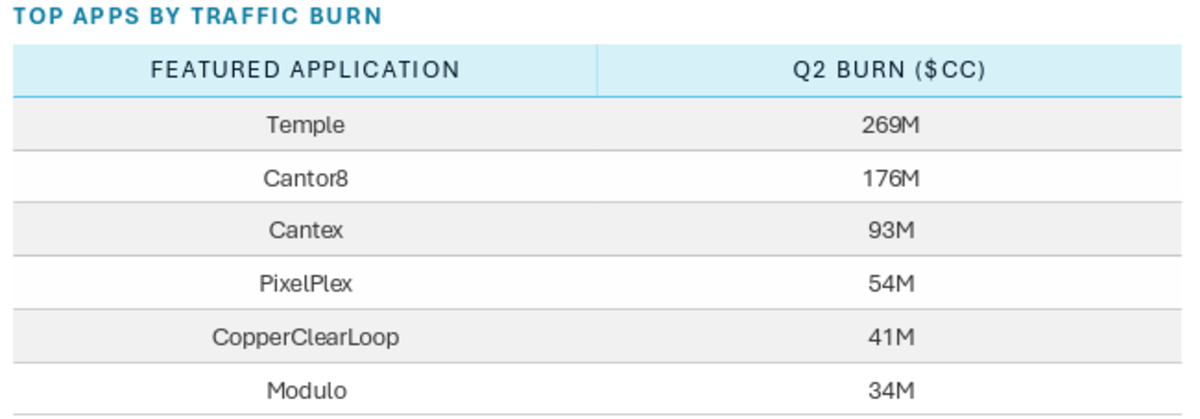
Featured apps more than doubled in three months, from 47 to 107, and the traffic data shows exactly where usage is concentrated: lending and trading marketplaces dominate.
Featured App | Q2 Burn ($CC) |
Temple | 269M |
Cantor8 | 176M |
Cantex | 93M |
PixelPlex | 54M |
CopperClearLoop | 41M |
Modulo | 34M |
Source: Official Report
Beyond marketplaces, private credit went live through T-RIZE's Kairos Digital Loan Notes and Chicago-based Newity's small-business lending product.
On the payments side, Visa expanded its Global Settlement Pilot Program to include this network, partnering with Brale, while Helios Finance launched a card letting users spend USD off their $CC holdings.
New Governance Rules Are Forcing Skin in the Game
Four governance proposals reshaped incentives this quarter. CIP-0105 requires Super Validators to lock a share of earned rewards to keep their voting weight, and CIP-0116 applies the same logic to Featured Apps, with asset issuers facing a steeper $25 million CC lockup versus 5 million for others.
CIP-0117 introduced Logical Synchronizer Upgrades, letting validators adopt new software on their own timeline instead of coordinating a hard-deadline network upgrade; Protocol 3.5 shipped to MainNet on June 27 using this method.
CIP-0104 changed how Featured Apps get rewarded, moving from self-reported activity markers to automatic, traffic-based measurement.
Asia Is the Next Battleground
Momentum is shifting toward Japan and South Korea:
Japan: The Japanese Securities Clearing Corporation, with Mizuho, Nomura, and Digital Asset, is piloting tokenized collateral for Japanese government bonds. BlackRock and State Street have joined a parallel study on the same asset class.
South Korea: Hanwha Investment & Securities, Shinhan Securities, KB Securities, and Shinhan Asset Management have all signed on in some form. Exchanges Upbit and Bithumb now list $CC pairs against the Korean won, Bitcoin, and USDT.
Glossary
Super Validator: An institution with governance influence and network-security responsibilities beyond standard participation.
Validator: An entity operating infrastructure to transact privately and run applications.
Featured App: An application recognized and rewarded for generating verified on-chain activity.
Burn-Mint Equilibrium (BME): A tokenomics measure comparing tokens burned against tokens minted.
$CC: The native coin used for fees, rewards, and governance weight.
Conclusion
Put together, the Canton Network Ecosystem 2026 trajectory looks less like a crypto trend and more like plumbing work: unglamorous, slow to build, but increasingly load-bearing for how tokenized treasuries, deposits, and collateral move between regulated institutions.
If Japan's bond pilots and Korea's securities partnerships mature the way the U.S. and European rollouts did, the next chapter of this story will read less like an experiment and more like a settlement layer traditional finance has quietly come to depend on.
YMYL Disclaimer: This article is for informational and educational purposes only and does not constitute investment, legal, or financial advice. Figures are drawn from Canton Strategic Holdings' Q2 2026 Ecosystem Report and independently verified public sources as of publication. Digital assets, including $CC, are volatile and carry a risk of loss. Readers should conduct independent research and consult a licensed advisor before making financial decisions.
Also read: