DAPPOS tokenomics: Token Allocation and Vesting Guide


DAPPOS Tokenomics: What the Foundation Announced
The project confirmed the tokenomics of its native token, $DOS, on July 29, 2026. The announcement covers supply, allocation, vesting, and utility for the token that will power the DAPPOS AI operating system.
This article breaks down DAPPOS tokenomics using only official figures shared by the project.
It also covers the ongoing DAPPOS airdrop registration window and how $DOS fits into the wider Web3 AI operating system that has been building.
What Is DAPPOS and Why $DOS Exists
The platform describes itself as an all-in-one AI operating system. The project brings intelligence, execution, and services together around a single user goal.
Its flagship product, xBubble, includes three parts. Bubble Engine builds task-specific standard operating procedures.
Bubble Pilot matches each request to the right solution. Bubble Code applies the same system to software and business creation.
According to the project, xBubble has attracted more than 10,275 paying One Person Company clients. It has generated over 6.8 million dollars in cumulative revenue so far.
The project is described as the coordination layer for this ecosystem. It aims to align users, service providers, infrastructure partners, community contributors, and token holders around one shared goal: lowering the barrier between an idea and a working business.
Native Token Overview
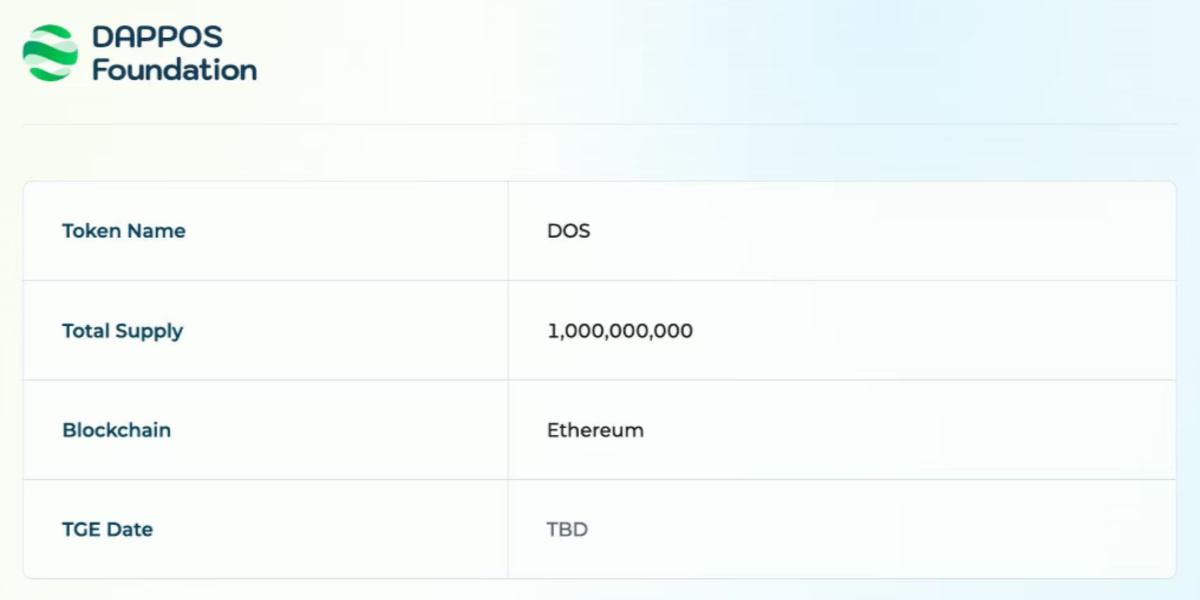
Source: Official Post
The table below lists the core facts about the asset, based on the official announcement.
Detail | Information |
Token Name | DOS |
Total Supply | 1,000,000,000 |
Blockchain | Ethereum |
TGE Date | TBD |
The project has not yet confirmed an exact token generation event date. Readers should rely only on official channels for updates on this timeline.
Project Vesting and Unlock Schedule
Vesting timelines shape how many tokens enter circulation over time. The project published a detailed schedule for each allocation category.
Category | Allocation | Vesting Schedule |
Team | 20% | 12-month cliff, then linear release over 48 months |
Investors | 22.5% | 12-month cliff, then linear release over 48 months |
Ecosystem | 20% | 5% at TGE, 3.5% over first 12 months, and the remainder linear over 48 months |
Treasury | 20% | 9% at TGE, 2% over first 12 months, and the remainder linear over 48 months |
Marketing | 11.5% | 3% at TGE, then 12-month cliff, then linear over 48 months |
Airdrop | 6% | 3% at TGE, remaining 3% released evenly over 3 months |
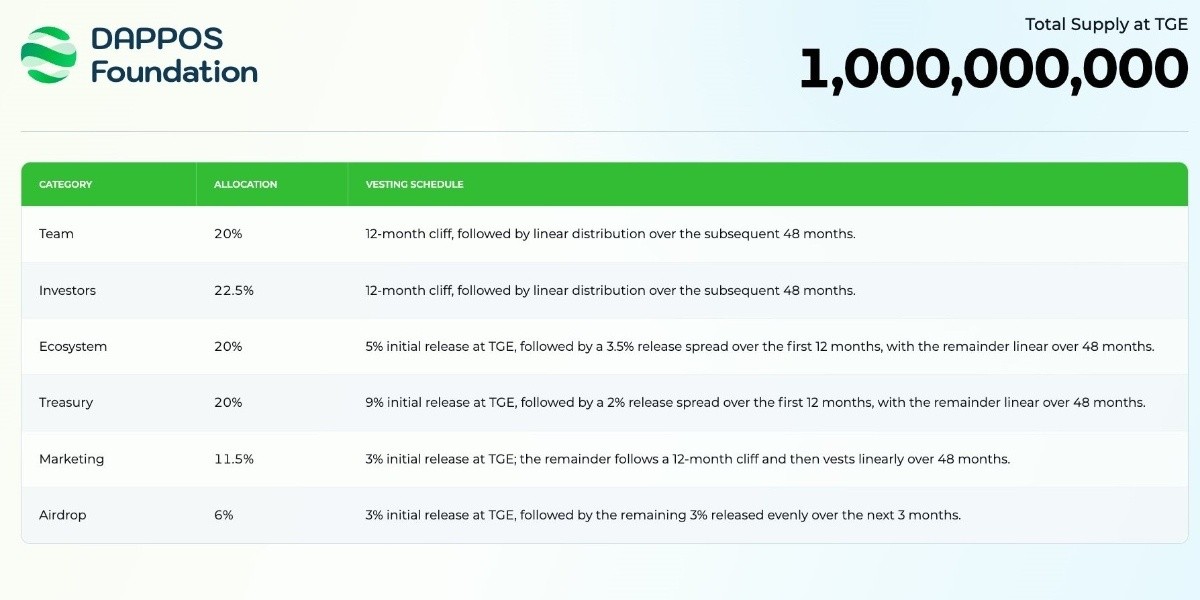
Source: X Post
Team and investor tokens do not fully unlock until 60 months after TGE. Both categories share the same 12-month cliff followed by a 48-month linear release.
Token Release Timeline
The project also shared a cumulative release chart covering the full 60-month period. Circulating supply starts near 20% at TGE, driven by ecosystem, treasury, marketing, and airdrop unlocks.
The curve then rises steadily as team and investor tokens begin releasing after month 12. Full release across all six categories completes at the 60-month mark.
This structure gives the ecosystem working capital from day one. It also delays insider unlocks until the network has had time to grow.
Token Utility of $DOS
The project serves four main functions within the DAPPOS ecosystem, according to the official announcement.
Subscription for premium features. $DOS lets users unlock enhanced Bubble Engine capabilities. This may include proactive SOP optimization and customized AI workflow support. Users who stake $DOS may also earn extra AI consumption credits.
Transaction fee payments. Users can pay fees for intent executions using $DOS. The project states this comes with discounts compared to paying with other mainstream tokens.
Staking module. Ecosystem participants, including execution layer providers and infrastructure partners, may need to stake $DOS as collateral. This supports network security and service reliability. Token holders who do not provide services can delegate their $DOS to eligible participants.
Protocol governance. $DOS holders can propose and vote on protocol decisions. This lets the community shape how project evolves over time.
DAPPOS Airdrop Registration
Separately from the DAPPOS tokenomics announcement, project opened an airdrop registration window through its official portal; the sign-up period runs from July 24, 00:00 UTC, to August 2, 00:00 UTC.
Users can register only through the official portal shared by the DAPPOS team. Submissions are expected to go through an eligibility review once the window closes, before any token claims begin.
The platform has also confirmed that 6% of the total $DOS supply is set aside specifically for airdrop distribution. As with the DAPPOS tokenomics schedule, readers should confirm any eligibility details directly through official DAPPOS channels rather than third-party listings.
Risks and Considerations
Several factors remain unconfirmed as of this writing. The TGE date is still listed as TBD by the DAPPOS Foundation.
Detailed staking reward rates, governance voting mechanics, and specific service provider requirements have not been published in full.
Readers should treat any figures beyond the official tokenomics announcement as unconfirmed until DAPPOS releases further documentation.
As with any token allocation, actual circulating supply and market price will depend on demand, exchange availability, and broader crypto market trends after launch.
Expert Opinion
DAPPOS tokenomics follows a fairly conservative structure compared to many newer token launches. The 12-month cliff for team and investor allocations, paired with a 48-month linear release, delays insider unlocks well beyond most competing projects.
Placing the entire TGE unlock inside ecosystem, treasury, marketing, and community categories gives the network working capital without an immediate insider payout.
This design choice may support price stability in the early months after launch, though actual market behavior will depend on exchange listings, trading volume, and broader market conditions once $DOS goes live.
The token utility design also ties $DOS directly to product usage, through fee discounts, staking, and premium feature access, rather than relying only on speculative demand.
Final Thoughts
DAPPOS tokenomics sets out a clear allocation and vesting plan across team, investor, ecosystem, treasury, marketing, and airdrop categories.
The token is designed to coordinate access to premium AI services, transaction fees, staking, and governance across the project ecosystem.
With the airdrop registration window active until August 2, 2026, and the TGE date still pending, the coming weeks should bring further clarity on the token launch. Readers should continue checking official DAPPOS channels for confirmed updates.
Disclaimer: This article is for educational and informational purposes only and should not be considered financial or investment advice. Always conduct your own research before making investment decisions.





.jpg)