Mutuum Finance Presale: Everything You Need to Know Before Joining


What's Really Going On With Mutuum's Presale Right Now?
The Mutuum Finance presale has been running since early 2025, and it is still one of the more talked-about DeFi raises heading into the second half of 2026. Unlike a lot of early-stage token sales, Mutuum backs its pitch with a public GitBook documentation site, a full allocation table, and a published roadmap you can check against actual progress.
Every figure below comes from Mutuum's own site and documentation, unless marked otherwise. Where third-party reporting fills a gap, that is labeled clearly, since presale statistics change daily.
What Is Mutuum Finance?
Mutuum Finance is a non-custodial DeFi protocol where you lend, borrow, and earn interest directly through smart contracts — no banks, no middlemen, nobody holding your funds. It runs on a Peer-to-Contract model: lenders pool their crypto, borrowers draw against it with collateral, and interest rates adjust automatically based on pool usage.
Depositors get mtTokens back to track their share plus accrued interest, and per the official documentation, an overcollateralized stablecoin is also in the works. It's Ethereum-based for now, with multi-chain expansion planned.
One thing to flag: Mutuum isn't DAO-governed. Its own docs say day-to-day decisions sit with the team, not on-chain community votes — a deliberate choice framed around staying compliant with regulation, but still a real departure from how most DeFi protocols operate.
Understanding the Mutuum Presale:
The MUTM-presale runs directly through Mutuum's own official presale page, rather than through a third-party launchpad. Buyers connect a wallet such as MetaMask or Trust Wallet, then purchase MUTM using supported cryptocurrencies. Card payments have also been reported as an option on the presale-dashboard in past coverage.
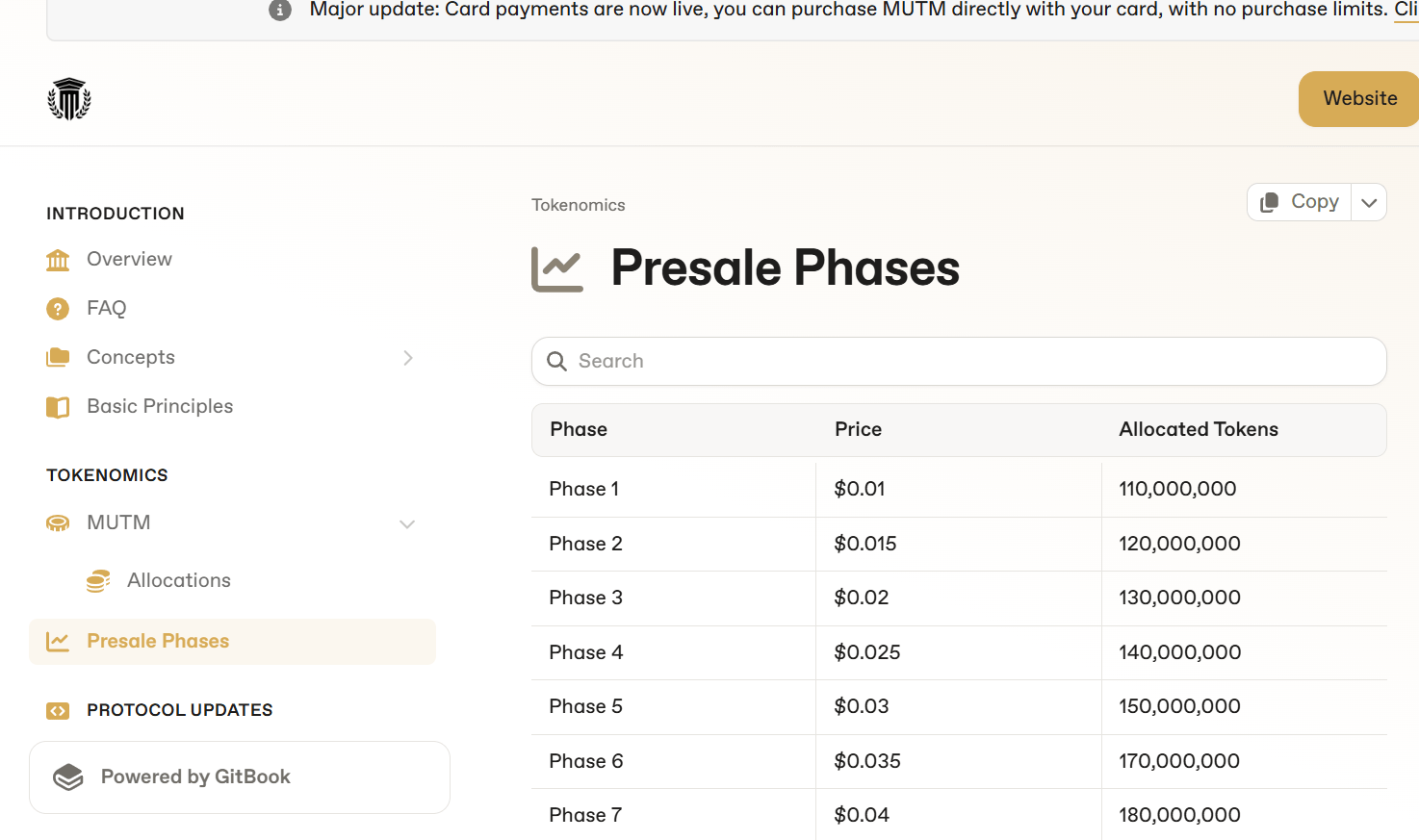
The sale is structured across 11 fixed-price phases.
| Phase | Price | Tokens Allocated |
| Phase 1 | $0.01 | 110,000,000 |
| Phase 2 | $0.015 | 120,000,000 |
| Phase 3 | $0.02 | 130,000,000 |
| Phase 4 | $0.025 | 140,000,000 |
| Phase 5 | $0.03 | 150,000,000 |
| Phase 6 | $0.035 | 170,000,000 |
| Phase 7 | $0.04 | 180,000,000 |
| Phase 8 | $0.045 | 190,000,000 |
| Phase 9 | $0.05 | 200,000,000 |
| Phase 10 | $0.055 | 210,000,000 |
| Phase 11 | $0.06 | 220,000,000 |
That adds up to 1,820,000,000 MUTM across all 11 phases, matching the 45.5% presale allocation described below.
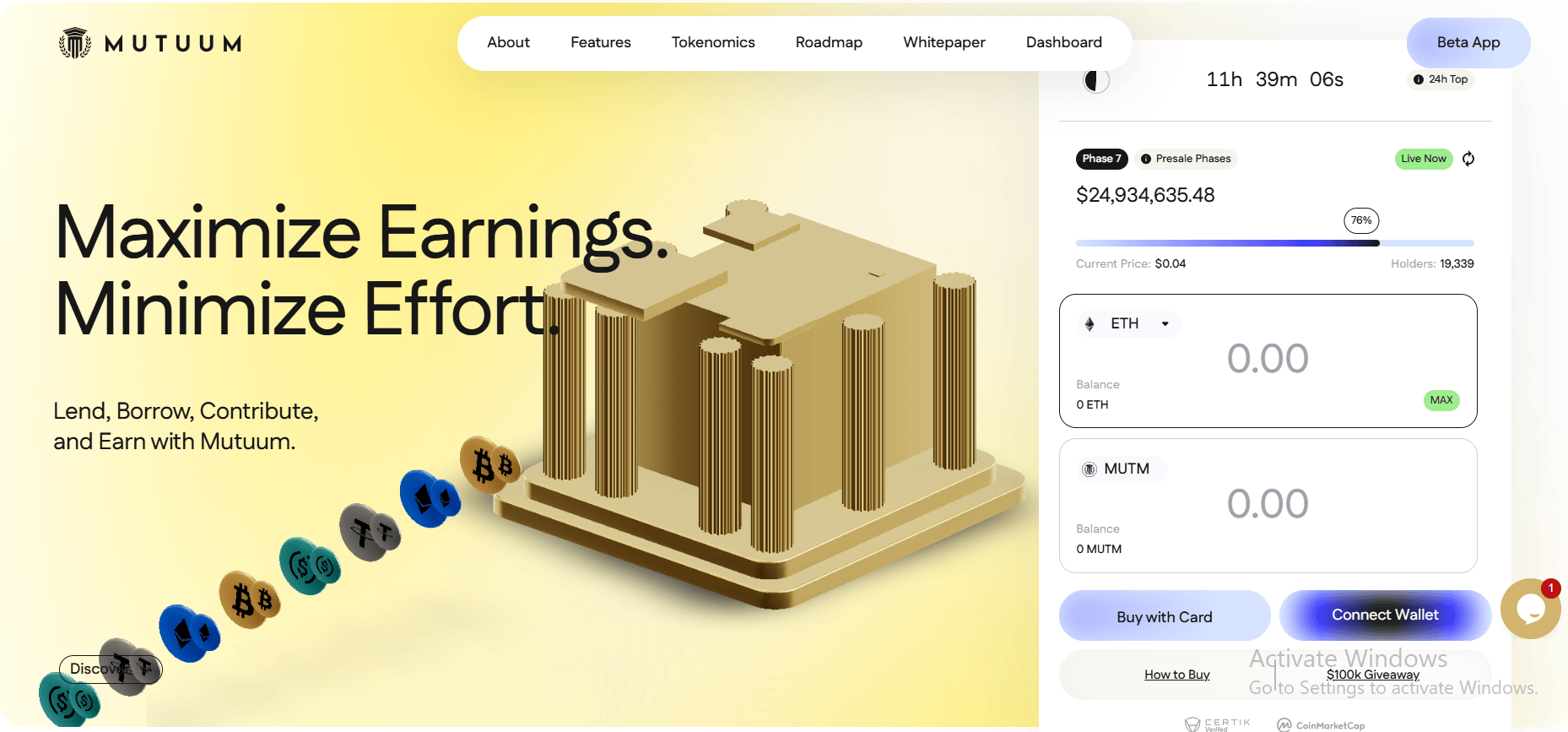
Where the presale stood recently: Based on independent presale coverage from mid-to-late July 2026, Mutuum was in Phase 7 at $0.04 per token, with roughly $24 million raised and more than 19,000 holders. These numbers move daily as the stage sells through, so treat them as a snapshot rather than a live figure.
Check the live Mutuum sale page directly for the current phase and price before buying.
Mutuum Finance Tokenomics Details:
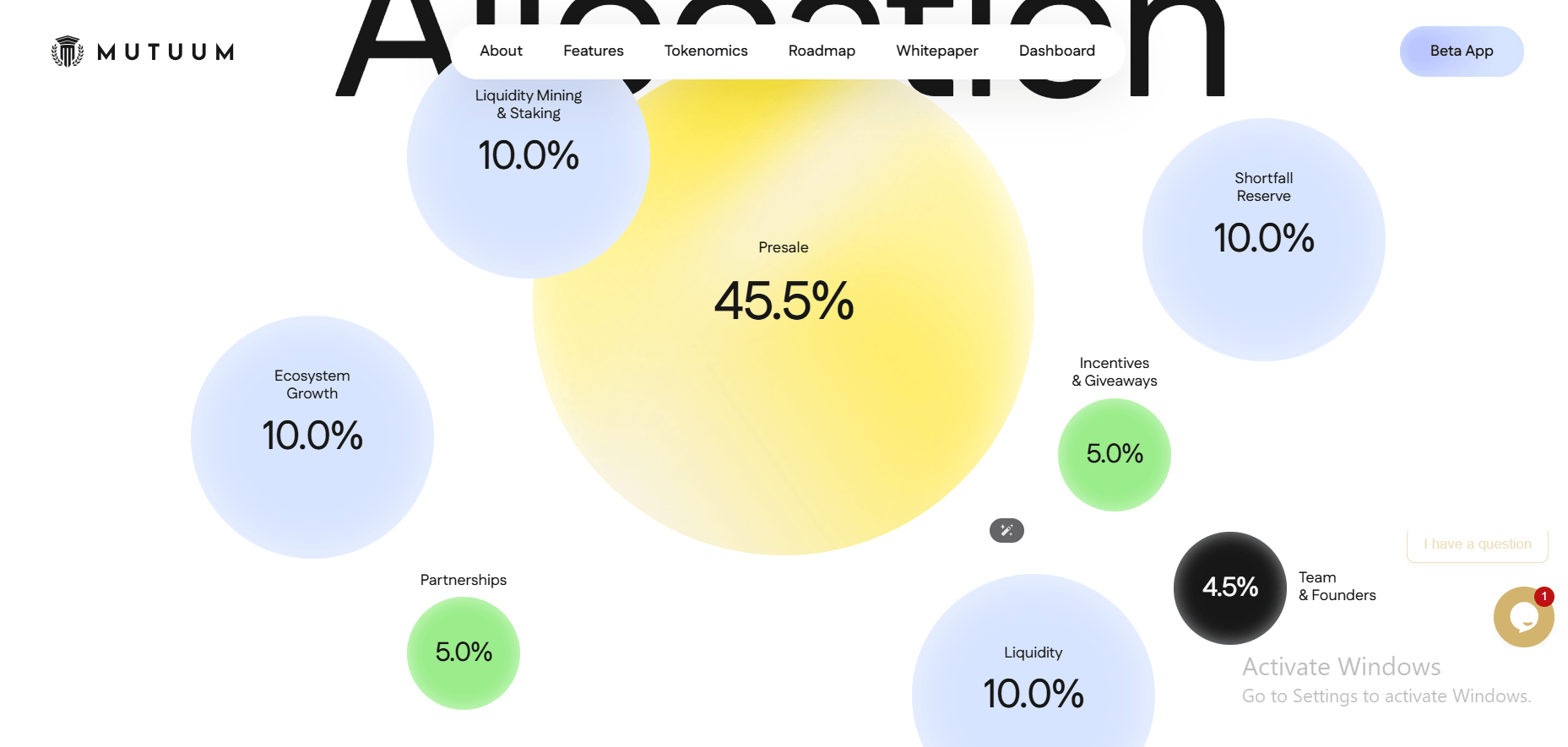
Supply and allocation are the core of MUTM tokenomics. MUTM has a total supply of 4,000,000,000 tokens, fixed at that figure per the official Allocations documentation.
| Category | Allocation | Token Amount |
| Presale | 45.5% | 1,820,000,000 |
| Liquidity Mining and Incentives | 10% | 400,000,000 |
| Ecosystem Growth and Developer Rewards | 10% | 400,000,000 |
| Security and Shortfall Reserve | 10% | 400,000,000 |
| Liquidity | 10% | 400,000,000 |
| Partnerships | 5% | 200,000,000 |
| Community Incentives and Giveaways | 5% | 200,000,000 |
| Team and Founders | 4.5% | 180,000,000 |
MUTM Vesting Schedule:
Presale tokens vest over 6 months. Nothing unlocks in month 1. Starting in month 2, tokens release in equal steps of 20% per month until the full amount unlocks at the end of month 6.
| Month | Unlocked |
| TGE (Month 0) | 0% |
| End of Month 1 | 0% (cliff) |
| End of Month 2 | 20% |
| End of Month 3 | 40% |
| End of Month 4 | 60% |
| End of Month 5 | 80% |
| End of Month 6 | 100% |
Team and Founders tokens vest over 18 months, with a 6-month cliff first. After that cliff, tokens release in roughly equal monthly steps of about 8.33% until fully unlocked at month 18. That is a considerably longer lock than the presale allocation, which puts insider liquidity well behind public buyer liquidity.
The Liquidity allocation carries its own 6-month lock, separate from token vesting, meant to keep exchange liquidity in place through the early post-launch period.
Mutuum Token Utility:
MUTM works inside the Mutuum protocol in a few concrete ways:
-
Earning through mtTokens — deposited assets earn mtTokens, which accrue interest automatically as the pool generates yield.
-
Staking rewards — mtTokens can be staked for extra rewards through a buy-and-distribute mechanism, where a share of protocol fees buys MUTM on the open market and distributes it to stakers.
-
Liquidity mining — MUTM powers the reward pool for suppliers and borrowers.
-
Ecosystem grants — funds contributors and projects building on top of Mutuum.
-
Community incentives — supports the promotion and loyalty programs listed in the allocation table above.
How to Join the Mutuum Presale:
-
Set up a compatible wallet, such as MetaMask wallet or Trust Wallet, if you do not already have one. Store your seed phrase somewhere safe and offline.
-
Fund the wallet with a supported cryptocurrency for the current phase.
-
Go to the Mutuum-presale dashboard directly at mutuum.com. Do not use a link from an email, ad, or social media comment.
-
Connect your wallet and complete the purchase at the current price.
-
Confirm the transaction and keep your own record of the purchase for reference.
Risk and Due Diligence Checklist:
Every token sale carries risk, even one with public documentation behind it. Here is what to check before buying.
| Checklist Item | Status Based on Available Data |
| Official site confirmed | Yes, mutuum.com and docs.mutuum.com |
| Tokenomics and allocation disclosed | Yes, published allocation table with token amounts |
| Vesting schedule disclosed | Yes, for Presale and Team and Founders categories specifically |
| Team identity disclosed | No, Public bios or founder names are not published on the official site |
| Company registration disclosed | Yes, a Costa Rica-registered entity, per the site footer |
| Confirmed exchange listing date | No, Not announced as of this writing |
| Bug bounty program status | Documented in principle; the project's own roadmap lists full establishment as a later-phase item, not yet complete |
Two things to know: Mutuum hasn't shared any founder names publicly, and while some articles say the audit and bug bounty are fully done, the project's own roadmap says only the first audit is complete — the bigger review and bug bounty are still in progress. Better to check this yourself before trusting outside claims.
Industry Analyst Perspective
Mutuum's tokenomics lean toward a longer, more conservative rollout than most DeFi presales attempt. The 4.5% team allocation is low by industry norms, and an 18-month vesting schedule with a 6-month cliff keeps insider liquidity well behind the general public. The 45.5% presale share is unusually large too — it spreads ownership widely, but it also means a large chunk of supply turns liquid within 6 months of TGE under the published vesting terms.
The bigger open questions sit outside the tokenomics document. No mainnet date or exchange listing has been confirmed, and the team remains publicly unnamed. The roadmap shows meaningful work still ahead in Phase 3 and Phase 4, including the full external audit and the complete bug bounty rollout. The presale-numbers and the actual execution timeline are two separate things, and right now, only one of them is fully in Mutuum's control.
Conclusion:
To sum up the Mutuum in a few numbers: the Mutuum Finance presale pairs a fixed 4 billion MUTM supply with a large 45.5% public allocation, a comparatively small 4.5% team share, and vesting terms that lock insiders up far longer than presale buyers.
That is a structure that generally favors early participants over the team, at least on paper. Before buying, confirm the current phase and price directly on mutuum.com, and weigh the disclosed strengths, like the published allocation table and roadmap, against the disclosed gaps, like the unnamed team and the still-pending final audit and bug bounty milestones.
Disclaimer:
This article is for informational purposes only, not financial or investment advice. Presale crypto is risky and could result in total loss of funds. Figures here may change, so always check Mutuum's official site for current terms and talk to a financial advisor before investing.