Which Crypto Companies Made CNBC's Top Fintech Companies 2026 List


Top Fintech Companies: CNBC's 2026 Crypto Company Rkings
CNBC and market research firm Statista released their fourth annual World's Top Fintech Companies list, and for the first time, digital assets got their own dedicated category. The report covered 500 companies across eight segments, including payments, neobanking, wealth technology, enterprise fintech, insurtech, regtech, and digital assets. You can find the full report on CNBC's official page.
Forty companies made the cut in the Digital Assets category alone. Five of those names stand out for anyone following crypto closely: Coinbase, Crypto.com, Ledger, Gemini, and Ripple. This piece walks through what CNBC's top fintech companies 2026 list says about these five, what each one actually does in the crypto market, and how their tokens or stocks have been moving lately.
The Crypto Names on CNBC's List
Before getting into each company individually, here is a quick snapshot of where these five sit on the top fintech companies 2026 list and what they bring to the table.
| Company | Core Business | Crypto Market Role |
| Coinbase | Regulated crypto exchange, custody, and Layer 2 network | Largest US-based on-ramp for retail and institutional crypto trading |
| Crypto.com | Exchange, card, and blockchain infrastructure | Runs its own chain (Cronos) alongside a global trading and payments app |
| Ledger | Hardware wallet manufacturer | Self-custody security for individual and institutional crypto holders |
| Gemini | Regulated exchange and stablecoin issuer | Custody, trading, and the GUSD stablecoin, now a public company |
| Ripple | Payments infrastructure and blockchain technology firm | Cross-border settlement and enterprise blockchain, tied closely to XRP |
Coinbase, Crypto.com, Ledger, Gemini, and Ripple: What Each One Does in Crypto
Coinbase
Coinbase is the largest US-based cryptocurrency exchange, and it has spent the past few years positioning itself as more than a trading app.
-
Runs custody services for institutions
-
Helped build the USDC stablecoin through Circle
-
Operates Base, its own Layer 2 network built on Ethereum
Coinbase does not have its own native crypto token. Instead, the company itself trades as a public stock (COIN) on Nasdaq, which gives traditional investors a way to bet on crypto adoption without holding coins directly. Base, meanwhile, has grown into one of the more active Layer 2 networks by transaction count, which says something about how much infrastructure Coinbase has quietly built beyond just the trading app most people know it for.
Crypto.com
Crypto.com runs one of the more recognizable global exchange and payment card platforms in the industry, but its footprint goes well beyond that.
-
Operates Cronos, an EVM-compatible Layer 1 blockchain built for DeFi and tokenized markets
-
Cronos handles the transaction and staking layer for the Crypto.com ecosystem, and its native token, CRO, trades as one of the more actively watched exchange tokens on the market
-
Known for its Visa-branded crypto debit cards, which helped build one of the larger retail user bases in the industry outside of pure exchange trading
Ledger
Ledger makes hardware wallets, the small physical devices that let people store crypto offline instead of leaving it on an exchange. It is a private company, so there is no public stock or native token tied directly to Ledger the way there is with Coinbase or Crypto.com.
What it brings to the crypto market is trust in self-custody:
-
A huge share of the industry's security conversation, especially after major exchange hacks over the years, points people toward hardware wallets
-
Ledger remains one of the most widely used names in that space
-
Its devices, including the Nano and Stax lines, keep private keys offline entirely, so even if a computer gets compromised, the keys signing a transaction never touch the internet
Gemini
Gemini started as a regulated exchange founded by Cameron and Tyler Winklevoss, and it has since expanded into derivatives, custody, and its own dollar-pegged stablecoin, GUSD.
The bigger recent development is that Gemini itself went public:
-
Its parent company, Gemini Space Station, now trades on Nasdaq under the ticker GEMI, following its 2025 IPO
-
That makes Gemini one of the few crypto exchanges where the public can directly buy shares in the business rather than just trading through the platform
-
Gemini has also picked up a Derivatives Clearing Organization license from the CFTC this year, pushing it further into regulated derivatives trading alongside its existing spot exchange and custody business
Ripple
Ripple is the name most closely tied to XRP, though the two are legally separate. Ripple builds payments infrastructure aimed at banks and financial institutions, using blockchain rails to settle cross-border transactions faster and cheaper than the traditional correspondent banking system.
According to CNBC's coverage of this year's list, Ripple's inclusion reflects a broader shift where digital assets are moving away from pure speculation and into real settlement infrastructure. A few recent moves back that up:
-
Regulatory approval under the European Union's MiCA framework this year, widening its ability to offer regulated crypto services across the bloc
-
Pushing RLUSD , its own dollar-backed stablecoin that runs on both the XRP Ledger and Ethereum, as part of a broader push into institutional payments and tokenized finance
Market Impact: How These Tokens and Stocks Are Trading
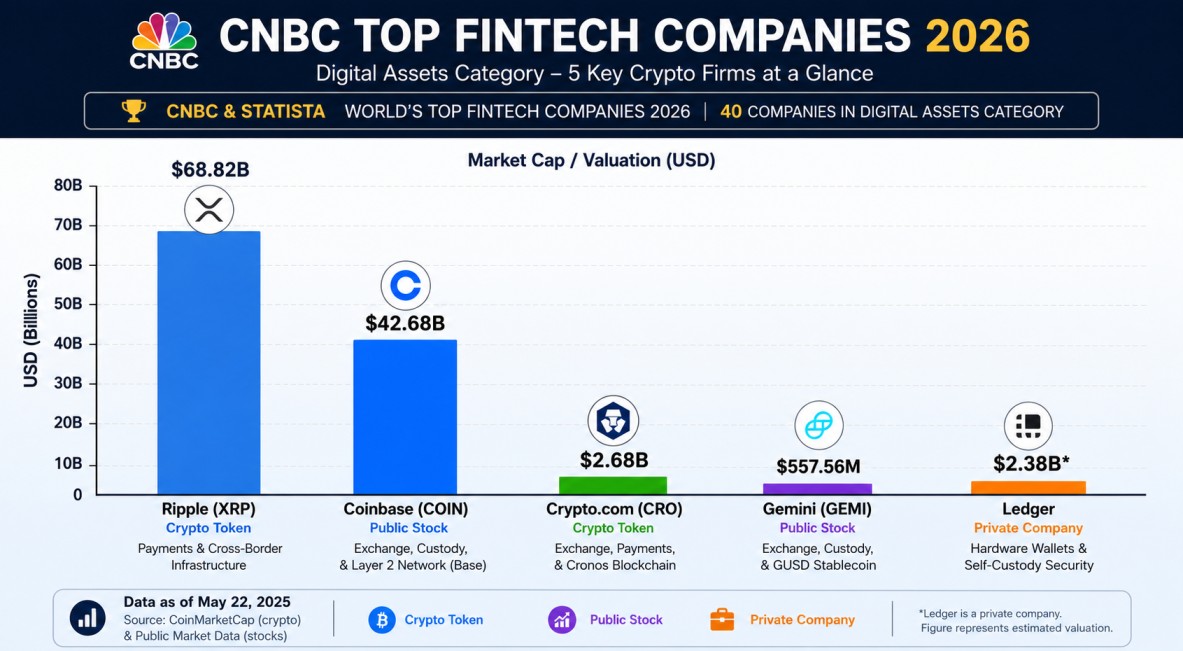
Making a list like CNBC's top fintech companies 2026 ranking does not move markets the way a major product launch or regulatory ruling does, but it is still worth looking at where these companies stand right now. The numbers below reflect live data pulled from CoinMarketCap for the $crypto assets, and recent public market data for the two companies that trade as stocks rather than tokens.
| Asset | Type | Market Cap |
| XRP (Ripple) | $Crypto token | $68.82B |
| CRO (Crypto.com / Cronos) | $Crypto token | $2.68B |
| COIN (Coinbase) | Public stock | $42.68B |
| GEMI (Gemini Space Station) | Public stock | $557.56M |
| Ledger | Private company | $2.38B |
XRP still sits comfortably inside the top ten $cryptocurrencies by market cap, while CRO trades at a much smaller scale but has been ticking upward lately. On the equity side, Coinbase's stock reflects its position as the dominant US exchange, while Gemini's stock has cooled off well below its 2025 IPO highs. Ledger does not show up in either table since it is a private company with no public stock or token. Token prices and small-cap stocks like GEMI can move quickly, so treat these figures as a snapshot rather than something fixed.
Conclusion
CNBC's top fintech companies 2026 list makes one thing clear: It has earned a permanent seat at the fintech table rather than sitting off to the side as a niche category. Coinbase, Crypto.com, Ledger, Gemini, and Ripple each represent a different piece of how digital assets actually function day to day, from exchanges and custody to hardware security and cross-border settlement. Whether that translates into stronger token prices or stock performance over time will depend on far more than a single ranking, but their presence on a mainstream list like this is a decent signal of how far the industry has come.
Disclaimer
This article is for educational and informational purposes only and should not be considered financial or investment advice. Crypto and stock prices are volatile and change constantly, so always check live data and do your own research before making any decisions.
Also read: