What is Polymarket? How the Prediction Market Platform Works

Why Polymarket Is Suddenly Everywhere
Prediction markets have moved from a niche crypto experiment into a space that traditional finance now takes seriously. At the center of this shift sits one platform that keeps showing up in headlines about elections, sports, and even Federal Reserve decisions.
So, what is Polymarket, and why has it attracted billions of dollars from names like Intercontinental Exchange, the parent company of the New York Stock Exchange? This guide breaks down what is Polymarket, how it functions, and where it stands with US regulators today.
What is Polymarket?
It is a prediction market platform where users trade on the outcomes of real-world events instead of placing a wager with a bookmaker. Founded in 2020 by Shayne Coplan and headquartered in New York City.
The platform lets people buy and sell shares tied to the likelihood of an event happening, covering categories such as politics, sports, weather, economics, awards, and crypto.
Unlike a traditional sportsbook, the exchange does not act as the house. It never takes the other side of a trade or profits when a user loses.
Instead, it connects traders directly with one another in an open, peer-to-peer market, and every trade settles through smart contracts running on the Polygon blockchain, with positions denominated in the USDC stablecoin.
How Does Polymarket Work?
To understand what is Polymarket at a mechanical level, it helps to look at how a single market functions.
Each question on the platform, such as whether a particular event will occur, is structured as an event contract with two outcomes: Yes or No.
Shares in these outcomes trade anywhere between $0.01 and $0.99, and that price is not arbitrary. It reflects the crowd's real-time estimate of how likely the event is. A share trading at 30 cents implies roughly a 30 percent chance of that outcome.
Here is the basic lifecycle of a trade:
Step | What Happens |
1. Choose a market | Pick an event and select Yes or No, or one outcome in a multi-outcome market |
2. Buy shares | Purchase shares at the current price using USDC |
3. Hold or trade | Sell at any time before resolution as odds shift with new information |
4. Resolution | A decentralized oracle confirms the real-world outcome |
5. Payout | Winning shares settle at $1.00 each; losing shares settle at $0 |
Every market also comes with predefined resolution rules and designated sources, listed directly in the market's "Rules" section, so traders know in advance exactly how and when an outcome will be verified.
This is one more piece of what is Polymarket that separates it from an ordinary betting site: the resolution process is transparent and set before anyone places a trade.
Key Features That Define the Platform
A few features explain why so many traders and analysts turn to this platform rather than traditional polling or sportsbooks:
Non-custodial control: Funds stay in the user's own wallet and are secured by their private key; the exchange itself never takes custody of trader funds.
Real-time probability pricing: Prices update instantly as news breaks, so the market reflects current sentiment rather than a static poll.
Continuous trading: Traders are not locked into a position and can exit anytime before a market closes.
Broad market coverage: Thousands of live questions span elections, central bank decisions, sports championships, and cultural events.
On-chain settlement: Every trade executes through audited smart contracts rather than a centralized backend.
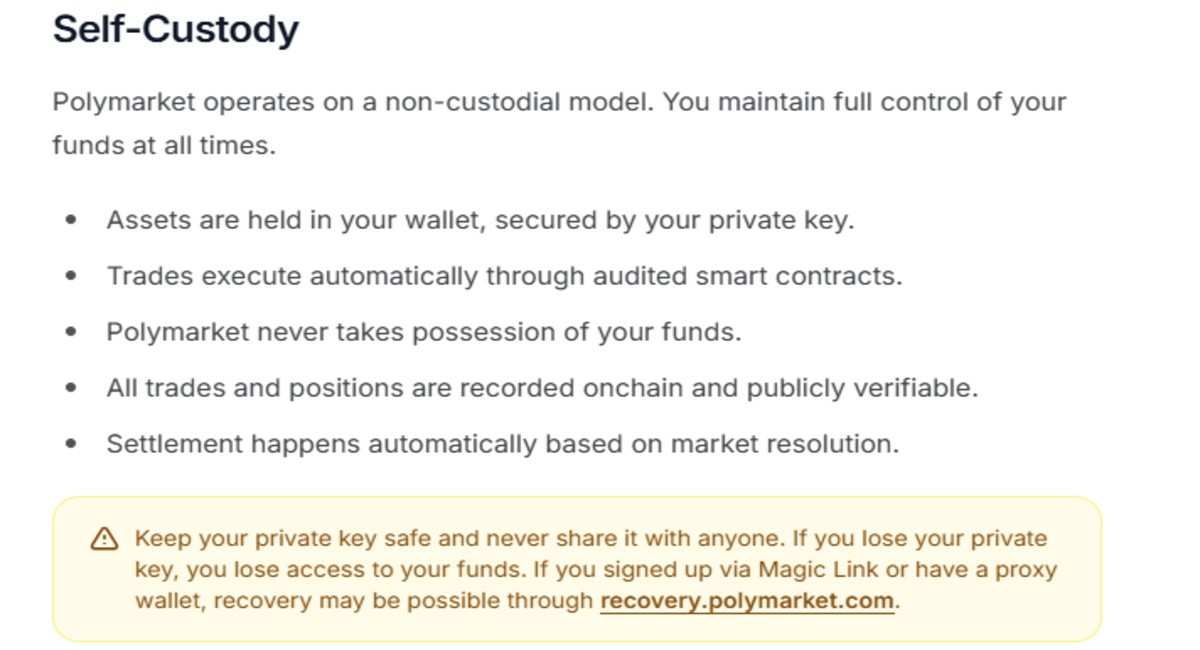
Source: Official Docs
Sports has become the largest category by trading volume on the platform, followed by politics and then crypto-related markets, a shift from earlier years when political contracts dominated activity around major elections.
Polymarket's Growth and the ICE Investment
Anyone asking what is Polymarket in 2026 also needs to see how much institutional capital has moved into the platform recently, led largely by Intercontinental Exchange (ICE), the company that owns the New York Stock Exchange.
Date | Development | Details | Source |
October 2025 | ICE strategic investment | Up to $2B commitment ($1B in Series D preferred stock plus an agreement to purchase additional shares from existing investors), implying a roughly $8B valuation at the time | ICE press release |
February 2026 | "Signals and Sentiment" data tool | ICE became a global distributor of the platform's event-driven data, feeding crowd-sourced probability data into ICE's institutional data products | |
March 2026 | Additional ICE investment | $600M direct cash investment, bringing ICE's total committed capital to nearly $2B | |
April 2026 | Reported new fundraising talks | Reportedly in discussions to raise $400M at a $15B valuation; not officially confirmed by the company |
Is Polymarket Legal? Understanding Its US Regulatory Status
The legal side of what is Polymarket has shifted sharply since 2022, moving from a federal ban to a regulated return.
Year | Event | Outcome | Source |
2022 | CFTC cease-and-desist order | $1.4M fine; US users blocked from the platform entirely | |
July 2025 | Acquired QCEX ($112M) | Gained QCX LLC and QC Clearing LLC, both already CFTC-licensed as a designated contract market and clearinghouse | |
Late 2025 | CFTC no-action letter/approval | Legal path secured for a regulated US-facing arm | CryptoBriefing |
April 2026 | Filed with the CFTC | Seeking approval to let US traders access the main global exchange directly, not just the US-only product |
Even with federal clearance, several states still treat sports- and politics-linked event contracts as gambling requiring separate state licensing, an ongoing legal fight in states like Tennessee and Nevada (Gambling Insider). Traders should check current eligibility rules for their location before signing up.
Risks to Know Before Trading
Price volatility: Prices can swing sharply the moment breaking news hits a market.
Full loss of position: Losing shares settle at $0, so a wrong call can wipe out that stake entirely.
Uneven regulatory status: Federally cleared, but state-level rules still vary and remain in dispute in some states.
Self-custody responsibility: Since the platform is non-custodial, users alone are responsible for securing their wallet's private key.
Glossary
Event Contract: A binary Yes/No share tied to a specific real-world outcome, redeemable for $1 or $0.
Non-Custodial: A system where the platform never holds user funds directly; assets remain in the user's own wallet.
Oracle: A data mechanism used to determine and confirm the real-world outcome of a market.
USDC: A US dollar-pegged stablecoin used to fund trades on Polymarket.
Designated Contract Market (DCM): A CFTC-regulated exchange license, the same tier held by major traditional derivatives exchanges.
Conclusion
So, what is Polymarket at its core? It is a non-custodial, blockchain-settled prediction market that has grown from a blocked-in-the-US crypto platform into a partner of the New York Stock Exchange's parent company, backed by billions in institutional capital and a clearer regulatory path in the US.
Whether used for speculation or as a real-time sentiment gauge, it has become one of the most closely watched platforms in crypto and finance alike.
Disclaimer: This article is for educational purposes only and does not constitute financial, investment, or trading advice. Prediction markets involve real financial risk, including the potential loss of the full amount traded. Readers should conduct their own research and consider regulatory eligibility in their region before using any prediction market platform.