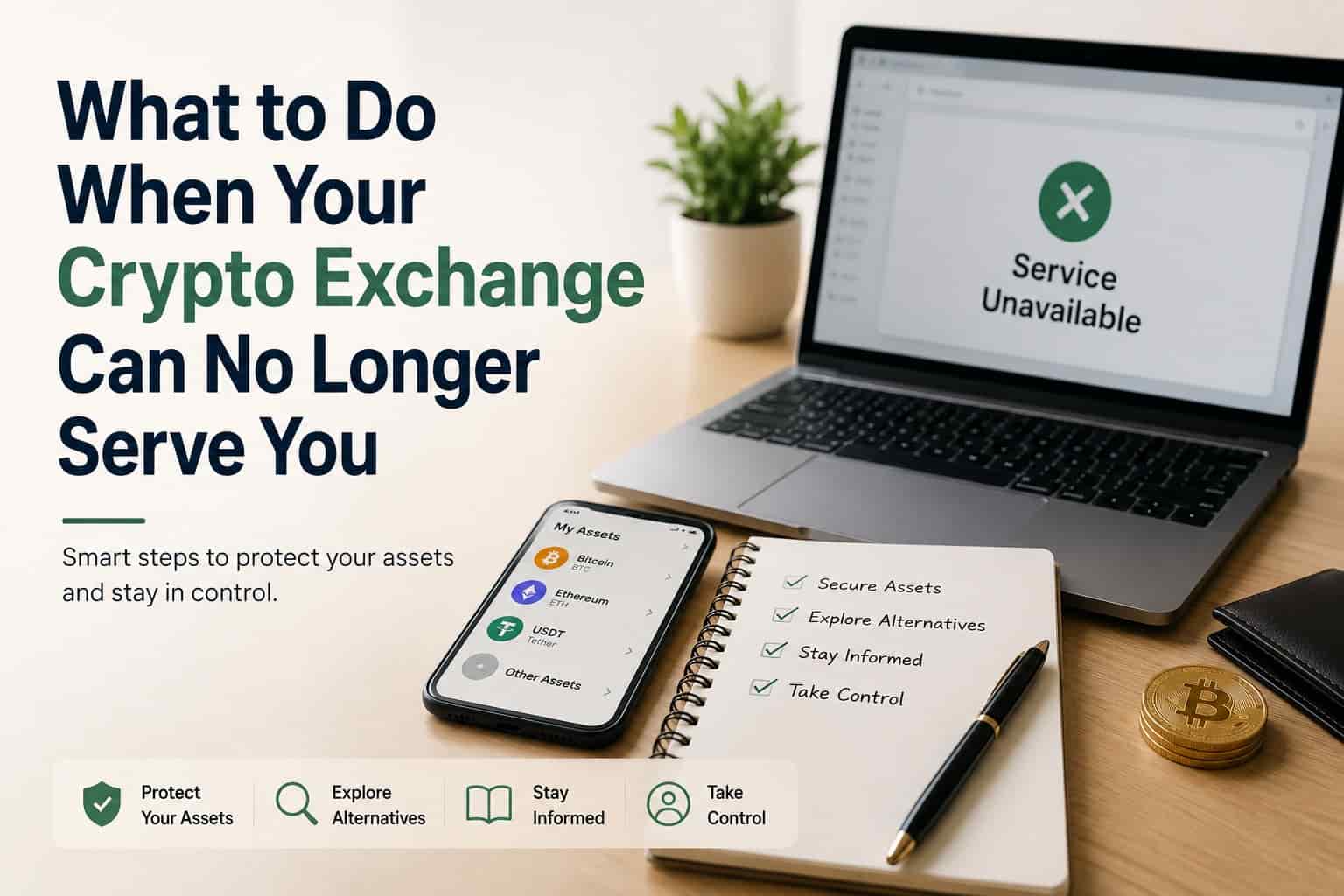
What to Do When Your Crypto Exchange Can No Longer Serve You

Crypto Holders Guide to Navigating Regulatory Disruption
This kind of thing has happened before, and it'll happen again. Every time it does, millions of crypto holders are forced to make high-stakes decisions under time pressure, and how that plays out usually comes down to whether they had a plan before the notification arrived.
The Situation
You log in one morning to a notification. Your exchange has lost its license, or a regulator has put restrictions on it, or it's shutting down in your country. The message says your funds are safe, but that trading, transfers, or withdrawals may be limited, and that you have a window of time to act.
This isn't just an imaginative scenario. It's played out with Mt. Gox, Celsius, FTX, Bittrex, and others, each time following a similar arc: reassurance first, then uncertainty, then a scramble.
The people who had already thought through what they'd do moved calmly. The people who hadn't tended to make decisions in a hurry, and rushed decisions with money are usually where the real damage happens.
The response that works is largely the same regardless of which exchange or regulator is involved. Here's what that looks like in practice.
Step 1: Verify Before You Act
Before withdrawing anything, figure out what's actually happening. Read the exchange's official communication in full. Look up the regulatory announcement directly rather than relying on summaries or social media threads. Get clear on the actual timeline and what is specifically restricted, is it new deposits, trading, withdrawals, or all of it?
In most regulated markets, exchanges are required to maintain some form of orderly withdrawal process even after losing authorization. Headlines like "your funds are gone" are often premature in the first hours or days.
What's usually true is narrower: there's a window, and the smart move is to use it deliberately rather than burn it in a panic.
Step 2: Decide Where You're Moving To Before You Withdraw It
This is the step people skip most often, and skipping it is where a lot of costly mistakes come from. A deadline creates pressure to withdraw first and sort out the destination later. Resist that.
Broadly, you have two options. Moving funds to another exchange is faster, but it just swaps one piece of regulatory risk for another, and this whole situation is a reminder that exchange authorization can and does change. Moving to self-custody, meaning a wallet where you alone hold the keys, takes your assets out of any exchange's regulatory orbit entirely.
If you go the self-custody route, set the wallet up completely, generate the address, verify it on the device itself, before you initiate a single withdrawal. Sequencing matters here more than speed.
Step 3: Test With a Small Amount First
Before moving anything significant, send a small test amount — the equivalent of €10–20 in whatever asset you're transferring. Wait for it to confirm on-chain, then independently verify it landed at the right address using a block explorer, rather than just trusting the wallet's own display.
This step feels slow when you're already anxious about a deadline, but it's arguably the most important one in the whole process. A wrong address on a large transfer is usually unrecoverable, and there's no support line that fixes that.
Step 4: Move One Asset at a Time
Avoid trying to withdraw everything simultaneously. During mass-exit events, exchange withdrawal queues get congested, network fees spike, and mistakes compound when you're juggling multiple transfers at once.
Start with your largest holding, confirm it's arrived safely, and only then move on to the next asset. It's slower than doing everything in parallel, but it's the version of this that actually holds up under pressure.
Step 5: Secure Your Recovery Phrase Immediately and Permanently
If you've moved to self-custody, you now have a recovery phrase, usually twelve or twenty-four words (or, on some wallets, a hexadecimal key that represents the same thing). This phrase is the access to your funds. Lose it and your assets are unreachable. Expose it to anyone else and your assets are theirs.
Write it down on paper as a first step, but paper alone is vulnerable to fire, water, and time. Never photograph it, never type it into any app, cloud note, or password manager, and don't store it in any digital form at all, that includes "just this once" to check something. A steel backup is the more durable option precisely because it survives the things paper doesn't.
There are products built specifically around this two-part job — generating and storing keys offline, and backing up the recovery phrase physically.
NGRAVE, for instance, makes the ZERO, a fully air-gapped hardware wallet (no USB, Bluetooth, or Wi-Fi at all) that has reportedly received an EAL7 security certification, which the company describes as the highest security assurance level given to a consumer financial product.
It pairs with GRAPHENE, a stainless-steel backup for the recovery phrase designed to survive fire and water damage. NGRAVE ZERO is one option among several on the market (Ledger and Trezor make comparable hardware wallets), and worth comparing rather than assuming any one is automatically the right fit.
Step 6: Keep Your Exchange Account Open
Once your assets are safely moved, the instinct is often to delete the account entirely. There's usually no need to. The exchange may regain its license. You might want trading access again down the line. An account with nothing in it isn't really a risk, it's just an option you're keeping open at no cost.
The Real Lesson
None of this means exchanges are inherently dangerous, they serve a real function, particularly for trading and liquidity. What events like this actually demonstrate is the difference between two roles: exchanges are for trading, and wallets are for ownership. That distinction tends to matter most exactly when you can least afford for it to matter.
Setting up self-custody isn't especially complicated. A hardware wallet typically takes about half an hour to configure, and securing a recovery phrase properly takes another fifteen minutes or so. That's less time than most people spend comparing exchanges in the first place, and the protection holds regardless of what happens to any single platform's license down the line.
The next time something like this happens, and it will happen again, to some exchange, somewhere, the only real question is whether you acted before the notification arrived, or after.
Disclaimer: This article is intended for informational and educational purposes only and does not constitute financial, investment, legal, or trading advice.
Also read: