XDAO Tokenomics Explained: Full $DAO Supply and Allocation Structure

XDAO Tokenomics: Strong Structure or Hidden Risks in $DAO Model
Most crypto projects write a whitepaper, publish a tokenomics chart, and move on. XDAO has taken a different approach and if you've been following the project, you know that its token structure is actually one of the more thought-out designs in the DAO space right now.
With the TGE approaching and community interest growing, this is the right time to break down what we know about XDAO's $DAO tokenomics: how the supply is structured, what the token actually does, why so much of it is burned, and what the scarcity model means in practice.
Let's go through it all.
From $XDAO to $DAO: What Changed and Why
Before getting into the numbers, you need to understand one important shift.
XDAO originally launched with the $XDAO token. In late 2024, the team announced a full transition to a new unified token $DAO to be launched exclusively on the TON blockchain. Public trading of the old $XDAO was suspended, and existing holders were given the assurance that their tokens would be proportionally converted to the new $DAO token after TGE. No holder would lose their position in the transition.
The reason behind the switch was straightforward. The multi-blockchain structure of the original token was creating technical complexity and fragmentation. Moving to a single token on TON a blockchain with high transaction speed and a massive Telegram-native user base allowed the team to unify the ecosystem, simplify management, and build more cleanly on top of Telegram Mini Apps. The $DAO is the result of that decision.
The Numbers: $DAO Token Allocation at a Glance
The total supply of the $DAO token stands at 250 million tokens. Here is how that supply is distributed, according to data shared by CryptoRank:
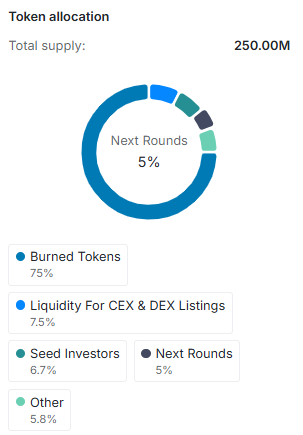
Note: The allocation data above is sourced from CryptoRank. As of publication, XDAO has not published official tokenomics documentation on its website.
The figure that stands out immediately is the 75% burn. Three-quarters of the entire supply is permanently removed from circulation before the token even reaches the market. That is an unusually aggressive allocation for any project, and it is not a cosmetic move it is the foundation of the $DAO scarcity model.
Why 75% Is Burned: The Scarcity Logic
This is the part of XDAO's tokenomics that the team has been most vocal about, and it deserves a proper explanation.
XDAO is built on a core principle: to activate a DAO on the platform, you must lock $DAO tokens on its balance. You can withdraw those tokens later, but only by deactivating the DAO which effectively shuts it down. As long as an organisation is active, the tokens funding it are locked and removed from market circulation.
The token emission is deliberately capped so that only 100,000 DAOs can operate simultaneously. More DAOs can be created, but only 100,000 can be active at any given time. Beyond that, new organisations go into a queue. And here is the detail that ties everything together: each new DAO costs more to create than the previous one. The pricing is progressive by design.
When you combine this with the 75% burn:
The circulating supply is already tiny relative to total supply
Every active DAO locks more tokens out of circulation
Growing demand for DAO creation continuously pulls tokens off the market
The later someone joins, the more $DAO they need which reinforces demand for early participants
This is not just a token with utility tacked on. The token is the mechanism. You cannot run the platform without it, and running the platform removes supply from circulation. The team has described this model as creating "real scarcity" and structurally, that claim holds up.
What $DAO Is Used For: The Three Core Functions
The official XDAO team broke down the token's utility in a multi-part thread on their official Twitter/X account. Three use cases define how $DAO functions inside the ecosystem.
1. DAO Activation
As described above, $DAO tokens must be locked on a DAO's balance to keep it active. The tokens aren't spent they're locked in place. Withdraw them and the DAO deactivates. This creates a direct, ongoing link between the health of the platform and the demand for the token.
2. Reputation and Authority
The more $DAO a participant holds, the more weight they carry within the ecosystem. Holdings influence voting authority, raise an organisation's standing within the Telegram community, and determine how much influence a member has in governance. Every DAO on XDAO is a public entity, and $DAO holdings are part of what makes that reputation visible and verifiable.
3. Access to XDAO PRO
By staking $DAO tokens inside a DAO, participants unlock access to XDAO PRO features. This tier includes reduced platform fees, additional modules and customisation tools, and more flexible configurations for any type of organisation from investment clubs to startup teams to freelance collectives.
These three functions are not theoretical. They are built into the platform's architecture at every level. The team's own description captures it well: this is not just a token it is the key tool that powers digital organisations on XDAO.
Seed Investors, Next Rounds, and Liquidity
Looking at the rest of the allocation:
The 6.7% for seed investors reflects the capital XDAO raised in its early funding rounds. The seed round closed at a $50 million valuation and brought in investors including DWF Labs, Panony, Telos Foundation, and Grizzly Capital. Investment terms included a 12-month cliff and a 36-month linear vesting period meaning seed tokens will enter circulation gradually, not all at once.
The 7.5% reserved for CEX and DEX liquidity is the allocation set aside to support market-making when it lists on exchanges. Without this, a token can launch to high demand and immediately become illiquid, leading to extreme volatility. This allocation helps ensure there is a functioning order book from day one.
The 5% for next rounds signals that XDAO has not closed the door on future fundraising. Whether this is used for a public round, strategic partnerships, or ecosystem grants, the team has kept this portion flexible.
The 5.8% categorised as other is not broken down further in available data. This likely covers team allocations, advisors, marketing, and ecosystem development, but until the team publishes a full breakdown, this remains unconfirmed.
What This Tokenomics Structure Actually Means for Participants
The picture here is one of a project that has thought carefully about supply side dynamics.
A 75% burn from the start means the effective circulating supply at TGE will be small. Seed investor vesting is long, which limits early selling pressure. The locking mechanism means every growing DAO on the platform is an active force compressing available supply. And the progressive pricing model means demand is structurally tied to platform growth.
None of this guarantees any particular outcome. Tokenomics is only one part of the equation adoption, competition, team execution, and broader market conditions all matter as much or more. But on paper, XDAO's structure is built to reward the ecosystem as it grows, not just at the moment of listing.
Stay Updated Through Official Channels
The $DAO TGE date has not been officially announced at the time of writing. XDAO has confirmed that TGE preparations are underway, with Q4 2026 cited as the most likely window by community observers.
For accurate updates on the TGE and aidrop timeline, token distribution, and any changes to the tokenomics structure, always refer directly to XDAO's official Twitter/X account, their Telegram channel, and Medium blog. Third-party sources are useful for context but the team's own channels are where confirmed information appears first.
Conclusion
XDAO’s $DAO tokenomics is built around strong scarcity mechanics, high token burn, and utility-driven demand through DAO activation and governance. While the model looks structurally robust on paper, its real impact will depend on adoption, ecosystem growth, and execution after TGE. Investors and users should evaluate both the token utility and broader market conditions before making any decisions.
Disclaimer
This article is for informational purposes only and does not constitute financial, investment, or trading advice. Cryptocurrency markets are highly volatile, and readers should conduct their own research before making any decisions related to digital assets.