ApeMars Flagged as Honeypot by Blockaid on Uniswap — What It Means

What the Blockaid Honeypot Flag on ApeMars Actually Means
Uniswap is now showing a direct warning on the APRZ token page — and every holder needs to understand what it means.
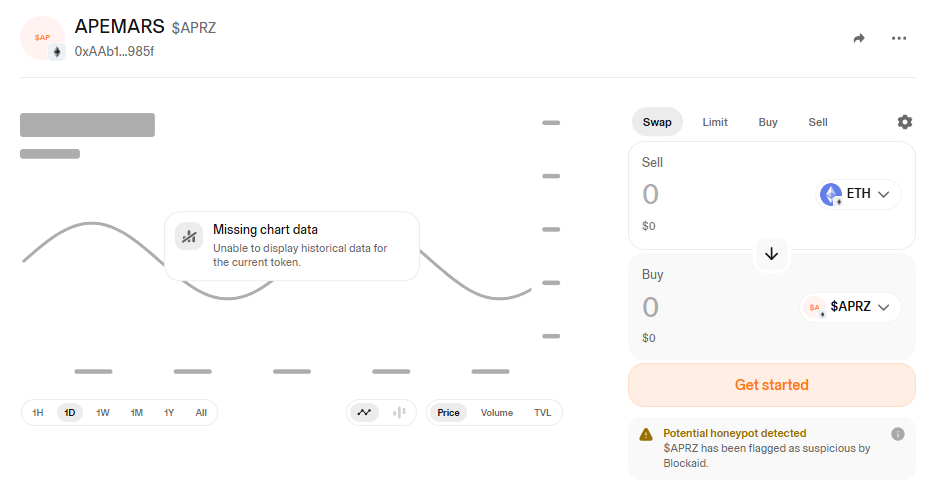
As of June 15, 2026, the official Uniswap interface is displaying two critical alerts. First: "Potential honeypot detected — $APRZ has been flagged as suspicious by Blockaid." Second: "Missing chart data — Unable to display historical data for the current token." Both warnings are visible on the live Uniswap token page. The ApeMars honeypot is now the most important development since the June 7 crash.
 Source: ApeMars Uniswap listing
What the Blockaid Honeypot Flag on APRZ Actually Means
Blockaid is a Web3 security firm that scans token contracts in real time and flags suspicious patterns directly inside Uniswap's interface. When Blockaid flags a token as a "potential honeypot," it means the contract has triggered at least one pattern that matches known honeypot behaviour — where buyers can purchase tokens but cannot sell them.
This flag appears in orange directly on the Uniswap swap interface and is visible to every user who visits the APRZ token page. It does not require any action by the user to appear — it fires automatically based on Blockaid's contract analysis.
What a honeypot flag means in plain English: A honeypot is a token contract designed to trap buyers. You can buy the token. You cannot sell it. Your ETH goes in — and cannot come back out. Blockaid's flag means the APRZ contract has triggered a pattern matching this behaviour.
The critical comparison: DeepSnitch received an identical Blockaid honeypot at launch — later confirmed as a false positive caused by the project's own anti-dump code. Blockaid removed the flag entirely on April 19, 2026. This is the only precedent where a Blockaid honeypot flag on a similar presale token was confirmed as a false positive and removed. The key difference: the DeepSnitch team immediately communicated, explained the cause, and delivered a working product within 10 days. The ApeMars team has made zero statements since June 7 — the X account remains suspended, no Telegram admin has explained anything, and no official team member has addressed the Blockaid flag.
The SolidProof audit conflict: The earlier SolidProof audit confirmed no critical issues on the APRZ contract — no mint function, no blacklist, no drain capability, renounced ownership. That audit result has not changed. But the Blockaid is a live, real-time scan based on current contract interaction patterns — not a point-in-time audit. Both can be true simultaneously: the contract may be structurally clean by audit standards while triggering Blockaid's pattern-matching for honeypot behaviour based on how it responds to simulated sell transactions.
The honest read: the ApeMars honeypot is either a false positive from anti-dump code — as happened with DeepSnitch — or it reflects actual sell restriction behaviour in the contract. Without a team statement, neither can be confirmed or ruled out.
Missing Chart Data: What Uniswap Is Showing Right Now
The second warning on the Uniswap interface is equally significant: "Missing chart data — Unable to display historical data for the current token."
This message appears when Uniswap's data infrastructure cannot retrieve price history for the token. Three causes explain this:
Near-zero liquidity: With approximately $1.4K in liquidity remaining as of June 9, 2026 — and potentially lower since then — the APRZ/WETH pair may have reached a point where Uniswap's data layer cannot construct meaningful price history from the available transaction record.
Pool inactivity: If the APRZ/WETH pool has had no transactions for an extended period, Uniswap's chart system stops updating and eventually shows missing data. DexScreener showed $0 in 24-hour volume on Bitget as of June 12 — indicating effectively zero trading activity.
Data indexing gap: Uniswap's interface occasionally fails to display chart data for tokens where the contract has been flagged by security tools — the honeypot and the missing chart data may be connected responses from the same underlying security layer.
What this means for holders practically: there is currently no visible price chart for APRZ on Uniswap's own interface. Any holder trying to trade APRZ through Uniswap sees a security warning before they can proceed, a blank chart, and a swap interface showing $0 on both sides.
What Every APRZ Holder Must Do Right Now
The ApeMars honeypot changes the risk profile for every holder considering any wallet interaction with the APRZ contract.
If you have not yet claimed your tokens through apemars.com:
Do not rush to claim because of this flag. The claim contract at 0xaab17f1fccea5be51f6e2a5254927e06b06a985f is separate from the trading behaviour Blockaid flags. The SolidProof audit confirmed renounced ownership and no drain capability. The claim portal is a token transfer TO your wallet — not a contract approval that gives external access to your holdings. However, calculate your gas fee ($5–$30 on Ethereum) against the current token value before confirming any transaction. At near-zero liquidity, claimed tokens may be impossible to sell.
If you already hold APRZ in your wallet:
Do not attempt to sell through Uniswap until the Blockaid flag is either confirmed as a false positive and removed, or the team publishes a verified explanation of the contract behaviour triggering the flag. Attempting to sell a honeypot-flagged token where sell transactions are restricted results in losing gas fees without completing the transaction.
Do not interact with any recovery offers:
Any message asking you to send ETH to "recover" your tokens is a secondary scam. Do not engage. Phishing sites targeting ApeMars holders appeared within hours of the crash. The Blockaid flag will trigger a new wave of fake "resolution services" and fake team accounts offering to "remove the flag" for a fee. No legitimate service asks for ETH to clear a security flag.
Three things to watch that could change this picture:
A Blockaid statement confirming the flag as a false positive — this is exactly what saved DeepSnitch
An official team statement explaining the contract behaviour
A transaction on Etherscan showing the team adding liquidity to the APRZ/WETH pair
Conclusion
The ApeMars honeypot from Blockaid on Uniswap is the most serious development in the APRZ story since the June 7 crash. It may be a false positive — as it was for DeepSnitch — or it may confirm sell restrictions in the contract. Without a team statement, both possibilities remain open. Do not attempt to trade APRZ through Uniswap while the flag is active. Do not send ETH to any recovery service. Watch Etherscan, apemars.com, and Blockaid's official channels for a resolution statement.
YMYL Disclaimer
This article is for informational purposes only and does not constitute financial or investment advice. Crypto presales are high-risk and readers should verify all information independently before making any financial decision.










