Australia Crypto Travel Rule Live: Every Transfer Tracked Now

Australia Crypto Travel Rule: No Minimum Threshold Explained
A $5 transfer now carries the same identity reporting weight as a $50,000 one.
The Australia crypto travel rule went live today, July 1, 2026 — the most significant change to how regulated exchanges handle digital asset transfers since the country introduced anti-money laundering rules for digital currency providers back in 2018. From this moment forward, every regulated crypto exchange operating in Australia must collect, verify, and transmit sender and recipient identity data on every incoming and outgoing transfer, with no minimum threshold attached to the requirement.
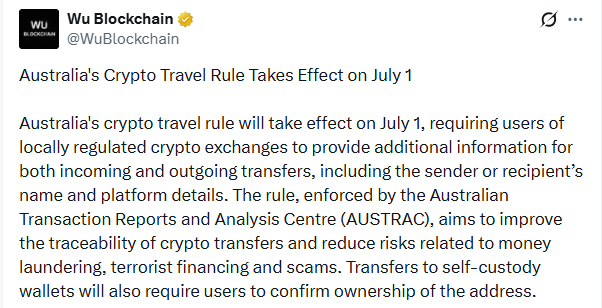 Source: X(formerly Twitter)
That last detail is what makes this different from comparable rules in the United States, which only applies reporting obligations to transfers from $3,000 and above.
Australia Crypto Travel Rule: What Changed on July 1
The Australia crypto travel rule is the final phase of an anti-money laundering and counter-terrorism financing framework overhaul that Parliament passed in November 2024. Most reforms under that package came into force in March 2026 — but transfer obligations for virtual assets were deferred under transitional rules until today's July 1 start date.
The law is enforced by AUSTRAC — the Australian Transaction Reports and Analysis Centre, the country's financial intelligence agency. AUSTRAC has already been supervising 27 local crypto exchanges and has flagged the sector as high-risk for money laundering, citing more than $5 billion in crypto-related scam losses reported annually in the region. Last year alone, the agency received more than 2 million threshold transaction reports and over 450,000 suspicious matter reports across its reporting entities — figures expected to rise now that more businesses fall under the framework.
The law applies to a specific set of businesses: crypto-to-fiat exchanges, crypto-to-crypto exchanges, custody services, transfer services, and certain services connected to token issuances — any platform with a connection to Australia that touches these activities. Individual users sending digital asset directly between two private wallets they control, with no regulated exchange in the transfer chain, are generally outside the rule's scope.
Australia Crypto Travel Rule: No Minimum Threshold Explained
The no-minimum-threshold element of the crypto travel rule is the detail generating the most community discussion.
The Financial Action Task Force — the global financial crime watchdog — extended its travel law to cryptocurrencies in 2019, and countries including the United States, the United Kingdom, Singapore, and New Zealand implemented the standard years before Australia. But Australia's version stands out even among those adopters: the country joins France, the Netherlands, and Japan in applying the law without any transaction floor. A transfer of $5 triggers the exact same data collection requirement as a transfer of $50,000.
Under the rule, exchanges classified as ordering institutions must collect and verify payer information — name, account details, and wallet information — before processing any covered transfer. They must also gather payee and tracing information. Where a transfer goes to a self-hosted wallet rather than another exchange account, the rules adjust slightly but don't disappear. The ordering institution must determine whether the destination wallet is custodial or self-hosted, and collect relevant customer information before the transaction proceeds. AUSTRAC has deferred formal reporting requirements on unverified self-hosted wallets until March 2029, giving the sector time to build the infrastructure needed for that next phase.
Some platforms moved ahead of today's deadline. Kraken and CoinJar began applying additional verification requirements for Australian clients on transfers to private wallets from as early as March 31, 2026. That early implementation signals how seriously large exchanges are approaching the new compliance environment — and serves as a practical preview of what all Australian exchange users encounter from today onward.
Australia Crypto Travel Rule: What Users Must Do Now
For the roughly 31% of Australian adults who held digital asset in 2025, the practical experience of the Australia crypto travel rule shows up directly when sending or receiving through a regulated exchange.
Sending digital asset to another exchange account involves providing more transfer details upfront — sender name, account information, and platform details. Sending digital asset to a personal hardware wallet or non-custodial app prompts a confirmation that the user controls the destination address. Head of fraud and financial crime at exchange Swyftx described the practical impact: "The additional steps mainly come into force for transfers that involve another party or another exchange." For straightforward exchange-to-personal-wallet moves, the process is closer to a quick ownership confirmation than a formal reporting event.
Self-custody wallets themselves remain fully permitted. Nothing in the Australia travel rule prohibits Australians from holding Bitcoin or other assets in hardware wallets or non-custodial apps. The rule governs what regulated exchanges must do when those assets move through their platforms — not what individuals do with their own wallets in isolation.
ASIC, the corporate and markets regulator, extended its temporary licensing relief for digital asset businesses until September 30, 2026, giving platforms more time to complete full financial services licensing applications under the broader framework moving through Parliament. A Senate committee has separately endorsed a bill to bring exchanges and tokenized custody platforms under the country's financial services licensing regime — extending well beyond what the travel rule covers on its own.
The Australia crypto travel rule aligns the country with EU, Singapore, and Japan standards. Whether tighter compliance normalizes identity data across borders or drives users further into self-custody without triggering the law becomes the next measurable signal for regulators to watch.
Conclusion
The Australia crypto travel rule is live. Zero minimum threshold, every transfer tracked, and AUSTRAC enforcing it across 27 supervised exchanges. Self-custody remains permitted. But every movement through a regulated platform now carries identity data along with it. The next major milestone is March 2029 — when reporting on unverified self-hosted wallets begins. Today is only the starting line.
YMYL Disclaimer
This article is for informational and educational purposes only. It does not constitute legal, financial, or compliance advice. All details regarding the Australia travel rule are based on publicly available AUSTRAC guidance and regulatory reporting as of July 1, 2026. Individual compliance obligations may vary depending on the nature of the business or activity. Always consult a licensed legal or compliance adviser before making decisions about digital asset transfers, exchange operations, or self-custody arrangements in Australia.


1 month ago
I have been a crab fisherman for 40 years. I started working at a local fish plant a few years ago. I love playing lotto bets, so I buy lotto tickets often but find it difficult to win. I read about Lord Bubuza's lottery spells on the internet, so I contacted him for help to win Lotto 649. He told me that he would need to cast a lotto spell so that he can reveal the lotto numbers I will choose. I was sceptical, but my wife Nancy told me to give it a try. I provided his requirements to cast the lotto spells, and he gave me the numbers. I bought a Lotto 649 ticket and played as Lord Bubuza instructed, to my surprise it was a big win. I won $64,000,000. My partner Nancy and I travelled to the Atlantic Lottery in Moncton to confirm the win and collect the prize. I will retire from my crab fishing with this win and continue to recommend lord Bubuza. Join me and appreciate Lord Bubuza for his help via Email: lordbubuzamiraclework@hotmail.com or WhatsApp: +1 (365) 808 5313 ...!!!

1 month ago
I have been a crab fisherman for 40 years. I started working at a local fish plant a few years ago. I love playing lotto bets, so I buy lotto tickets often but find it difficult to win. I read about Lord Bubuza's lottery spells on the internet, so I contacted him for help to win Lotto 649. He told me that he would need to cast a lotto spell so that he can reveal the lotto numbers I will choose. I was sceptical, but my wife Nancy told me to give it a try. I provided his requirements to cast the lotto spells, and he gave me the numbers. I bought a Lotto 649 ticket and played as Lord Bubuza instructed, to my surprise it was a big win. I won $64,000,000. My partner Nancy and I travelled to the Atlantic Lottery in Moncton to confirm the win and collect the prize. I will retire from my crab fishing with this win and continue to recommend lord Bubuza. Join me and appreciate Lord Bubuza for his help via Email: lordbubuzamiraclework@hotmail.com or WhatsApp: +1 (365) 808 5313
1 month ago
I have been a crab fisherman for 40 years. I started working at a local fish plant a few years ago. I love playing lotto bets, so I buy lotto tickets often but find it difficult to win. I read about Lord Bubuza's lottery spells on the internet, so I contacted him for help to win Lotto 649. He told me that he would need to cast a lotto spell so that he can reveal the lotto numbers I will choose. I was sceptical, but my wife Nancy told me to give it a try. I provided his requirements to cast the lotto spells, and he gave me the numbers. I bought a Lotto 649 ticket and played as Lord Bubuza instructed, to my surprise it was a big win. I won $64,000,000. My partner Nancy and I travelled to the Atlantic Lottery in Moncton to confirm the win and collect the prize. I will retire from my crab fishing with this win and continue to recommend lord Bubuza. Join me and appreciate Lord Bubuza for his help via Email: lordbubuzamiraclework@hotmail.com or WhatsApp: +1 (365) 808 5313
1 month ago
I have been a crab fisherman for 40 years. I started working at a local fish plant a few years ago. I love playing lotto bets, so I buy lotto tickets often but find it difficult to win. I read about Lord Bubuza's lottery spells on the internet, so I contacted him for help to win Lotto 649. He told me that he would need to cast a lotto spell so that he can reveal the lotto numbers I will choose. I was sceptical, but my wife Nancy told me to give it a try. I provided his requirements to cast the lotto spells, and he gave me the numbers. I bought a Lotto 649 ticket and played as Lord Bubuza instructed, to my surprise it was a big win. I won $64,000,000. My partner Nancy and I travelled to the Atlantic Lottery in Moncton to confirm the win and collect the prize. I will retire from my crab fishing with this win and continue to recommend lord Bubuza. Join me and appreciate Lord Bubuza for his help via Email: lordbubuzamiraclework@hotmail.com or WhatsApp: +1 (365) 808 5313
1 month ago
I have been a crab fisherman for 40 years. I started working at a local fish plant a few years ago. I love playing lotto bets, so I buy lotto tickets often but find it difficult to win. I read about Lord Bubuza's lottery spells on the internet, so I contacted him for help to win Lotto 649. He told me that he would need to cast a lotto spell so that he can reveal the lotto numbers I will choose. I was sceptical, but my wife Nancy told me to give it a try. I provided his requirements to cast the lotto spells, and he gave me the numbers. I bought a Lotto 649 ticket and played as Lord Bubuza instructed, to my surprise it was a big win. I won $64,000,000. My partner Nancy and I travelled to the Atlantic Lottery in Moncton to confirm the win and collect the prize. I will retire from my crab fishing with this win and continue to recommend lord Bubuza. Join me and appreciate Lord Bubuza for his help via Email: lordbubuzamiraclework@hotmail.com or WhatsApp: +1 (365) 808 5313
2 months ago
In an industry often marked by deception and unreliable operators, TechY Force Cyber Retrieval stands out for its integrity, credibility, and expertise. Unlike dubious services that prey on victims twice by offering hollow assurances, TechY Force Cyber Retrieval distinguishes itself through transparency, diligence, and consistently proven results. Their commitment to ethical standards is unwavering. They never issue inflated guarantees, nor do they demand upfront payments from already distressed clients. Instead, they operate on a results-based fee structure, meaning clients pay only when tangible progress or a successful recovery is achieved. This model reflects both their technical confidence and genuine concern for the individuals they serve. TechY Force Cyber Retrieval comprises legal analysts, blockchain investigators, and cybersecurity professionals who bring comprehensive insight into complex digital fraud cases. Whether handling phishing exploits, exchange security breaches, or sophisticated wallet tracing, the firm addresses each scenario with analytical precision and methodical rigor. They use cutting-edge forensic tools to trace transactions across decentralized ledgers and often collaborate with financial institutions or law enforcement agencies as needed. TechY Force Cyber Retrieval is well-versed in global regulatory frameworks, ensuring each recovery process aligns with legal protocols. Their ability to navigate cross-border compliance and data privacy issues equips them to handle cases that span multiple jurisdictions. Clients benefit from a clear legal strategy and a thorough technical investigation focused on asset recovery and long-term resolution. What truly sets them apart is their client-centric approach. Every case is assigned a dedicated recovery advisor who maintains clear communication throughout the entire process. Clients receive actionable updates, strategic explanations, and post-recovery advice to strengthen their digital security. This educational aspect empowers individuals to recognize and avoid future threats in the volatile crypto landscape. In today’s economy, where cybercriminals can erase years of investment in seconds, and blockchain anonymity complicates enforcement, TechY Force Cyber Retrieval offers clarity and control. Their evidence-based approach, proven results, and principled values make them the preferred choice for victims of crypto-related fraud. For those seeking a dependable, transparent, and competent partner in the pursuit of lost digital assets, TechY Force Cyber Retrieval stands as the gold standard in cryptocurrency recovery. WhatsApp +.1.5.6.1.7.2.6.3.6.9.7 Mail. support@techyforcecyberretrievals.com Telegram. @Techcyberforc Website. https://techyforcecyberretrievals.com
2 months ago
The Truth About Bitcoin Recovery Services HIRE META TECH RECOVERY PRO After a devastating hack that depleted my USDT holdings totaling $550,000, I felt powerless and uncertain whether I would ever recover my funds. The attackers had obtained unauthorized access, then transferred my assets across multiple wallets, obscuring the transaction trail and making recovery appear impossible. The whole scenario changed when I contacted MetaTech Recovery Pro, a team of digital asset recovery specialists. Leveraging advanced blockchain analytics, coordinated legal support, and deep technical expertise, they conducted a thorough investigation of the stolen funds. They traced the transfers with precision, identified the fraudulent wallets involved, and ultimately recovered my entire account. Due to their professionalism, attention to detail, and persistent effort, my $550,000 USDT was fully restored. What initially seemed destined to become a complete loss instead became a testament to effective expertise, diligence, and successful recovery. I highly recommend MetaTech Recovery Pro, as they are the most trusted and reliable digital asset recovery team available. Reach out to them via - Telegram:@metatechrecoveryproteam - - W/S https://wa.link/5ay4fv - - Metatech@Writeme.Com - - https://metatechrecoverypro.com - - support@metatechrecoverypro.com -
2 months ago
The Truth About Bitcoin Recovery Services HIRE META TECH RECOVERY PRO After a devastating hack that depleted my USDT holdings totaling $550,000, I felt powerless and uncertain whether I would ever recover my funds. The attackers had obtained unauthorized access, then transferred my assets across multiple wallets, obscuring the transaction trail and making recovery appear impossible. The whole scenario changed when I contacted MetaTech Recovery Pro, a team of digital asset recovery specialists. Leveraging advanced blockchain analytics, coordinated legal support, and deep technical expertise, they conducted a thorough investigation of the stolen funds. They traced the transfers with precision, identified the fraudulent wallets involved, and ultimately recovered my entire account. Due to their professionalism, attention to detail, and persistent effort, my $550,000 USDT was fully restored. What initially seemed destined to become a complete loss instead became a testament to effective expertise, diligence, and successful recovery. I highly recommend MetaTech Recovery Pro, as they are the most trusted and reliable digital asset recovery team available. Reach out to them via - Telegram:@metatechrecoveryproteam - - W/S https://wa.link/5ay4fv - - Metatech@Writeme.Com - - https://metatechrecoverypro.com - - support@metatechrecoverypro.com -
2 months ago
Trusted Cryptocurrency Recovery Specialists.. CYBER VAULT GUARD As cryptocurrency continues to shape the future of finance, cybercriminals are becoming more sophisticated than ever. From investment scams and wallet compromises to phishing attacks and unauthorized transactions, thousands of individuals lose access to their digital assets every day. At CYBER VAULT GUARD, we specialize in cryptocurrency investigations and recovery support. Our experienced team uses advanced blockchain forensic tools and investigative techniques to trace digital asset movements, analyze transaction histories, and uncover critical evidence. How We Help 1. Comprehensive Case Review Our recovery experts carefully examine wallet addresses, transaction records, and supporting evidence to understand the nature of the loss. 2. Blockchain Forensics Using advanced tracing technology, we follow transaction paths across blockchain networks to identify key leads and patterns. 3. Recovery Strategy Development Based on our findings, we develop a tailored recovery approach and provide clients with a clear understanding of their available options. 4. Ongoing Expert Support Our specialists keep clients informed throughout the investigation process, providing professional guidance every step of the way. Why Choose CYBER VAULT GUARD? Experienced Cryptocurrency Recovery Specialists Advanced Blockchain Investigation Techniques Professional and Confidential Case Handling Dedicated Client Support Get Started Today If you have lost cryptocurrency to a scam, hack, or fraudulent scheme, contact CYBER VAULT GUARD for a confidential case assessment. Email: cybervaultguard(@)aol(.)com WhatsApp: +44 7.4.0.1 7.7.1.4.5.5 Telegram: @cybervaultguard
2 months ago
CONTACT 24/7 SUPPORT HELP Mail support@techyforcecyberretrievals.com WhatsApp +.1.5.6.1.7.2.6.3.6.9.7 Telegram +.1.5.6.1.7.2.6.3.6.9.7 On May 4, 2026, which marked Independence Day, my longtime friend came to visit. As we sat together reflecting on recent events, I opened up about a major financial misstep that had been haunting me. That is when he mentioned TechY Force Cyber Retrieval and explained how they had assisted someone close to him in recovering stolen cryptocurrency. I was hesitant but also desperate for hope. Just a few weeks earlier, I had come across what appeared to be a legitimate opportunity on Telegram. A bot claimed to offer student loan conversion into interest-free crypto loans. The timing felt perfect. I was burdened by debt and eager for any form of relief. Everything seemed polished, from digital forms and fake legal documents to fabricated success stories. Without thinking twice, I sent 35,000 dollars in ETH as a so-called processing fee to initiate the transaction. The moment the funds left my wallet, everything changed. The bot went silent, the Telegram group disappeared, and I was left staring at my screen in disbelief. I had been manipulated and robbed. I reported the scam to the police and reached out to various crypto platforms but was told there was little they could do. The consensus was that crypto recovery was nearly impossible. I felt powerless. At my friend’s urging, I contacted TechY Force Cyber Retrieval. They replied within hours. Their team was patient, thorough, and highly knowledgeable. They asked for transaction details and blockchain records and began a full-scale investigation. Within days, they traced the ETH to several wallets and discovered that the final destination was an account on KuCoin.Through direct collaboration with the exchange, TechY Force Cyber Retrieval halted the movement of funds. After verifying my claim, they successfully recovered 31 800 dollars from the compromised account. That amounted to around 87 percent of my original loss and felt nothing short of miraculous. What truly impressed me was not just the recovery but the education they provided. They explained how these scams operate, why they succeed, and how I could protect myself moving forward. If you have lost crypto to a scam, do not give up. TechY Force Cyber Retrieval helped me reclaim what I thought was gone forever.












