Binance News: Binance Agent OS and MCP Server Launch

Binance News: Agent OS Brings AI Tools Under One Platform
Binance announced the launch of Agent OS on August 20, 2026, marking one of the biggest pieces of Crypto news today and a major News highlight this week for developers and traders exploring AI-driven crypto tools.
As of August 20, 2026, 10:40 UTC, the official announcement confirms that Agent OS combines the API, Binance Wallet Agentic Hub, x402, Skill Hub, and Model Context Protocol (MCP) support into one connected platform.
Alongside this, introduced the Binance MCP Server, giving compatible AI applications a standardized way to access liquidity and tools without users needing to manage API keys manually.
What Is Binance Agent OS?
According to the Binance announcement, Agent OS is a developer platform built as part of Intelligence. It is designed to reduce fragmented, one-off integrations by giving developers a single, discoverable toolkit.
Component | What It Does |
API | Programmatic access to trading, market, wallet, and on-chain features |
Wallet Agentic Hub | Wallet functions built for agent-driven interactions |
x402 | Payment and settlement primitives for agent-driven flows |
Skill Hub and Wallet Agentic Hub | Modular capabilities across market data, wallets, trading |
MCP Server | Standardized connector layer for compatible AI agents |
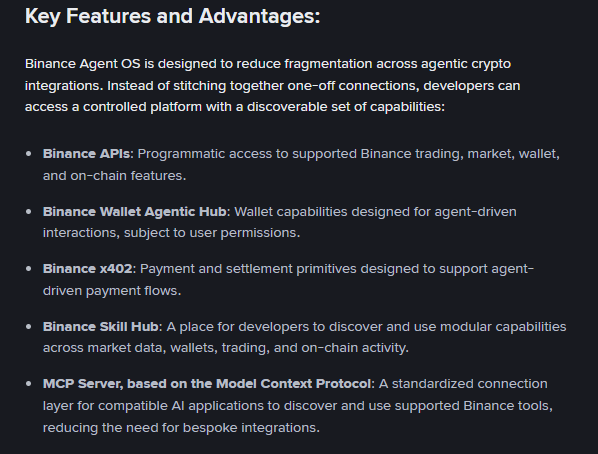
This structure is central to the Agent OS launch news, since it shifts from scattered agent tools toward one coherent ecosystem for agentic AI crypto tools.
Binance MCP Server Explained
The MCP Server is the standout piece of this rollout. MCP, or the Model Context Protocol, is an open standard that lets AI applications connect to external tools in a uniform way.
Per the official filing, the MCP Server allows Claude, Claude Code, Codex, ChatGPT, and VS Code to connect through a single MCP endpoint instead of requiring separate, custom-built connections for each tool.
This directly enables:
AI agent trading news-worthy capability: agents can place trades once authorized
Claude Code integration and ChatGPT MCP connection through the same open endpoint
Market data access (tickers, order books, candlesticks, funding rates) with no authentication required
Binance's own developer documentation lays out the full setup path for teams building on top of this Model Context Protocol server.
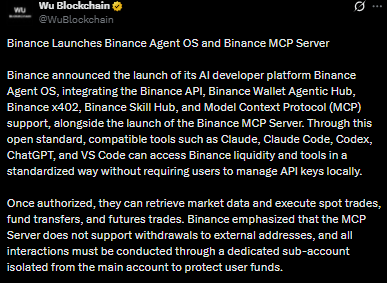
WuBlockchain also covered the launch in their recent Binance News updates, highlighting Agent OS, the MCP Server’s AI integrations, trading capabilities, and the security restrictions around sub-account access.
What Can an AI Agent Actually Do?
Once a user grants authorization, scopes define what the can access. Based on the official disclosure, permitted actions include:
Reading market data with no login required
Viewing Agentic sub-account balances, positions, and bills
Executing Spot, Margin, Convert, USD-M Futures, and COIN-M Futures actions, depending on granted scopes
Transferring funds only within the user's own Agentic sub-account, such as Spot to USD-M
This is what positions the update as genuine AI trading platform launch news—making waves across broader Crypto news rather than a simple feature tweak, since it touches live trading and fund movement, not just data retrieval.
Safety Limits Has Confirmed
Binance was explicit about the guardrails placed on this system, which matters for any sub-account AI trading news angle:
No withdrawal scope exists; agents cannot move funds to external addresses.
All activity must run through a dedicated Agentic sub-account, isolated from the main account.
The cannot pull funds from the main account into the Agentic sub-account; users must fund it manually.
Order and transfer actions still require the user to review details before confirming.
This sub-account fund isolation model is Binance's core answer to the security risk of letting AI agents touch real trading and transfer functions.
Why This Matters Now
In this latest piece of Binance News, the exchange framed this as infrastructure for what it called the next phase of an internet shaped by agents that can search, coordinate, and transact on a user's behalf.
For a crypto AI developer platform, tying the API integration layer to an open standard like MCP could cut integration work for developers while giving users a more seamless, permissioned way to reach liquidity and AI-powered spot and futures trading tools through agents they already use daily.
Whether this leads to wider crypto exchange AI automation across other exchanges remains to be seen, and adoption will depend on how developers and traders respond to OS features in 2026 in the coming weeks.
Disclaimer: This Binance News report is based solely on official announcement and developer documentation. Details may be updated by without prior notice; readers should check the original source for the latest version.
Also read:









