Bitcoin News: Zcash Founder Questions BTC's 21M Supply Cap


Bitcoin News Today: BTC New Supply Policy and Impact Details
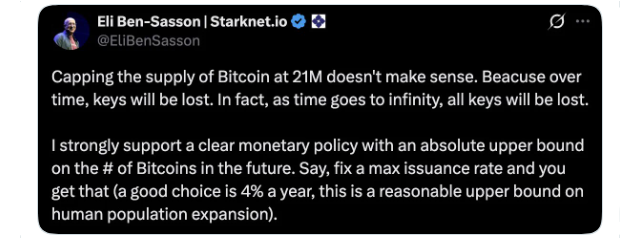
A fresh debate hit Bitcoin News this week after Zcash co-founder Eli Ben-Sasson questioned the logic behind Bitcoin's fixed 21 million supply cap. He shared his view on X, and BTC News feeds picked it up fast.
Source: X Official
The question he posed raises some concerns on the golden asset’s structure.
Is a supply change even possible on a network built around immutability? And if it happened, would it help BTC total supply stay useful, or would it break the trust that built Bitcoin's price in the first place?
Eli Ben-Sasson's Statement Raises a Big Question on Bitcoin total Supply
Zcash Founder, Ben-Sasson posted online that capping Bitcoin at 21 million "doesn't make sense" because private keys get lost every year. Over infinite time, he said, all keys eventually disappear, leaving no usable coins at all.
Ben-Sasson didn't ask for unlimited coin printing. He said he still backs a monetary policy with a clear, absolute upper bound on future BTC supply. His disagreement sits with how that bound gets defined, not whether one should exist.
He wants a fixed maximum issuance rate instead of a fixed total number. His reasoning rests on two points: lost coins and long-term miner income.
Estimates from Ledger data put lost BTC between 2.3 million and 3.7 million coins, or roughly 11% to 20% of everything mined.
Miners lose block reward income entirely once BTC halvings finish near the year 2140, leaving only transaction fees to fund network security.
The Method for a New Bitcoin Supply Policy
Ben-Sasson's plan swaps a capped total stock for a capped yearly flow of new coins. Here's the method in short:
Set a fixed maximum issuance rate, with 4% per year as his suggested figure.
Tie that rate loosely to human population growth.
Use new issuance to replace coins lost to forgotten keys or dead wallets.
Apply the change through a hard fork, since it rewrites BTC's core consensus rules.
Keep some room for lower rates, like 1% or 2%, as alternatives floated in discussions.
Bitcoin Ecosystem: How This Would Change the BTC coin Original Purpose and Design
Bitcoin's entire identity rests on scarcity. The 21 million ceiling gives it a "digital gold" reputation, and that fixed number drove adoption among investors who wanted an asset outside central bank control.
Switching to a percentage-based issuance model changes that story. BTC price and Market Cap have both grown around the promise of a hard stop on new coins, and any shift toward ongoing inflation, even a small one, moves BTC closer to how central banks manage currency supply.
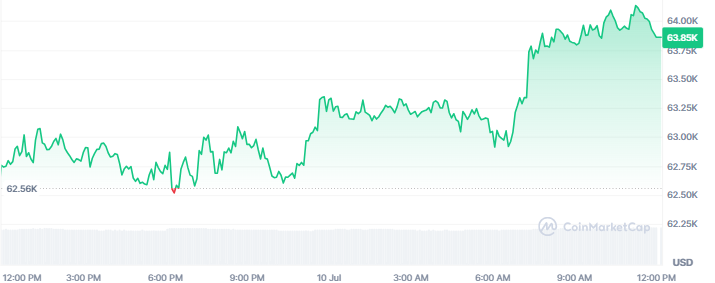
Bitcoin price today stands near $63,870, up 1.81% with the daily volume of 28.43 billion. The price recently gained above the $63K mark after falling near the $61K range on US-Iran Tension.
Source: CoinMarketCap Official
Supporters point to a possible upside though. A steady 4% issuance could offset lost coins and give miners lasting income after 2140, keeping network security strong for the long run.
Is Changing Fixed Total Supply Possible in Crypto World
Crypto Tokens Took Similar Paths, and Their Outcomes
Ethereum removed its hard cap and later added a burn feature through EIP-1559. This has made ETH deflationary during high network activity at times, and it still holds a strong Market Cap ranking among top assets.
Dogecoin runs on infinite supply, adding close to 5 billion new coins each year. It gained popularity through community support and tipping culture, but critics say its price moves depend more on hype than on any real scarcity story.
Bitcoin Cash forked away in 2017 over a block size dispute and kept a matching 21 million cap. Even with the same cap as BTC, it trails badly in adoption and mining power, showing forks often struggle to match the original chain.
Community Reaction: A Split Perspective on the Idea
Bitcoin developers and holders, including Blockstream's Adam Back, rejected the proposal outright, and many compared it to fiat-style monetary policy. Several questioned Ben-Sasson's motives given his ties to Starknet and Zcash.
A smaller group saw merit in the discussion, especially around miner income after 2140. Their view treats this as a fair question about long-term security, separate from any short-term BTC coin price impact.
Could Bitcoin Supply Change Possible, and What Would It Take?
Changing BTC 21 Million supply would require a hard fork, meaning Bitcoin's core code and consensus rules get rewritten. That process needs agreement from node operators, miners, and the wider user base, not just developers.
History shows this kind of disagreement usually ends in a chain split rather than full consensus, as seen with Bitcoin Cash in 2017. Given how central the fixed cap sits to Bitcoin's price and reputation, most signs point toward this idea staying a talking point rather than turning into an actual Bitcoin supply increase anytime soon.
Disclaimer: This article is for informational purposes only and does not constitute financial or investment advice. Crypto markets carry significant risk. Always do your own research before making any investment decisions.
Also read:









