Bitcoin News Today: Louisiana Pension Fund Grows Indirect BTC Exposure


In today's Bitcoin News, spot BTC ETFs in the US pulled in about $68.99 million on July 22. That marks seven straight days of net inflows.
This is the longest run of steady buying since mid-June. It points to growing interest from big investors.
Which BTC ETF got the most money on July 22?
As per SoSoValue data, BlackRock's IBIT led the pack again. It brought in $38.8 million in new money.
Fidelity's FBTC came in second with $21.5 million. Bitwise's BITB added $5.4 million.
Morgan Stanley's new MSBT fund, still fresh to the market, pulled in $3.8 million.
Fund | Net Flow (July 22) |
IBIT (BlackRock) | +$38.8 million |
FBTC (Fidelity) | +$21.5 million |
BITB (Bitwise) | +$5.4 million |
MSBT (Morgan Stanley) | +$3.8 million |
GBTC (Grayscale) | -$38.3 million |
BTC Mini Trust (Grayscale) | +$37.9 million |
Grayscale's older GBTC fund lost $38.3 million. But its cheaper Mini Trust option gained almost the same amount, $37.9M.
This shows people are moving out of the pricier fund and into the low-fee version instead.
Why is a state pension fund buying Strategy stock?
The Louisiana State Employees' Retirement System, known as LASERS, has added to its stake in Strategy. This gives the pension fund indirect exposure to Bitcoin.
A filing covering holdings through June 30 shows LASERS held 21,300 Strategy shares. That is up from 20,600 shares at the end of March, a rise of 3.4%.
The position was worth about $1.85M at quarter-end. BitcoinTreasuries.NET later valued it near $2.13 million in a July 22 post.
BitcoinTreasuries.NET summed it up simply, saying government workers are gaining BTC exposure through the move.
It is worth noting LASERS does not hold Bitcoin directly. It owns shares of Strategy, a company whose balance sheet holds the largest corporate Bitcoin stockpile around.
LASERS manages 24 retirement plans covering more than 150,000 members. This Strategy stake is a small piece of a much bigger fund, reported at $16.3 billion in assets as of August 2025, and $17.2 billion at fiscal year-end June 30, 2025.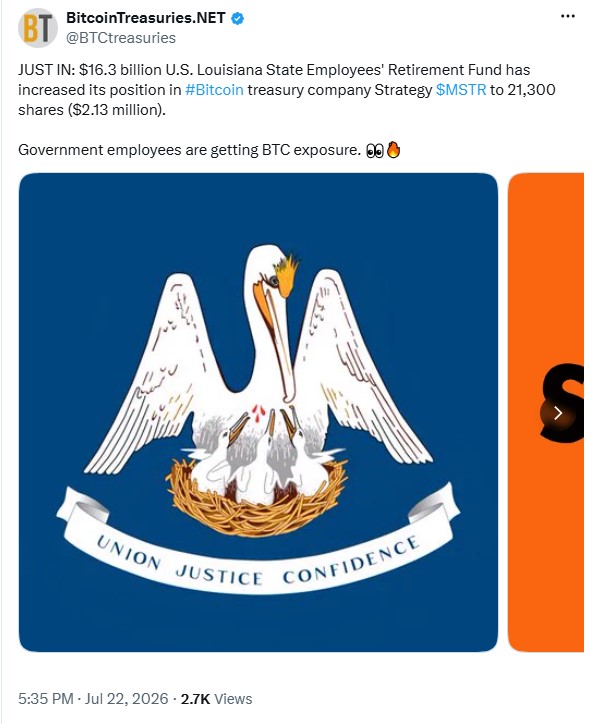
What is Strategy's current Bitcoin holding?
Strategy currently holds 843,775 BTC. That number has stayed the same through July 19.
During this time, the company raised another $263.5 million by selling more MSTR shares. Its cash reserve grew to $3.225 billion as a result.
Earlier this year, Strategy trimmed its Bitcoin stack under a new capital plan. That was a shift from its long history of steady buying.
MSTR stock does not move exactly like Bitcoin's price. Share issuance, debt costs, and how investors view the company's crypto holdings all play a role too.
Are other pension funds looking at crypto?
Yes, and Louisiana is not alone. Japan's National Business Corporate Pension Fund plans to put about 1% of its assets into crypto through a multi-asset fund in fiscal 2026.
In the US, Indiana passed a law letting certain public retirement plans offer at least one crypto-linked investment choice.
Florida lawmakers have floated a bigger idea. Their proposal would let some state-controlled funds, including pension money, put up to 10% into approved Bitcoin products.
Louisiana's approach through Strategy Shares is different from these direct-allocation plans, but it shows the same trend. Public money managers are testing ways to get near Bitcoin without buying it outright.
What this means going forward
Seven days of ETF inflows is a decent streak, though it does not guarantee prices will keep climbing. Markets can turn quickly, and past flows don't predict future ones.
The LASERS move is modest in size next to its full portfolio. Still, it adds to a wider pattern of pension funds inching toward crypto-linked assets through stocks, funds, and new state rules.
Disclaimer
This article is for informational purposes only and should not be considered financial or investment advice. Past performance does not guarantee future results. Always do your own research and consult a licensed financial advisor before making investment decisions.
Also read:
2 months ago
I would strongly love to recommend the services of the best team of dark web hackers. They are professional and very discreet in carrying out their jobs, they have the best customer service agents and satisfaction at heart. If you have any services you wish to contact them for, go on REALCYBERHACKERS @ GMAIL . COM/ Whatsapp +14106350697 They help track and monitor your cheating partner's phone without his idea, clear or erase criminal records as well as repair a bad credit score, all social media hacks,funds recovery and many others.

2 months ago
HOW DO I RECOVER MY LOST CRYPTO FROM A SCAMMER? CONTACT // GEO COORDINATES RECOVERY HACKER There is an expert hacker that can help you in recovering all the money lost to scammers online. GEO COORDINATES RECOVERY HACKER It recently worked for me and I now have peace of mind after the huge recovery of all my lost funds. I’m truly grateful for their service and I recommend their service to everyone who needs to recover their stolen crypto funds. I will advise you to contact them with the details below. Email: geovcoordinateshacker@gmail.com Website; https://geovcoordinateshac.wixsite.com/geo-coordinates-hack Telegram @Geocoordinateshacker
2 months ago
After experiencing issues related to a cryptocurrency and online investment scam, I sought professional assistance. The team responded promptly, explained the recovery process clearly, and maintained consistent communication throughout. WhatsApp: +1 (343) 947-3496 support@mightyhackarrecovery.com https : // mightyhackarrecovery . com /news-articles/ While every case is different and no recovery can be guaranteed, I appreciated their professionalism, transparency, and responsiveness during the process. If you're considering seeking help after becoming the victim of an online scam, be sure to do your own research and carefully evaluate any recovery service before making a decision. It's also important to be aware of well-known investment and cryptocurrency schemes that have been associated with fraud allegations, regulatory enforcement, or Ponzi-style operations. Examples include: BitConnect, OneCoin, MMM, MMM Global, Zeek Rewards, TelexFree, AdSurfDaily, WCM777, Fortune Hi-Tech Marketing, Yilishen Tianxi Group, Ezubao, Fanya Metal Exchange, Mirror Trading International, Africrypt, BTC Global, Menzgold, Gold Coast Fund Management, DKM Diamond Microfinance, MBA Forex, Chinmark Group, Agridime, CryptoFX, HyperFund, HyperVerse, Mining Max, PlusToken, GainBitcoin, SpeakAsia, Saradha Group, Rose Valley Group, PACL Limited (Pearls Agrotech Corporation Limited), Stock Guru India, I Monetary Advisory (IMA), Heera Gold, Royal Twinkle Star Club, City Limouzines, Stock Generation, USI Tech, Juicy Fields, Arbistar, AIDA Marketing, Mining City, OmegaPro, CashFX Group, GSPartners, NovaTech FX, Torque Trading, Banners Broker, Traffic Monsoon, My Big Coin, BitClub Network, Coin.mx, AirBit Club, Meta 1 Coin, Profit Connect Wealth Services, Fortress Real Developments, London Capital & Finance, Blackmore Bond, Basset & Gold, Ethical Forestry, Harlequin Property, Axiom Legal Financing Fund, Brite Advisors, Trio Capital, Storm Financial, Westpoint Corporation, Banksia Securities, Bridgecorp, Ross Asset Management, Blue Chip Group, Hanover Finance, Dominion Finance, Crown Forex, Forex Trend, Panteon Finance, Finiko, Mutual Benefits Corporation, Equity Funding Corporation of America, Towers Financial Corporation, National Heritage Life Insurance Company, Reed Slatkin Investment Club, DBSI Inc., Petters Company Inc., Petters Group Worldwide, Agape World Inc., International Loan Network, Rex Venture Group, Secure Investment, SwissCash, Dunamis Online, Karatbars International, iComTech, Trade Coin Club, WealthBoss, Crypto888 Club, and Beurax. Always verify whether an investment opportunity is registered with the appropriate financial regulator, be cautious of promises of guaranteed or unusually high returns, and remember that legitimate investments carry risk and do not require recruiting others or making rushed decisions.







