Is Bitcoin BIP-110 Actually Failing? Bitcoin News Today Update


Bitcoin News Today: BIP-110 Fallout Leaves the BTC Community Divided
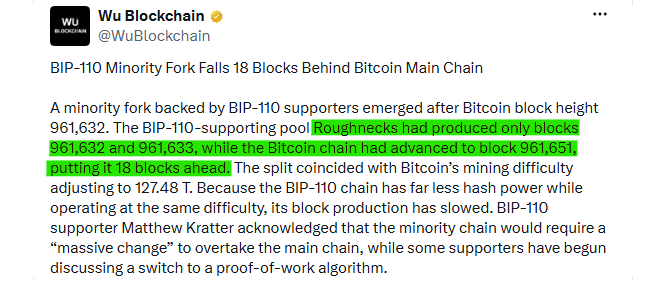
In the biggest Bitcoin news today, a controversial soft fork has been said to have fallen apart. Bitcoin BIP-110 went live at block height 961,632. Its chain mined only two blocks before stalling. Support peaked at 2.53%, far short of the 55% threshold the plan needed to succeed.
Source: Wu Blockchain Official
Even with these numbers, some of the community still support the new fork. So the question in Bitcoin news today is: did BIP-110 already fail, or is it too early to say?
On activation terms alone, the answer is yes, it failed. But the broader terms say more.
Bitcoin News Today: What Is BIP-110 And Why It Was Rejected So Fast
A soft fork is a rule change that tightens what a network will accept, without breaking older software. BIP-110 tried to use that method to block certain types of data from being stored on the blockchain for one year.
This includes images, text, and Ordinals-style inscriptions, which are non-financial files attached to the coin's transactions.
The Knots developer Luke Dashjr led the push for this $BTC network upgrade. Supporters argued that inscriptions clog block space and push transaction fees higher.
To activate, the rule needed 55% of mined blocks to signal approval. It reached only 2.53%, so it never turned on across the main network.
Minority Chain Falls Fifty Seven Blocks Behind The Main Bitcoin Chain
Once the proposal failed to reach its threshold, backers still launched a separate chain anyway. The mining pool Roughnecks produced its first two blocks there. Meanwhile, the main blockchain kept moving at its usual pace.

Within a short window, the gap widened to 57 blocks. Michael Saylor of Strategy noted that roughly 99.85% of $BTC's total hashpower, the combined computing power that secures the network, stayed on the original blockchain. Only a tiny fraction moved to the new branch.
Can The BIP-110 Chain Ever Catch Up To The Mining Difficulty Level?
Difficulty Leaves BIP-110 Chain Nearly A Year Behind Schedule
Bitcoin mining difficulty adjusted to 127.48 trillion right as the split happened, as per CloverPool insight. The new blockchain inherited that same difficulty but almost none of the hashpower to support it.

That mismatch matters for any BTC mining company observing the split. A difficulty adjustment happens every 2,016 blocks. At the current pace of the minority chain, reaching that mark could take close to 350 days.
Fork supporter Matthew Kratter admitted the chain would need a massive shift to catch up. Some backers are now discussing a move to a different proof-of-work algorithm, the method miners use to validate new blocks, which would turn the project into an entirely separate coin rather than a real BTC update.
Bitcoin Price Today Holds Steady While Market Shrugs Off The Fork
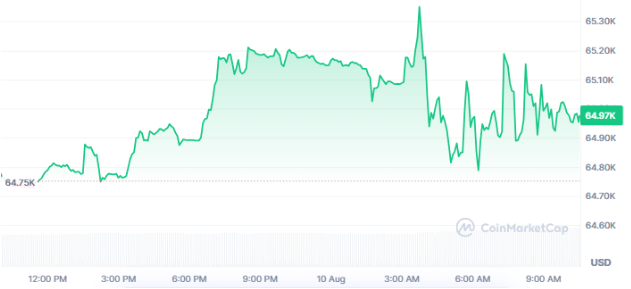
Despite the fork drama, $BTC price today holds towards its key level in $64K, almost reaching to $65K:
Source: CoinMarketCap Official
-
Price: $64,975.20, up 0.33% over 24 hours
-
Market cap: $1.3 trillion
-
24-hour trading volume: $14.33 billion, up 18.79%
-
Circulating supply: 20.06 million BTC
Mining infrastructure company OCEAN also issued a related BTC news update. It said some miners using its templates may have unknowingly directed hashpower to the BIP-110 chain for about 18 hours.
OCEAN confirmed it will send direct $BTC rebates, worth about 0.3 BTC total, to cover the difference. Payments are expected within 72 hours, with transaction details to follow.
What This Means Going Forward
So, has Bitcoin BIP-110 failed? On every measure that counts, activation support, hashpower, block production, price impact, the answer is yes. It technically still exists as a minority chain, but existing and succeeding are not the same thing.
For Bitcoin news today, the bigger takeaway is simple: the main chain kept running exactly as designed. The next serious network change will be decided the same way, through actual mining choices, not announcements.
Glossary
-
Soft Fork: A rule change that tightens network rules while remaining compatible with older software.
-
Block Height: The number identifying a specific block in a blockchain.
-
Hashpower: The computing power miners use to secure $BTC and produce new blocks.
-
Mining Difficulty: A measure of how hard it is for miners to find a valid block.
-
Minority Chain: A blockchain branch supported by only a small portion of the network's mining power.
-
Ordinals: Data and inscriptions attached to individual Bitcoin units, including images, text, and other files.
-
Block Signaling: The process miners use to indicate support for a proposed network rule change.
Disclaimer: This article is for informational purposes only and does not constitute financial or investment advice. Crypto markets carry significant risk. Always do your own research before making any investment decisions.









