CLARITY Act News Today: Senate Faces Final Crypto Vote Deadline 2026


CLARITY Act News: US Senate Races to Pass Crypto Market Structure Bill
Four weeks. That's all the Senate has left before recess, and one senator says there's only one legal route left to get it done. If you're holding digital assets and waiting on regulatory clarity, this window may decide whether that clarity arrives this year or gets pushed into 2027.
Here's what most reports aren't telling you about what's actually stuck, and why the clock matters more than the vote count.
What Happened With Clarity Act News Today
Senator Cynthia Lummis said no regulatory rule can, on its own, hand the CFTC authority over digital asset spot markets, add sanctions powers against U.S. adversaries, or shield developers from unwarranted prosecution. In her view, the CLARITY Act is the only viable path to address these issues.
Her comment landed as Congress returned from the July 4 recess with roughly a month left to move the Digital Asset Market Clarity Act before the August break, which is widely seen as its last realistic shot in 2026.
Why It Matters For Traders And Investors
Right now, crypto oversight sits in a patchwork of agency rules that a future administration can rewrite or unwind. Lummis argues that only an act of Congress can lock in lasting protections, including for developers who build non-custodial software and could otherwise face legal exposure.
For traders, this is the difference between temporary comfort and a durable market structure. Agency rulemaking can plug gaps now, but it won't stop the uncertainty that has kept institutional capital cautious.
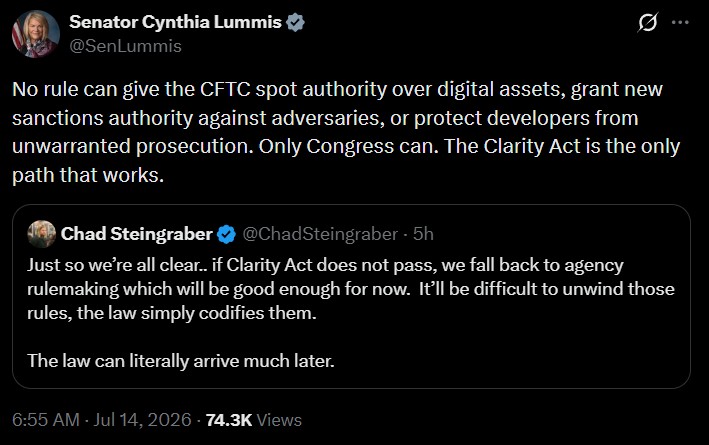
Source: Official X
Key Details Behind The Clarity Act News Today
-
The crypto bill merges Senate Banking and Senate Agriculture Committee versions. It splits oversight so the CFTC handles commodities like Bitcoin, while the SEC handles securities.
-
Updated legislative text was expected this week, following meetings held through the July 4 recess.
-
Two sticking points remain unresolved: the final shape of developer protections tied to the Blockchain Regulatory Certainty Act, and an ethics framework covering officials' crypto holdings, including scrutiny of President Trump's crypto-related earnings.
-
Getting to 60 votes is harder now, with a shrinking Republican conference following the death of Senator Lindsey Graham and Mitch McConnell's continued absence.
-
Galaxy Digital's Alex Thorn has pegged the odds of passage this year at roughly 50%, citing the narrowing calendar and competing priorities like the NDAA.

Source: Wu Blockchain
Industry Split On The Clarity Act's Odds
Not everyone in the crypto space agrees on how this plays out. Solana Policy Institute President Kristin Smith remains upbeat, pointing to returning lawmakers and fresh bill text as signs that momentum is building toward a floor vote.
Others are far less certain, and they warn that each new round of negotiations shrinks an already tight window. That divide matters for traders trying to price in regulatory risk, since optimism from some corners doesn't guarantee the votes needed. The gap between these outlooks shows just how unsettled the path to passage still is.
What To Watch Next
Watch for the merged Senate text this week, which should reveal whether developer protections and ethics guardrails made the final cut. Also worth tracking: a House Financial Services Committee field hearing in New York on how the Clarity Act could unlock innovation, and White House crypto adviser Patrick Witt's scheduled military leave starting July 27, which lands squarely inside this critical stretch.
Conclusion
The next four weeks will likely determine whether a comprehensive crypto market structure becomes law in 2026, or slips to next year.
Lummis's message is clear: agency rules can hold the line temporarily, but only Congress can make it permanent. Traders should watch the ethics and developer-protection debates closely, since either one could decide the outcome.
Disclaimer: This article is for informational purposes only and does not constitute financial, investment, or legal advice. Cryptocurrency markets are volatile, and regulatory outcomes are uncertain. Readers should conduct their own research and consult a qualified professional before making investment decisions.
2 months ago
Bitcoin USDC Recovery That Delivers Results: The Smart Way to Recover Bitcoin and USDC META TECH RECOVERY PRO Hire A Hacker Review of META TECH RECOVERY PRO, a professional cyber intelligence expert, crypto recovery lawyers, and private investigators, is designed for individuals and organizations seeking a credible and structured response to cybersecurity incidents and complex digital-asset losses. This service integrates threat-informed investigative methodology with legal and compliance-focused expertise, enabling clients to address both the technical root causes and the procedural requirements that often determine whether recovery efforts succeed.CONTACT THEM VIA https://metatechrecoverypro.com, Telegram:@metatechrecoveryproteam. W/S +1 (469) 692 8049. support@metatechrecoverypro.com META TECH RECOVERY PRO leverages advanced cyber intelligence capabilities to assist with incident analysis, attribution support, and evidence preservation. In practical terms, this may include forensic imaging guidance, digital artifact collection, timeline reconstruction, and the identification of indicators of compromise that can support law-enforcement engagement and potential civil or criminal proceedings. By emphasizing proper documentation and chain-of-custody practices, the approach helps ensure that recovered data and investigative findings remain usable in legal contexts. In addition to technical support, the inclusion of crypto recovery lawyers strengthens the engagement by translating investigative outputs into actionable legal strategies. Such strategies may involve reviewing available claims, advising on jurisdiction-specific procedures, preparing formal filings, supporting subpoenas or discovery requests where applicable, and assisting with coordination across stakeholders. This legal integration is particularly relevant for crypto-related incidents, where recovery often depends on the ability to connect on-chain activity, wallet behavior, and exchange interactions to identifiable parties through lawful processes. The involvement of private investigators further enhances coverage by enabling structured background inquiries and targeted verification of leads. Real-world recovery cases frequently require more than technical analysis; they may involve tracing communication patterns, validating identities, and confirming connections among accounts, devices, and entities associated with the loss. When combined with cyber intelligence and legal oversight, these investigative activities can improve the likelihood of locating responsible parties and recovering assets or damages. From a risk-management perspective, clients also benefit from a professional, process-driven framework rather than improvised actions that could compromise evidence or worsen outcomes. For example, delays in reporting, unauthorized access attempts, or changes to affected systems can reduce the clarity of forensic findings. A coordinated workflow that prioritizes containment, evidence integrity, and lawful escalation can therefore be critical to achieving measurable results. Overall, the Hire A Hacker Review of META TECH RECOVERY PRO presents a comprehensive option for those requiring a specialized blend of cyber intelligence, crypto recovery legal expertise, and private investigation services. By aligning technical investigations with legal strategy and real-world casework, the service supports clients in pursuing responsible recovery pathways while maintaining compliance and strengthening the evidentiary foundation for subsequent action.

2 months ago
Bitcoin USDC Recovery That Delivers Results: The Smart Way to Recover Bitcoin and USDC META TECH RECOVERY PRO Hire A Hacker Review of META TECH RECOVERY PRO, a professional cyber intelligence expert, crypto recovery lawyers, and private investigators, is designed for individuals and organizations seeking a credible and structured response to cybersecurity incidents and complex digital-asset losses. This service integrates threat-informed investigative methodology with legal and compliance-focused expertise, enabling clients to address both the technical root causes and the procedural requirements that often determine whether recovery efforts succeed.CONTACT THEM VIA https://metatechrecoverypro.com, Telegram:@metatechrecoveryproteam. W/S +1 (469) 692 8049. support@metatechrecoverypro.com META TECH RECOVERY PRO leverages advanced cyber intelligence capabilities to assist with incident analysis, attribution support, and evidence preservation. In practical terms, this may include forensic imaging guidance, digital artifact collection, timeline reconstruction, and the identification of indicators of compromise that can support law-enforcement engagement and potential civil or criminal proceedings. By emphasizing proper documentation and chain-of-custody practices, the approach helps ensure that recovered data and investigative findings remain usable in legal contexts. In addition to technical support, the inclusion of crypto recovery lawyers strengthens the engagement by translating investigative outputs into actionable legal strategies. Such strategies may involve reviewing available claims, advising on jurisdiction-specific procedures, preparing formal filings, supporting subpoenas or discovery requests where applicable, and assisting with coordination across stakeholders. This legal integration is particularly relevant for crypto-related incidents, where recovery often depends on the ability to connect on-chain activity, wallet behavior, and exchange interactions to identifiable parties through lawful processes. The involvement of private investigators further enhances coverage by enabling structured background inquiries and targeted verification of leads. Real-world recovery cases frequently require more than technical analysis; they may involve tracing communication patterns, validating identities, and confirming connections among accounts, devices, and entities associated with the loss. When combined with cyber intelligence and legal oversight, these investigative activities can improve the likelihood of locating responsible parties and recovering assets or damages. From a risk-management perspective, clients also benefit from a professional, process-driven framework rather than improvised actions that could compromise evidence or worsen outcomes. For example, delays in reporting, unauthorized access attempts, or changes to affected systems can reduce the clarity of forensic findings. A coordinated workflow that prioritizes containment, evidence integrity, and lawful escalation can therefore be critical to achieving measurable results. Overall, the Hire A Hacker Review of META TECH RECOVERY PRO presents a comprehensive option for those requiring a specialized blend of cyber intelligence, crypto recovery legal expertise, and private investigation services. By aligning technical investigations with legal strategy and real-world casework, the service supports clients in pursuing responsible recovery pathways while maintaining compliance and strengthening the evidentiary foundation for subsequent action.
2 months ago
Bitcoin USDC Recovery That Delivers Results: The Smart Way to Recover Bitcoin and USDC META TECH RECOVERY PRO Hire A Hacker Review of META TECH RECOVERY PRO, a professional cyber intelligence expert, crypto recovery lawyers, and private investigators, is designed for individuals and organizations seeking a credible and structured response to cybersecurity incidents and complex digital-asset losses. This service integrates threat-informed investigative methodology with legal and compliance-focused expertise, enabling clients to address both the technical root causes and the procedural requirements that often determine whether recovery efforts succeed.CONTACT THEM VIA https://metatechrecoverypro.com, Telegram:@metatechrecoveryproteam. W/S +1 (469) 692 8049. support@metatechrecoverypro.com META TECH RECOVERY PRO leverages advanced cyber intelligence capabilities to assist with incident analysis, attribution support, and evidence preservation. In practical terms, this may include forensic imaging guidance, digital artifact collection, timeline reconstruction, and the identification of indicators of compromise that can support law-enforcement engagement and potential civil or criminal proceedings. By emphasizing proper documentation and chain-of-custody practices, the approach helps ensure that recovered data and investigative findings remain usable in legal contexts. In addition to technical support, the inclusion of crypto recovery lawyers strengthens the engagement by translating investigative outputs into actionable legal strategies. Such strategies may involve reviewing available claims, advising on jurisdiction-specific procedures, preparing formal filings, supporting subpoenas or discovery requests where applicable, and assisting with coordination across stakeholders. This legal integration is particularly relevant for crypto-related incidents, where recovery often depends on the ability to connect on-chain activity, wallet behavior, and exchange interactions to identifiable parties through lawful processes. The involvement of private investigators further enhances coverage by enabling structured background inquiries and targeted verification of leads. Real-world recovery cases frequently require more than technical analysis; they may involve tracing communication patterns, validating identities, and confirming connections among accounts, devices, and entities associated with the loss. When combined with cyber intelligence and legal oversight, these investigative activities can improve the likelihood of locating responsible parties and recovering assets or damages. From a risk-management perspective, clients also benefit from a professional, process-driven framework rather than improvised actions that could compromise evidence or worsen outcomes. For example, delays in reporting, unauthorized access attempts, or changes to affected systems can reduce the clarity of forensic findings. A coordinated workflow that prioritizes containment, evidence integrity, and lawful escalation can therefore be critical to achieving measurable results. Overall, the Hire A Hacker Review of META TECH RECOVERY PRO presents a comprehensive option for those requiring a specialized blend of cyber intelligence, crypto recovery legal expertise, and private investigation services. By aligning technical investigations with legal strategy and real-world casework, the service supports clients in pursuing responsible recovery pathways while maintaining compliance and strengthening the evidentiary foundation for subsequent action.
2 months ago
Bitcoin USDC Recovery That Delivers Results: The Smart Way to Recover Bitcoin and USDC META TECH RECOVERY PRO Hire A Hacker Review of META TECH RECOVERY PRO, a professional cyber intelligence expert, crypto recovery lawyers, and private investigators, is designed for individuals and organizations seeking a credible and structured response to cybersecurity incidents and complex digital-asset losses. This service integrates threat-informed investigative methodology with legal and compliance-focused expertise, enabling clients to address both the technical root causes and the procedural requirements that often determine whether recovery efforts succeed.CONTACT THEM VIA https://metatechrecoverypro.com, Telegram:@metatechrecoveryproteam. W/S +1 (469) 692 8049. support@metatechrecoverypro.com META TECH RECOVERY PRO leverages advanced cyber intelligence capabilities to assist with incident analysis, attribution support, and evidence preservation. In practical terms, this may include forensic imaging guidance, digital artifact collection, timeline reconstruction, and the identification of indicators of compromise that can support law-enforcement engagement and potential civil or criminal proceedings. By emphasizing proper documentation and chain-of-custody practices, the approach helps ensure that recovered data and investigative findings remain usable in legal contexts. In addition to technical support, the inclusion of crypto recovery lawyers strengthens the engagement by translating investigative outputs into actionable legal strategies. Such strategies may involve reviewing available claims, advising on jurisdiction-specific procedures, preparing formal filings, supporting subpoenas or discovery requests where applicable, and assisting with coordination across stakeholders. This legal integration is particularly relevant for crypto-related incidents, where recovery often depends on the ability to connect on-chain activity, wallet behavior, and exchange interactions to identifiable parties through lawful processes. The involvement of private investigators further enhances coverage by enabling structured background inquiries and targeted verification of leads. Real-world recovery cases frequently require more than technical analysis; they may involve tracing communication patterns, validating identities, and confirming connections among accounts, devices, and entities associated with the loss. When combined with cyber intelligence and legal oversight, these investigative activities can improve the likelihood of locating responsible parties and recovering assets or damages. From a risk-management perspective, clients also benefit from a professional, process-driven framework rather than improvised actions that could compromise evidence or worsen outcomes. For example, delays in reporting, unauthorized access attempts, or changes to affected systems can reduce the clarity of forensic findings. A coordinated workflow that prioritizes containment, evidence integrity, and lawful escalation can therefore be critical to achieving measurable results. Overall, the Hire A Hacker Review of META TECH RECOVERY PRO presents a comprehensive option for those requiring a specialized blend of cyber intelligence, crypto recovery legal expertise, and private investigation services. By aligning technical investigations with legal strategy and real-world casework, the service supports clients in pursuing responsible recovery pathways while maintaining compliance and strengthening the evidentiary foundation for subsequent action.
2 months ago
Bitcoin USDC Recovery That Delivers Results: The Smart Way to Recover Bitcoin and USDC META TECH RECOVERY PRO Hire A Hacker Review of META TECH RECOVERY PRO, a professional cyber intelligence expert, crypto recovery lawyers, and private investigators, is designed for individuals and organizations seeking a credible and structured response to cybersecurity incidents and complex digital-asset losses. This service integrates threat-informed investigative methodology with legal and compliance-focused expertise, enabling clients to address both the technical root causes and the procedural requirements that often determine whether recovery efforts succeed.CONTACT THEM VIA https://metatechrecoverypro.com, Telegram:@metatechrecoveryproteam. W/S +1 (469) 692 8049. support@metatechrecoverypro.com META TECH RECOVERY PRO leverages advanced cyber intelligence capabilities to assist with incident analysis, attribution support, and evidence preservation. In practical terms, this may include forensic imaging guidance, digital artifact collection, timeline reconstruction, and the identification of indicators of compromise that can support law-enforcement engagement and potential civil or criminal proceedings. By emphasizing proper documentation and chain-of-custody practices, the approach helps ensure that recovered data and investigative findings remain usable in legal contexts. In addition to technical support, the inclusion of crypto recovery lawyers strengthens the engagement by translating investigative outputs into actionable legal strategies. Such strategies may involve reviewing available claims, advising on jurisdiction-specific procedures, preparing formal filings, supporting subpoenas or discovery requests where applicable, and assisting with coordination across stakeholders. This legal integration is particularly relevant for crypto-related incidents, where recovery often depends on the ability to connect on-chain activity, wallet behavior, and exchange interactions to identifiable parties through lawful processes. The involvement of private investigators further enhances coverage by enabling structured background inquiries and targeted verification of leads. Real-world recovery cases frequently require more than technical analysis; they may involve tracing communication patterns, validating identities, and confirming connections among accounts, devices, and entities associated with the loss. When combined with cyber intelligence and legal oversight, these investigative activities can improve the likelihood of locating responsible parties and recovering assets or damages. From a risk-management perspective, clients also benefit from a professional, process-driven framework rather than improvised actions that could compromise evidence or worsen outcomes. For example, delays in reporting, unauthorized access attempts, or changes to affected systems can reduce the clarity of forensic findings. A coordinated workflow that prioritizes containment, evidence integrity, and lawful escalation can therefore be critical to achieving measurable results. Overall, the Hire A Hacker Review of META TECH RECOVERY PRO presents a comprehensive option for those requiring a specialized blend of cyber intelligence, crypto recovery legal expertise, and private investigation services. By aligning technical investigations with legal strategy and real-world casework, the service supports clients in pursuing responsible recovery pathways while maintaining compliance and strengthening the evidentiary foundation for subsequent action.
2 months ago
HOW I RECOVER MY MONEY AFTER LOSING TO INTERNET SCAM I lost $480,000 to a crypto investment scam. It started with a fake advisor promising “guaranteed” returns through a crypto arbitrage platform. I started small, saw fake profits, and kept reinvesting even used my savings. When I tried to withdraw, everything vanished. I was devastated. After finally opening up to a friend, they told me about SHIELDSTRIDE HUB . I reached out, followed their instructions, and sent all the proof I had. I didn’t pay anything upfront just 10% of the recovered funds after the job was done. To my surprise, they recovered everything. I know not every case ends this way, but this was my experience. If you're in the same situation, you can check for help www. shieldstridehub. com
2 months ago
HOW I RECOVER MY MONEY AFTER LOSING TO INTERNET SCAM I lost $480,000 to a crypto investment scam. It started with a fake advisor promising “guaranteed” returns through a crypto arbitrage platform. I started small, saw fake profits, and kept reinvesting even used my savings. When I tried to withdraw, everything vanished. I was devastated. After finally opening up to a friend, they told me about SHIELDSTRIDE HUB . I reached out, followed their instructions, and sent all the proof I had. I didn’t pay anything upfront just 10% of the recovered funds after the job was done. To my surprise, they recovered everything. I know not every case ends this way, but this was my experience. If you're in the same situation, you can check for help www. shieldstridehub. com
2 months ago
How to Hire a Hacker to Recover Stolen Bitcoin ; META TECH RECOVERY PRO Top Crypto Recovery Expert in USA Meta Tech Recovery Pro was founded to help victims of crypto theft, cryptocurrency scams, and wallet loss recover their digital assets. We recognize that being defrauded is often accompanied by stress, uncertainty, and long-term disruption, and we approach each case with seriousness, discretion, and measurable progress. Our team combines experienced crypto recovery professionals with blockchain forensics specialists. Using systematic analysis of transaction histories, blockchain patterns, and relevant on-chain and off-chain activity, we trace where stolen funds moved, how wallet access was compromised, and what technical pathways may support restoration. This may include tracing suspicious transfers, mapping associated addresses, evaluating links to exchanges or custodial services, and determining recovery options based on the incident’s specific facts. Reach out to them via the following: - Support (@) metatechrecoverypro (.) com - https://wa.link/5ay4fv - - https://metatechrecoverypro (.) com We emphasize legitimacy, transparency, and responsible practice. Effective recovery requires both technical capability and ethical standards; therefore, we use structured procedures rather than unverifiable promises. We provide victims with clarity on what can be pursued and realistic outcomes, guided by evidence rather than marketing claims. Our services cover: - Lost access to a Bitcoin wallet (forgotten credentials, missing seed phrases, compromised devices, inaccessible keys). - Fraud from romance scams, where attackers manipulate victims into sending cryptocurrency while sustaining deceptive trust. - Defrauding via counterfeit or fake investment platforms, including impersonation of legitimate projects, promises of high returns, and deceptive withdrawal of funds. Timely action is critical, as crypto transactions are often irreversible and stolen funds may be quickly dispersed or converted. We encourage victims to document wallet addresses, transaction IDs, dates, communications, and any platform or contact information as early as possible to enable efficient forensic assessment. Our approach is comprehensive, considering how fraud operates, including tactics used to obscure fund flows, exploit wallet vulnerabilities, or socially engineer victims into approving transfers. By evaluating both behavioral and technical dimensions, we improve the likelihood of locating actionable leads and selecting the most appropriate recovery strategy. Recovery also requires accountability, confidentiality, and a patient, methodical mindset. Whether assets were taken through hacking, misdirection, manipulation, or wallet access loss, our team investigates thoroughly and guides you through the recovery process with professionalism. Meta Tech Recovery Pro is committed to helping victims reclaim what was taken, restore control where possible, and provide informed support throughout a challenging experience.
2 months ago
How to Hire a Hacker to Recover Stolen Bitcoin ; META TECH RECOVERY PRO Top Crypto Recovery Expert in USA Meta Tech Recovery Pro was founded to help victims of crypto theft, cryptocurrency scams, and wallet loss recover their digital assets. We recognize that being defrauded is often accompanied by stress, uncertainty, and long-term disruption, and we approach each case with seriousness, discretion, and measurable progress. Our team combines experienced crypto recovery professionals with blockchain forensics specialists. Using systematic analysis of transaction histories, blockchain patterns, and relevant on-chain and off-chain activity, we trace where stolen funds moved, how wallet access was compromised, and what technical pathways may support restoration. This may include tracing suspicious transfers, mapping associated addresses, evaluating links to exchanges or custodial services, and determining recovery options based on the incident’s specific facts. Reach out to them via the following: - Support (@) metatechrecoverypro (.) com - https://wa.link/5ay4fv - - https://metatechrecoverypro (.) com We emphasize legitimacy, transparency, and responsible practice. Effective recovery requires both technical capability and ethical standards; therefore, we use structured procedures rather than unverifiable promises. We provide victims with clarity on what can be pursued and realistic outcomes, guided by evidence rather than marketing claims. Our services cover: - Lost access to a Bitcoin wallet (forgotten credentials, missing seed phrases, compromised devices, inaccessible keys). - Fraud from romance scams, where attackers manipulate victims into sending cryptocurrency while sustaining deceptive trust. - Defrauding via counterfeit or fake investment platforms, including impersonation of legitimate projects, promises of high returns, and deceptive withdrawal of funds. Timely action is critical, as crypto transactions are often irreversible and stolen funds may be quickly dispersed or converted. We encourage victims to document wallet addresses, transaction IDs, dates, communications, and any platform or contact information as early as possible to enable efficient forensic assessment. Our approach is comprehensive, considering how fraud operates, including tactics used to obscure fund flows, exploit wallet vulnerabilities, or socially engineer victims into approving transfers. By evaluating both behavioral and technical dimensions, we improve the likelihood of locating actionable leads and selecting the most appropriate recovery strategy. Recovery also requires accountability, confidentiality, and a patient, methodical mindset. Whether assets were taken through hacking, misdirection, manipulation, or wallet access loss, our team investigates thoroughly and guides you through the recovery process with professionalism. Meta Tech Recovery Pro is committed to helping victims reclaim what was taken, restore control where possible, and provide informed support throughout a challenging experience.
2 months ago
TRUSTWORTHY BITCOIN RECOVERY EXPERT // HIRE WIZARD GEO COORDINATES RECOVERY HACKER I am incredibly appreciative of WIZARD GEO COORDINATES RECOVERY HACKER's knowledge, assistance, and direction during the process of recovering my lost bitcoin, their team was highly skilled in blockchain analysis, and they had the tools to trace the funds through various exchanges and wallets, even if the scammer tried to launder the money. My lost bitcoin was recovered in about 28 hours by WIZARD GEO COORDINATES RECOVERY HACKER. Their efforts are much appreciated, and I strongly suggest their service to everyone. Details Email: geovcoordinateshacker@gmail.com Website; https://geovcoordinateshac.wixsite.com/geo-coordinates-hack Telegram : @Geocoordinateshacker WIZARD GEO COORDINATES RECOVERY HACKER is ready to assist you in regaining the money that has been lost. They turned my despair into hope. I'm truly grateful.







