South Korea Crypto Regulation News: Travel Rule Threshold Scrapped


Crypto Regulation News: Korea Removes Travel Rule Threshold
In major crypto regulation news out of Seoul, South Korea's Financial Services Commission (FSC) has approved sweeping changes to the country's anti-money laundering framework for digital assets.
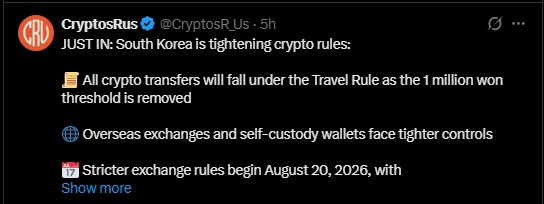
Source: Official Detail cover by CryptoRus
The Cabinet approved amendments to the Enforcement Decree of the Act on Reporting and Using Specified Financial Transaction Information on August 11, 2026, removing the long-standing 1 million won ($720) threshold for the crypto travel rule and tightening oversight of overseas exchanges and self-custody wallets.
What the New Crypto Regulation News Actually Changes
Under the current rules, registered virtual asset service providers (VASPs) only had to share sender and recipient information for transfers of 1 million won or more.
The amendment removes that threshold entirely, meaning all cryptocurrency transfers between registered VASPs, regardless of size, will now fall under Travel Rule information-sharing requirements.
This latest crypto regulation news is aimed squarely at closing a loophole known as "smurfing," where users split large transfers into smaller amounts to dodge monitoring.
The FSC cited one suspected evasion case involving roughly 200 million won used to buy USDT, followed by 216 separate withdrawals kept under the 1 million won threshold.
Key Changes Coming to Overseas Transfers and Wallets
The amendment introduces a unified risk-based approach for transfers between domestic VASPs and overseas VASPs or digital wallet service providers:
Transfers are allowed to low-risk overseas VASPs or wallets.
Transfers are allowed when the sender and recipient are confirmed to be the same entity.
High-risk transactions are prohibited outright.
Any transfer of 10 million won or more to an overseas VASP or wallet, regardless of risk level, must be reported to the Korea Financial Intelligence Unit (KoFIU).
Domestic VASPs will also face expanded registration scrutiny: the scope of major shareholders under review now includes the CEO or controlling shareholder, and, if the largest shareholder is a corporate entity, its company representative as well.
Timeline: When the Rules Take Effect
This crypto regulation news comes with a staggered rollout rather than a single effective date:
August 20, 2026 – Provisions covering VASP registration requirements and sanctions notifications for former employees take effect.
February 20, 2027 – The Travel Rule expansion and other transfer-related AML requirements take effect, six months after the decree's formal promulgation.
Existing VASPs also receive a one-year grace period for meeting certain new requirements, including debt-ratio limits, staffing standards, and internal control systems.
Broader VASP Registration and Financial Soundness Rules
Beyond the Travel Rule changes, the amendment also strengthens the registration screening process for virtual asset service providers.
Major shareholder reviews will now extend to anyone who appointed a majority of a company's CEOs or board, and financial soundness standards, including a debt ratio cap of 200% or below, will be enforced more strictly.
The FSC said it plans to update its registration manual and hold a public briefing for VASPs and prospective operators on August 13, 2026, in Seoul to explain the changes ahead of implementation.
Why This Crypto Regulation News Matters
South Korea has one of the world's most active retail cryptocurrency trading markets, and this move signals authorities are prioritizing anti-money laundering enforcement over convenience for smaller transfers.
By closing the transaction-splitting loophole and extending scrutiny to overseas exchanges and self-custody wallets, the FSC is aligning more closely with global standards pushed by the Financial Action Task Force (FATF), which has flagged weak travel rule compliance among high-volume trading jurisdictions.
Global Crypto Tax Context
South Korea's overhaul comes as crypto tax rules worldwide continue to diverge sharply by country.
India applies a flat 30% tax on virtual digital asset gains plus 1% TDS, with no loss offsetting allowed.
The UAE and Singapore charge 0% on personal cryptocurrency profits, while Germany and Portugal exempt gains held longer than a year.
South Korea crypto itself has separately delayed its planned 22% cryptocurrency tax to 2027, meaning this Travel Rule tightening arrives well ahead of that broader tax framework taking effect.
Conclusion
This latest crypto regulation news marks one of South Korea's most significant AML overhauls to date, eliminating the 1 million won travel rule threshold entirely and introducing risk-based controls for overseas and self-custody transfers.
With VASP registration rules starting August 20, 2026, and the full Travel Rule expansion following on February 20, 2027, exchanges operating in South Korea now have a firm runway to prepare for stricter compliance obligations across the board.
Disclaimer
This article is for educational and informational purposes only and should not be considered financial or investment advice. Always conduct your own research before making investment decisions.