Taiko Hack 2026: How Attackers Drained $1.7M Using Fake Bridge Proofs?

Taiko Hack 2026: $1.7M Drain from ERC20 Vault via Forged Bridge Proof
Attackers drained roughly $1.7 million — including 650,000 USDC and 130 ETH — from ERC20 Vault on Ethereum in a matter of hours on June 22, 2026.
If you hold funds on any bridge deployed on Taiko, the team has already declared those security assumptions unreliable — and every minute counts. Here's what most reports aren't telling you about how the exploit actually worked, and what traders need to watch before moving any assets.
What Happened in the Taiko Hack?
On June 22, 2026, the project confirmed a critical compromise of its chain state verification mechanism — the core system that validates what's real on its Ethereum-based Layer 2 rollup.
Block production was halted entirely. All proposers stopped generating new blocks while the team coordinated with the Security Council and ecosystem partners to contain the damage. The hack affected every bridge deployed on the network, not just one isolated contract.
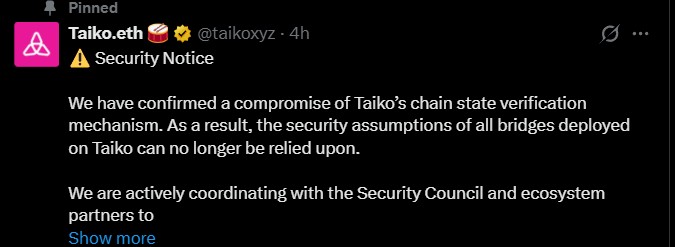
Source: Official X
How Did Attackers Pull It Off?
Blockchain security firm Blockaid was first to flag the attack, and its preliminary findings point to a flaw in the source-signal proof verification of cross-chain bridge.
Here's the critical detail: attackers crafted a forged message proof that was accepted by Ethereum mainnet — even though no matching MessageSent event ever existed on the Taiko chain.
That means the attacker registered a completely fake cross-chain message and used it to unlock real assets sitting in the ERC20 Vault.
SGX Prover Registration Was the Entry Point
The exploit specifically abused permissionless prover registration system, which allows anyone to register as a prover — including SGX (Secure Enclave) instances.
A rogue SGX instance was registered, submitted invalid proofs, and the system accepted them. The result: approximately $1.7 million drained, split across USDC, ETH, and TAIKO tokens.
Who Are the Attacker Wallets?
The platform published four confirmed attacker addresses:
-
0x7506DeA0c38ca0B55364B22424374c5A1ae1B76a
-
0x5fbc60a12bc6635e7d587d8dac52e4b1388b4990
-
0x3cc936b795a188f0e246cbb2d74c5bd190aecf18
-
0x9108828e30f2de407aadb0af677b4a9228e4acd4
These addresses have been flagged for blacklisting. Centralized exchanges have been urgently requested to suspend all TAIKO deposits until official clearance is issued.
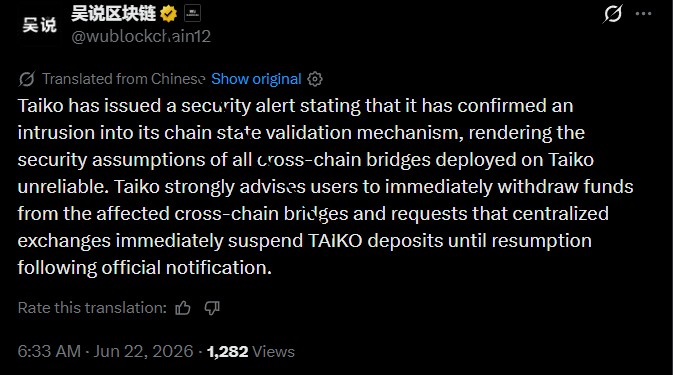
Source: Wu Blockchain X
TAIKO Token Price Today
Following the Hack, TAIKO price today fell over 16% in 24 hours to around $0.079. Trading volume surged above $30 million as panic selling intensified. The chart shows extreme volatility, with a sharp spike and rapid reversal after news of the $1.7 million bridge exploit emerged.
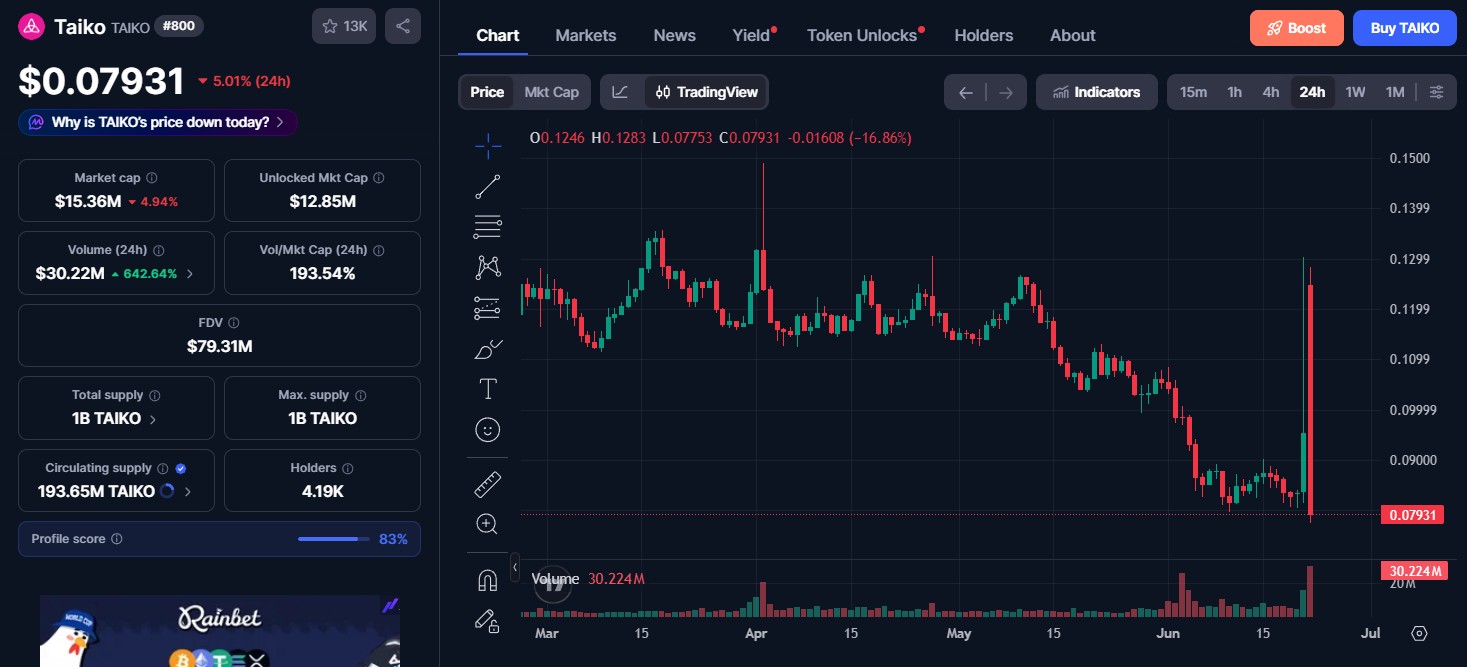
Source: CoinMarketCap
What Should You Do Right Now?
The official guidance is direct: Withdraw your funds from all bridges deployed on Taiko immediately. This isn't a precaution — the security assumptions for every bridge on the network are officially considered unreliable until further notice.
If you hold assets on any Taiko bridge, do not wait for another update before acting. The team has paused block production, but the exploit window existed, and more funds may still be at risk.
What to Watch Next
-
For users: Monitor official channels for confirmation that bridge systems have been patched and re-verified before moving funds back.
-
For traders: TAIKO token activity on CEXs will be constrained as long as deposit suspensions remain active. Watch for the official re-enable announcement, which may trigger sharp price movement in either direction.
For the broader market: This is the second high-profile rollup bridge exploit in recent months. Scrutiny of SGX-based prover systems across other L2s is likely to increase.
Conclusion
This crypto hack is a stark reminder that permissionless prover architectures carry real attack surfaces — especially when proof verification can be fooled without a corresponding on-chain event. With $1.7M drained, block production halted, and security assumptions voided, it faces a significant recovery challenge. The next critical signal to watch: when and how the Security Council officially clears bridge systems for reopening.
Disclaimer: This article is for informational purposes only and does not constitute financial or investment advice. Cryptocurrency investments carry significant risk. Always conduct your own research before making any financial decisions. CoinGabbar is not responsible for any losses incurred.


2 months ago
I lost $292,900 in Bitcoin after investing with an online mining company. After realizing I had been scammed, I spent a long time searching for ways to recover my funds and contacted several services without success. During my research, I came across Mighty Hacker Recovery through Google and YouTube. What caught my attention was that they said they would not require any upfront payment before providing their recovery service. I decided to contact them to discuss my case and understand their process. Throughout the process, they kept me informed about the progress. After several days, I was asked to provide my Bitcoin wallet address, and my case was concluded. Their fee was handled after the service rather than being requested in advance. If you've been the victim of a cryptocurrency scam, it's important to do your own research, ask questions, and carefully evaluate any recovery service before proceeding. Every case is different, so take the time to verify information and understand the process before making any decisions. For Bitcoin scam recovery, cryptocurrency scam, crypto recovery service, recover stolen Bitcoin, Bitcoin fraud help, blockchain investigation, crypto wallet recovery, online investment scam, digital asset recovery, and crypto scam support. Contact Them on WhatsApp +1 (343) 947-3496 or mightyhackarrecovery@techie.com or support@mightyhackerrecovery.com or https://mightyhackarrecovery.com Scam recovery Online fraud help Scam alert Report fraud Fraud investigation Fake website checker Scam checker Identity theft protection Consumer protection Chargeback for scam Wire transfer scam Tech support scam Employment scam Rental scam Shopping scam Email scam WhatsApp scam Telegram scam Facebook scam Instagram scam

2 months ago
Mighty Hacker Recovery offers professional services in cybersecurity and digital recovery for individuals and businesses. Their services include data recovery, digital forensics, cybersecurity consulting, malware detection, and incident response. They promise experienced, confidential, and fast support while following ethical practices. Clients can contact them via their website https://mightyhackarrecovery.com/ or WhatSapp Canada +1 (343) 947-3496 for assistance. Additionally, the text poses various questions related to crypto recovery, including inquiries about stolen cryptocurrency, recovery experts, and their effectiveness. BITCOIN RECOVERY EXPERT AT MIGHTY HACKER RECOVERY USDT RECOVERY EXPERT AT MIGHTY HACKER RECOVERY ETH RECOVERY EXPERT AT MIGHTY HACKER RECOVERY CRYPTOCURRENCY FRAUD RECOVERY HACKER FOR HIRE AT MIGHTY HACKER RECOVERY WhatSapp Canada +1 (343) 947-3496







