EU MiCA Regulation 2026: Kraken and Stablecoins Lead EU Crypto News

EU MiCA Regulation 2026: Stablecoin Issuers, CASPs and Kraken License
Just one week into full enforcement, Europe already counts 21 licensed stablecoin issuers — and still zero approvals in a category regulators built the rulebook around.
If you trade, hold, or issue crypto assets in the EU, this gap could decide which tokens survive the next phase of MiCA and which quietly disappear from exchanges.
Kraken just made a move that could change how millions of European users access crypto — and it has nothing to do with trading fees.
What Happened: MiCA Transition Period Officially Ends
The EU's Markets in Crypto-Assets Regulation (MiCA) moved into full application on July 1, 2026, closing the transition window that let crypto firms operate under national rules. Every crypto-asset service provider (CASP) now needs EU-wide or national authorization to keep serving customers across the bloc.
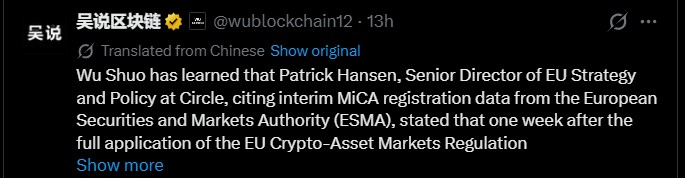
Circle's Senior Director of EU Strategy and Policy, Patrick Hansen, shared a fresh snapshot of the rollout using interim registration data from the European Securities and Markets Authority (ESMA), just days after the deadline passed.
Source: X
Stablecoin Issuers Are Multiplying Fast
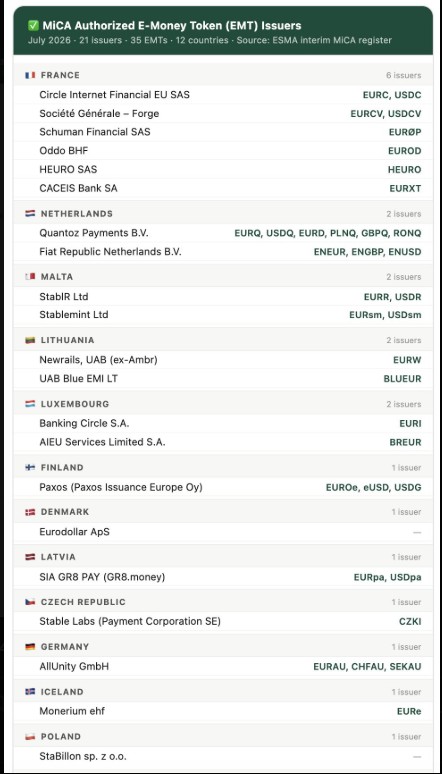
According to the ESMA data Hansen referenced, the EU now has 21 authorized electronic money token (EMT) issuers spread across 12 member states, up from 19 issuers in 12 fewer countries back in March 2026. Together, they have issued 35 separate EMTs.
Country-by-Country Breakdown
France remains the bloc's clear leader with six regulated issuers under its financial regulator, the ACPR, followed by the Netherlands, Malta, Lithuania, and Luxembourg with two issuers apiece. Several other states, including Germany license, Denmark, Finland, Iceland, Latvia, Poland, and the Czech Republic, each host a single licensed issuer.
Source: Patrick Hansen
Currency Coverage Keeps Expanding
Pricing currency diversity has also grown, with the 35 tokens now covering eight denominations compared to five earlier in the year. Euro-denominated tokens dominate the list, followed by dollar-pegged tokens, with smaller pools tied to the British pound, Czech koruna, Swiss franc, Polish zloty, Swedish krona, and Romanian leu.
The Bigger Gap: Global Stablecoins Still Mostly Outside MiCA
Hansen also pointed to a bigger-picture problem behind the headline growth: out of the world's 50 largest stablecoins by market cap, only three — USDC, USDG, and EURC — currently meet MiCA's compliance bar. In his view, the real measure of success for the regulation won't just be how many new local tokens get licensed, but how much of the world's existing stablecoin liquidity and trading activity can eventually be pulled inside the MiCA perimeter.
Still Zero Asset-Referenced Token Issuers
Despite the growth on the EMT side, not a single asset-referenced token (ART) issuer has been authorized more than two years after MiCA's framework for this category took effect. ARTs, which are backed by baskets of assets or single non-currency assets such as gold, occupy a major part of MiCA's Titles III and IV — yet uptake has stayed flat at zero, pointing to structural hurdles that could shape the regulation's upcoming review.
CASP Registrations Cross 270
On the service-provider side, more than 270 crypto-asset service providers have now registered under MiCA, a milestone widely viewed as one of the regulation's early wins. The next challenge for regulators is drawing more of the world's largest trading platforms and liquidity pools into this same licensing perimeter.
Kraken Eyes a First-of-Its-Kind EU Banking License
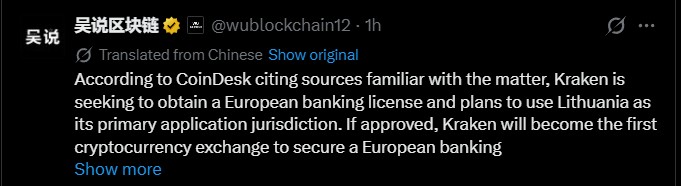
Separately, a report citing people familiar with the matter says Kraken is pursuing a full European banking license, with Lithuania lined up as its primary jurisdiction. If it clears approval, Kraken would become the first crypto exchange to hold an EU banking license, opening the door to services like bank accounts and consumer loans across the European Economic Area, similar to what neobank Revolut already offers.
Source: Wu Blockchain
Why This Application Matters
Kraken declined to comment on the report, and the Central Bank of Lithuania said its approval process stays confidential. Kraken CEO Arjun Sethi has previously outlined a decade-long goal of securing financial licenses across multiple regions, whether through acquiring existing institutions or applying directly.
This isn't Kraken's first regulatory move in the bloc, either. The exchange already holds an E-Money Institution license in Ireland and is registered as a CASP under MiCA, giving it a compliance foundation to build on as it pursues the banking license.
European Parliament Turns Its Attention to DeFi and NFTs
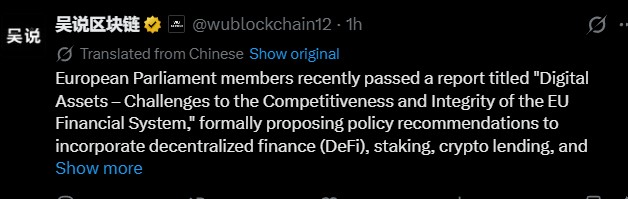
Days after MiCA's transition period closed, members of the European Parliament adopted a report titled "Digital Assets – Challenges to the Competitiveness and Integrity of the EU Financial System." The report does not amend MiCA or create new legal obligations, but it formally asks the European Commission to review whether decentralized finance, staking, crypto lending and borrowing, and NFTs need dedicated regulatory treatment.
Source: X
What to Watch Next
Lawmakers also flagged inconsistent enforcement across member states as a risk to the EU's single digital-asset market and called for tighter coordination. Any expansion of MiCA's scope would still require a separate legislative proposal, meaning changes here are unlikely to be immediate — but they signal where Brussels' focus is heading next.
This push builds on the groundwork the European Commission already laid in May 2026, when it opened a public consultation asking whether MiCA should be widened to cover more crypto activities — and whether current restrictions on interest-bearing stablecoins should be loosened.
Euro Stablecoins Are Already Gaining Ground
The Parliament's favorable view of tokenization and euro-denominated stablecoins is backed by fresh market numbers. Payments firm Decta found that the combined market cap of eight MiCA-compliant euro stablecoins jumped 128% over the 52 weeks ending June 28, 2026 — climbing from $295.6 million to $673.9 million.
Trading volume across those tokens rose 43.1% over the same stretch, while the pool of compliant euro stablecoins with active market data grew from five to eight. Decta credited EURC, EURCV, and EURI with driving most of that expansion.
Exchanges and Users Are Adjusting in Real Time
The end of MiCA's transition period is also reshaping user behavior. BNB Chain recently published guidance walking European users through moving funds from centralized exchanges into self-custody wallets and connecting directly to decentralized apps, as traders double-check whether their exchange still holds valid CASP authorization.
Why This Matters for Traders and Investors
For active traders, the growing list of licensed EMT issuers and CASPs signals a maturing, more predictable EU market — but the ART drought and looming DeFi review suggest more regulatory shifts are still ahead. Kraken's banking license bid, meanwhile, could set a precedent for how far crypto exchanges can expand into traditional finance on European soil.
Conclusion
One week into full MiCA enforcement, Europe's stablecoin and CASP numbers are climbing steadily, even as the ART category stays stalled and lawmakers eye DeFi next. With Kraken chasing a landmark banking license, the next few months could reshape how crypto and traditional finance intersect across the bloc.
Disclaimer: This article is for informational purposes only and does not constitute financial, investment, or legal advice. Cryptocurrency markets are volatile and regulatory frameworks can change rapidly. Readers should conduct their own research and consult a licensed professional before making any financial decisions.
Also read:
2 months ago
If you’ve lost money to a wallet drainer, phishing scam, DeFi rug pull, or any other crypto fraud Cryptera Chain Signals is the solution you’ve been searching for. As one of the top approved crypto recovery companies in 2026, Cryptera Chain Signals delivers real results with: Advanced Blockchain Forensics & Fund Tracing Professional Recovery for Bitcoin, Ethereum, USDT & more 98% Success Rate in traceable cases 5-Star Client Rating Don’t fall for fake recovery services. Get help from a legitimate, proven, and approved expert team that actually recovers funds. Take action today and recover what’s yours. 🌐 Website: https://www.crypterachainsignals.com Email: info@crypterachainsignals.com 📲 WhatsApp: +44 (744) 758-7744 Message us now for a confidential case assessment the first step toward getting your crypto back. Cryptera Chain Signals Trusted by victims. Proven by results.








