Fake Uniswap Google Ads — $400K Stolen in Phishing Scam 2026

Did you search "Uniswap" on Google this week,click the first result?
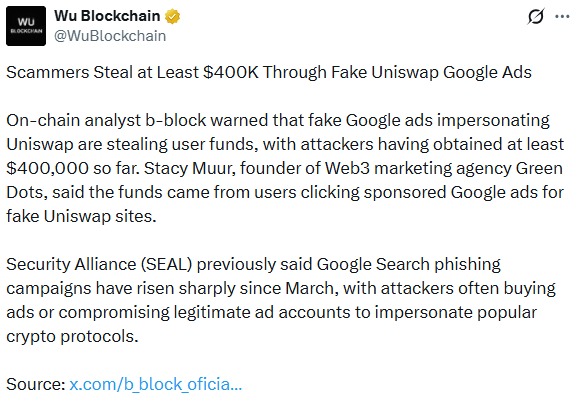
That single action may have cost some users everything. On May 25, 2026, on-chain analyst b-block posted a warning on X confirming that fake Uniswap Google ads had stolen at least $400,000 from crypto users — with two attacker wallet addresses publicly identified and verified on Etherscan.
The scam is running right now. Here is exactly how it works and what you need to do to protect yourself.
Source: X Account
How Fake Uniswap Google Ads Drain Wallets Without Warning
The attack is straightforward — and that is precisely what makes it so dangerous.
Stacy Muur, founder of Web3 marketing agency Green Dots, published definitive proof of the active exploit, calling out Google's advertising infrastructure for long-standing consumer vulnerabilities. "It's insane that Google has ignored this issue for years while fake links keep getting pushed above real ones and users keep getting drained," she said.
The mechanics are precise. The analyst shared two wallet addresses tied to the operation, which together held 146 ETH worth roughly $306,000 at the time of reporting, based on Etherscan data. Stacy Muur confirmed the phishing operation relied on sponsored Google search advertisements designed to appear above legitimate Uniswap links.
Victims click the ad, connect their wallet, and sign a malicious transaction. That approval grants attackers the power to drain assets or make trades directly from the connected wallet.
The wallet drainer tool identified in this attack is called AngelFerno — a scam-as-a-service script that targets DeFi users. AngelFerno is live on multiple domains itemized on GitHub phishing blocklists. Particularly nefarious attackers use Cyrillic characters in URLs — also known as Punycode URLs — to make the fake domain appear visually indistinguishable from the real one.
Victims land on convincing clones of real crypto apps, with all network traffic secretly routed through attacker-controlled servers. Attackers use hidden iframes and secondary payloads that remain invisible to Google's automated detection systems while showing users legitimate-looking URLs.
Three types of malicious payloads are being deployed across these campaigns: cryptocurrency wallet drainers—which use in-browser JavaScript to push victims into approving harmful transactions; seed phrase stealers—which present cloned websites where users are prompted to type their wallet recovery phrase directly; and fake browser extensions.
You do not need to download anything. Connecting your wallet and signing one transaction is enough to lose everything.
Fake Uniswap Google Ads Part of a $1.27M Wider Campaign
This is not an isolated incident. The fake Uniswap Google ads attack is the latest chapter in a sustained, organized criminal campaign that has been running for over a year.
The Security Alliance (SEAL) reported that phishing campaigns tied to malicious Google advertisements stole more than $1.27 million within weeks between March 13 and 30, 2026 alone. SEAL said it blocked more than 356 malicious advertisement links over the past year and warned the campaign remained active with continued reports from affected users.
One single theft in early March 2026 alone reached $385,000. SEAL notes the actual total is likely far greater, since reliable attribution is only possible when victims come forward with full details.
These campaigns targeted some of the most widely used platforms—including Uniswap, PancakeSwap, Morpho Finance, Hyperliquid, CoW Swap, and hardware wallet brand Ledger. Uniswap was the most impersonated brand at 41% of all detected malicious sites, followed by Morpho Finance at 31%.
In early May, attackers also abused Google Ads alongside legitimate shared chats with the AI chatbot Claude in a malvertising campaign targeting Mac users. Facebook remains a large hub for fake ads, according to Malwarebytes, which reported scammers running paid ads impersonating Microsoft — directing victims to near-perfect clones of the Windows 11 download page where malware designed to steal crypto and credentials was deployed.
In July 2025, a DeFi user lost $1.2 million through a nearly identical Uniswap scam involving fraudulent Google Ads. Forensic investigator ZachXBT publicly called for severe consequences against Google for failing to prevent phishing ads.
DeFiLlama confirmed that fake ads on Google are a common source of phishing attacks and pointed users to tools designed to verify legitimate crypto domains and reduce exposure to fraudulent websites.
How to Protect Yourself Right Now
Five steps every crypto user should take immediately:
1. Never click sponsored results for crypto platforms. Always scroll past ads and click only the organic result. Bookmark Uniswap's real URL — app.uniswap.org — directly.
2. Check the URL before connecting your wallet. Look carefully for Cyrillic characters, extra letters, or hyphens that make a fake domain appear identical to the real one.
3. Use a phishing blocker. Browser extensions like ScamSniffer or Wallet Guard flag known malicious domains before you land on them.
4. Never approve unknown transactions. If a site prompts you to sign a transaction you did not initiate — disconnect immediately and do not confirm.
5. Revoke approvals regularly. Use revoke.cash to check and remove any previously granted wallet permissions from unknown or suspicious sites.
Future Outlook — Expert Analysis
The pattern emerging from SEAL's research points to a structural problem that individual users cannot solve alone. SEAL warned that attackers continue to adjust tactics to evade Google's automated detection systems — using layered delivery architectures that make malicious payloads invisible until they reach the end user's browser.
Disclaimer: This article is for informational and educational purposes only and should not be considered financial, investment, cybersecurity, or legal advice. Always verify wallet recovery steps, app links, and announcements through official sources before taking any action.








