GTech Network Listing Date May 30: 10 Exchanges on Day One

GTech Network Listing Date: The Full 10-Exchange List Decoded
Can a brand-new BSC token trade on 10 exchanges at once and survive Day 1?
That's the question every GTech Network miner is asking right now. The gtech network listing date is officially confirmed for May 30, 2026. The team announced this via the official @gtechnetwork Twitter account. Trading goes live in 17 days. What makes this unusual isn't just the date — it's the scale. Ten exchanges, all on the same day. That's not how most BSC token launches work.
Most new tokens debut on one platform. Two is ambitious. Ten is almost unheard of.
GTech Network Listing Date: The Full 10-Exchange List Decoded
So where will you actually trade on May 30? Here's the complete list published on the GTech Network official website:
- Tier 1 (Major platforms): Binance Alpha, BingX, MEXC
- Tier 2 (Mid-tier CEX): LBank, Bitrue, Blofin, ByDFI
- Tier 3 (Emerging platforms): Bitunix, GrowX, VOOX
The plan covers both CEX (centralised exchange — a company-run trading platform) and DEX (decentralised exchange — no middleman required) access from Day 1.
BingX handles most retail spot trading. LBank provides a second liquidity layer. Binance Alpha — accessed via the Binance Web3 Wallet — puts it in front of millions of Binance users from the first hour.
There's one detail you need to know before getting excited. As of today, May 13, 2026, none of these exchanges have published their own independent GTC listing announcements. The exchange list exists only on the GTech Network website. Serious exchange listings come with public announcements from both sides. Watch official BingX and LBank channels — when they confirm directly, that's the real signal.
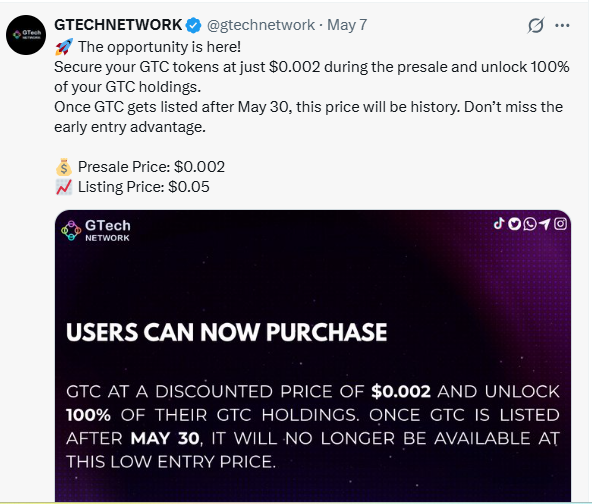 Source: X(formerly Twitter)
Has Any BSC Token Ever Listed on 10 Exchanges Simultaneously?
This is the question nobody has written about yet. The short answer is: almost never — and the outcome isn't always what you'd expect.
When Pi Network launched on multiple major exchanges simultaneously, the initial price spiked sharply. Then it dropped just as fast. The reason? Liquidity split across too many venues. Each exchange got thinner order books. Thinner order books mean bigger price swings — in both directions.
GTC enters with 200 million tokens in circulation at launch. The team burned 9 billion from an original 10 billion supply across three verified on-chain events. Every burn transaction hash is publicly viewable on BscScan. That tight supply is the strongest argument for why a 10-exchange launch might work here, where it failed for pure-hype tokens before.
Here's what the data tells us:
- Spread across 10 venues: Buy pressure splits, but so does sell pressure
- No single point of failure: If one exchange crashes on Day 1, nine others keep GTC trading
- More buyers, faster: 10 different user bases see GTC simultaneously — that's exponential reach on launch day
The risk and the opportunity live on the same side of the coin.
What the GTech Network Listing Date Means for Your GTC
The gtech network listing date matters for one core reason: what you do before it determines what you can do after it.
If you mined GTC and haven't withdrawn yet, move now. The team confirmed over 5,000 users already transferred tokens to personal wallets. Any GTC still sitting inside the app risks burning before trading begins. Use MetaMask or Trust Wallet on BNB Smart Chain — that's Binance Smart Chain, the blockchain GTC runs on.
Four products back this token before a single trade happens on May 30:
- GTC Store — gift cards for 5,000+ global brands, live now, accepts GTC and USDT
- GTC Crypto Card — active in 150+ countries with instant crypto-to-fiat at point of sale
- Real Estate tokenisation — fractional property investment via GTC or USDT
- GTC Staking — monthly rewards for holders, post-listing
The smart contract passed four independent security checks: CertiK, GoPlus, Scam Sniffer, and Forta all returned zero vulnerabilities. Most BSC tokens at this stage have one audit. GTC has four.
Market Outlook: Two Scenarios for May 30
Based on market sources and publicly available data, analysts outline two scenarios. All figures are assumption-based estimates — no guaranteed outcomes exist.
Bull case: BingX and Binance Alpha both go live simultaneously with healthy order books. The 200 million circulating supply stays tight against Day 1 demand. GTC holds at or above the $0.05 listing target and moves toward the $0.10–$0.12 analyst range.
Bear case: Liquidity spreads too thin across 10 venues. Presale buyers — who get a full 100% unlock with zero vesting — sell immediately. Price falls to the $0.02–$0.035 range in the first 48 hours.
The presale entry price was $0.002. The team's stated listing target is $0.05. That's a 25x gap on paper. Whether the market closes it on May 30 depends entirely on Day 1 volume.
Watch for one thing above everything else: an independent trading pair announcement from BingX or LBank. That's the confirmation that matters — not the GTech website. Not community guesses.
Conclusion
The gtech network listing date of May 30 is the most-watched BSC debut of the month. Ten exchanges, 200 million circulating tokens, four audits, and four working products make this unusual. But the real proof arrives when exchanges post their own announcements. Prepare your wallet. Verify the contract. Then watch the official channels.









