India Crypto News: ED Seizes Rs 3.35 Crore in Crypto Scam Case


India Crypto News Today: From Rs 3.35 Crore Crypto Scam To 2026 Rules
India's Enforcement Directorate has seized cryptocurrency assets worth Rs 3.35 crore in a fresh cryptocurrency raid. The action is tied to online investment and work-from-home scams.
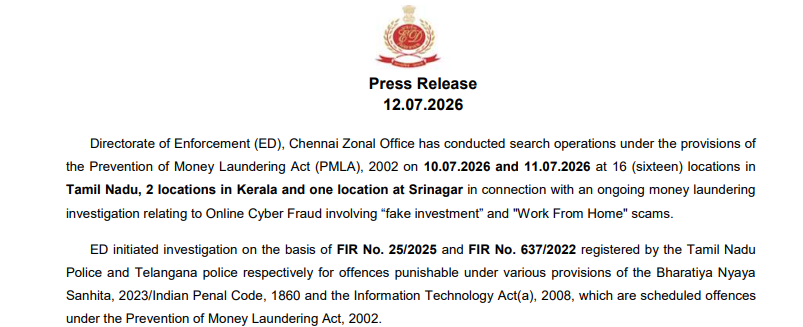
Source: Official Account of Enforcement Directorate
The agency also seized Rs 14.5 lakh in cash and froze bank accounts holding more than Rs 40 lakh. The agency searched across southern Indian states on July 10-11, 2026.
This India crypto news today fits inside a much bigger pattern of enforcement across the country.
India Crypto News Today: Inside the Latest ED Crypto Raid
ED officers searched 19 locations spread across Tamil Nadu, Kerala, and Srinagar over two days. The operation targeted people accused of running fake investment schemes and work-from-home job offers to trick victims out of their money.
Along with the cryptocurrenies and cash, officers picked up digital devices, documents, and bank records. All of this evidence now supports the case built under the Prevention of Money Laundering Act, or PMLA.
Seized Assets At a Glance
-
Rs 3.35 crore in digital assets,
-
Rs 14.5 lakh in cash, and
-
Rs 40 lakh in frozen bank balances
-
A well-organized fraud network moving money through digital wallets.
This case fits a bigger pattern. ED seized cryptocurrency assets in a similar case earlier this year too, when Bengaluru firms faced FEMA raids over stablecoin remittances worth more than Rs 2,500 crore in June 2026.
The seizure shows the Enforcement Directorate's expanding financial crime investigation across the country. The agency opened 1,080 ECIRs in FY26 alone, up from under 200 a year before 2014, and raids nearly doubled to 2,892 in FY26.
India Crypto Adoption: Why This Seizures Keep Rising Fast in One of the Biggest Markets
The Indian cryptocurrency market ranks among the largest cryptocurrency markets in the world by user adoption as per Chainalysis report. That scale draws fraud rings looking to move stolen money fast.
This India Crypto Raid is one entry in a fast-growing list, as provisional attachments across all PMLA cases hit a record Rs 81,423 crore in FY26, up 170% year over year, with a cumulative total past Rs. 2.36 lakh crore.
Digital asset shows up inside a growing share of these cases.
How India Cryptocurrency Regulations 2026 Are Shaping This Enforcement Push
India Crypto regulation 2026 still treats virtual digital assets as property for tax and anti-money laundering purposes, without legal tender status. No single law covers digital assets in the country yet.
Exchanges and wallet platforms must register with FIU-IND under PMLA, and 49 currently hold that registration, bound to KYC checks and suspicious transaction reporting.
The Reserve Bank of India keeps pushing India crypto ban move, strictly against banks holding virtual asset exposure. RBI expressed concerns about cryptocurrencies and continues to support the development of the digital rupee (CBDC).
The cryptocurrency tax stays flat on paper: a 30% tax on virtual digital asset gains with no loss set-off, plus a 1% TDS on transfers above ₹50,000 or ₹10,000, depending on the payer, under Section 194S.
Is India Moving Toward Clearer Cryptocurrency Law in 2026?
Recent Supreme Court Verdicts on Cryptocurrencies
Courts have started shaping how PMLA cases move forward. A 2026 ruling now requires a pre-cognisance hearing under the BNSS before certain steps in a case can proceed.
Another ruling from February 2026 stops asset confiscation while an attachment appeal is still pending. Judges also added a rule requiring production before a magistrate within 24 hours, protecting rights under Article 22.
A review of the 2022 Vijay Madanlal Choudhary judgment remains pending too. That case originally gave ED broad search and seizure powers, so any change here could reshape future enforcement action across the country.
What This Enforcement Push Means for the Nation's Cryptocurrency Future Ahead
Nothing here points to one digital asset law arriving soon. Expect the current mix of tax rules, FIU-IND registration, and PMLA raids to keep tightening case by case, with court rulings shaping the ground more than fresh legislation.
Fraud rings using cryptocurrencies for scams will likely keep drawing ED attention, given the size of the country's digital asset market. The next India Crypto news to watch sits with the pending Supreme Court review, not with Parliament.
Disclaimer: This article is for informational purposes only and does not constitute financial or investment advice. Cryptocurrency markets carry significant risk. Always do your own research before making any investment decisions.






