Little Pepe Is 28 Days Late: What History Says Happens Next


What Little Pepe Investors Can Learn From Pepe Unchained
Is 28 days of delay the beginning of the end — or just a bump in the road?
Little Pepe set April 30, 2026 as its official launch date. That date came and went. No confirmed Tier-1 exchange went live. No Uniswap. No Binance. No Coinbase. Today is May 28, 2026. CoinMarketCap still shows LILPEPE with $0 live trading volume. The presale sits at 98.46% sold — $28,192,766 raised out of $28,775,000. The entry price remains $0.0022 at Stage 13. Over 222,400 investors are waiting.
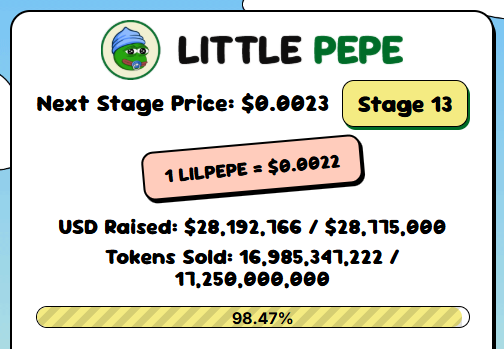 Source: Official Website
Rather than repeat the timeline, this article does something different. It uses verified data from comparable projects to answer the question investors are privately asking right now.
What Little Pepe Investors Can Learn From Pepe Unchained
The most direct comparison to Little Pepe is Pepe Unchained. The parallels are real and verified.
Both projects built a Layer 2 blockchain — meaning a faster, cheaper version of Ethereum that runs on top of it. Both used a meme coin presale to fund it. Both attracted large communities before listing. It raised $74 million. Little Pepe raised $28.19 million. Pepe-Unchained listed in December 2024.
Here is what the verified data shows happened next.
Pepe Unchained launched on Uniswap in December 2024, surged 200% on day one, then lost over 98% of its value over the following months. The original Layer 2 chain ran into infrastructure problems with its provider, forcing a full migration to Arbitrum in mid-2025. As of May 2026, PEPU once traded as high as $0.0232 but the current price is 99.5% below that peak.
The pattern is clear and it's not promotional. Day-one surge on listing hype. Then a crash driven by infrastructure failure. Then a multi-month recovery attempt.
What was different about Unchained's setup versus LILPEPE? PEPU listed immediately after presale with no vesting cliff. Every presale buyer could sell from minute one. That created massive day-one sell pressure. Little Pepe has a 3-month vesting cliff — meaning presale buyers can't sell for at least 90 days after listing. That single structural difference changes the day-one dump dynamic entirely.
PEPU: no vesting cliff — all presale sellers active on day one
LILPEPE: 3-month cliff — zero presale sellers on listing day
That's a real structural advantage for them over the Unchained comparison. The question is whether the Layer 2 mainnet delivers what it promises.
Little Pepe vs BlockDAG and DeepSnitch: Three Outcomes
Two other comparable projects from 2025–2026 tell a different side of the same story.
DeepSnitch (DSNT) listed on Uniswap in May 2026. DSNT crashed 99% the day it hit Uniswap. No vesting protection. No Layer 2 thesis. Just a meme presale with no structural price support. The token had no vesting cliff and no utility differentiation.
BlockDAG (BDAG) represents a different pattern. BDAG hit a new all-time low of $0.00006105 on May 20, 2026, despite already trading on over 13 exchanges. Multi-exchange access didn't prevent a sustained decline because the product story didn't follow the presale story at the same pace.
Here is what these three cases tell you about Little Pepe's current position, based on verified pattern analysis:
Pattern one — Delivered product, no vesting protection: 200% Day 1 surge, then 98%+ crash over 6 months. This was Unchained.
Pattern two — No product, no vesting: 99% crash on day one. This was DeepSnitch.
Pattern three — Multi-exchange listing, product partially delivered: Slow decline despite trading availability. This was BlockDAG.
Little Pepe's structural setup doesn't match any of these three exactly. The 3-month vesting cliff removes the day-one dump pattern. The Layer 2 gas token model — where LILPEPE is required for every transaction on the chain — creates ongoing demand if the chain attracts developers. Neither PEPU nor DSNT nor BDAG had this specific combination at listing.
All data is from verified public market sources. No guaranteed outcomes are provided.
Little Pepe Listing Outlook: Which Pattern Fits Right Now
Based on the verified comparison data, here is where it sits as of May 28, 2026.
The 28-day delay is not automatically a red flag. Several exchanges had already approved LILPEPE per official team communications. The Tier-1 platforms still completing due diligence are the variable. Standard Tier-1 review runs 30 to 65 days from application. A mid-April application date puts that window at late May to mid-June 2026 — which means the delay is within the normal compliance timeline range.
Two unresolved issues remain. No public mainnet update for the Layer 2 chain has been issued as of May 28, 2026. The whitepaper promised Q1 2026. That deadline passed silently. Exchanges listing a gas token want proof the chain is live before committing. Second, CoinMarketCap lists LILPEPE circulating supply at 100 billion but the official vesting page states 20 billion at TGE — a 5x discrepancy that exchange screening tools flag during compliance review.
Three scenarios from here, based on market analyst projections from public sources:
Bull case — Tier-1 confirms by June 15: LILPEPE price prediction targets of $0.05 to $0.10 cited by analysts
Base case — Tier-2 confirms, mainnet follows: $0.008 to $0.015 through year-end
Bear case — Silence extends past 60 days post-missed date: Community patience fractures
No guaranteed outcomes are provided. All projections are assumption-based from public market sources.
Conclusion
Little Pepe is 28 days past its promised date. The three comparable projects — Unchained, DeepSnitch, and BlockDAG — each show different outcomes driven by different structural setups. Little Pepe's 3-month vesting cliff separates it from the worst historical patterns. What happens next depends on one thing: whether the listing confirmation arrives before community patience runs out.
YMYL Disclaimer
This article is for informational purposes only and does not constitute financial or investment advice. Crypto presales are high-risk and readers should verify all information independently before making any financial decision.
Also read:






