Little Pepe Listing August 2026: What Every LILPEPE Buyer Should Know

Little Pepe Listing August 2026: Is a Tier-1 Exchange Still Possible?
The Little Pepe listing has no confirmed date as of July 31, 2026 — and 222,000 presale holders are asking the same five questions. Here are those questions answered with verified facts, no hype, and no price predictions. No buy recommendations, just what the data currently shows.
As of today, Little Pepe's official presale dashboard shows Stage 13 at 98.74% sold, with $28,298,676 raised and 17,033,488,079 of 17,250,000,000 tokens in this stage sold. Current price is $0.0022, with Stage 14 set at $0.0023.
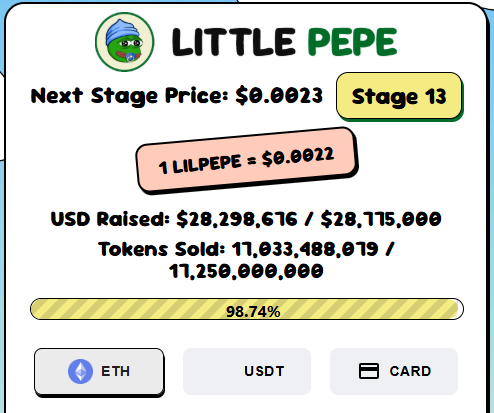 \Source: Official Website
Is the Little Pepe Listing Still Happening in August 2026?
No confirmed exchange listing has been announced as of this writing. The most important date every LILPEPE holder should have marked is August 11, 2026 — the last day of Binance's current compliance review window for the token. If no confirmation arrives by that date, the next realistic Tier-1 path pushes into Q4 2026 with no fixed re-application timeline confirmed publicly. OKX's own window closed June 30 without a public confirmation either way. Coinbase's second review is reportedly still ongoing, with no timeline published.
LILPEPE has technically traded on Tier-2 exchanges LBank and Phemex since April 30, at $0.003, hitting $0.003879 within 24 hours on thin liquidity. Nothing here confirms a Tier-1 listing is imminent; it confirms only that presale-price trading has already occurred elsewhere and that real open-market demand exists. The two signals worth watching: any announcement on Binance's own verified X account before August 11, and whether Stage 13 crosses 99.5% — which would indicate a whale or catalyst buyer has entered.
Did the LILPEPE Team Really Move Funds to Binance?
This is one of the harder claims to verify from public sources. No independently verifiable on-chain evidence — a specific transaction hash, wallet address, or block explorer record — was found tying the Little Pepe team's wallets to a Binance deposit as of this writing. Presale treasury movements to exchanges do happen routinely for legitimate reasons, including converting raised funds for operational use and pre-listing liquidity deployment, and aren't inherently a red flag on their own. Absent a specific, sourced transaction, this claim should be treated as unconfirmed rather than either dismissed or assumed true. Investors who want to verify independently can check the official presale contract address (0xa2209a2b7cdb0a15457322199fe45bdbad72c48f on Ethereum) directly on Etherscan.
What Does the GoPlus "Disable Sells" Flag Mean for LILPEPE Holders?
GoPlus Security's scanner has flagged that the LILPEPE contract creator holds the technical ability to disable token sells. This is a genuine, documented finding — not a fabricated rumor. CertiK's separate audit scored the contract 95.49 out of 100 with no critical vulnerabilities, and administrative functions like this exist in many legitimate contracts for emergency or compliance reasons. The team has described this capability as an administrative emergency control rather than a malicious feature. However, the Little Pepe team has never issued a dedicated public statement specifically addressing the GoPlus flag — and that silence is the part worth weighing when deciding how much control you are comfortable with a contract creator retaining over your ability to sell. CertiK and GoPlus use different methodologies; CertiK's audit does not override what GoPlus flags, and both findings can be true simultaneously.
Is the Little Pepe $777,000 Giveaway Real — and When Does It Pay Out?
Yes — this is a genuine, ongoing presale promotion, not a August 2026 announcement. Ten winners each receive $77,000 worth of LILPEPE tokens, with entry requiring a minimum $100 presale purchase plus completed social media tasks. Entry closes permanently when Stage 13 closes — no future stage qualifies and no second window opens. Like all presale token rewards, giveaway winnings follow the same vesting schedule as regular presale purchases: 0% at TGE, a 3-month cliff, then 5% monthly over 20 months. They do not pay out separately, earlier, or in a different form. Winners will only be able to access their first 5% of giveaway tokens approximately 90 days after TGE fires — which itself only triggers once a confirmed exchange listing closes the presale.
What Happens to Your LILPEPE Tokens If No Exchange Ever Lists It?
This is the risk no promotional article addresses directly. Presale funds are already collected and are not refundable through any mechanism the project has published. Tokens are allocated but locked under a vesting schedule that only begins once a Token Generation Event (TGE) fires — which itself only triggers upon a confirmed exchange listing. If no Tier-1 or Tier-2 listing materializes beyond the existing LBank and Phemex liquidity, holders would be left with tokens that have no active broader trading market. LBank and Phemex confirmed listings on April 30 do provide a baseline — LILPEPE is not unlisted everywhere. But the depth of liquidity on those platforms is thin relative to what a Tier-1 CEX listing would generate. The August 11 Binance window closing without confirmation is the clearest signal that this risk is becoming more material.
Conclusion
The Little Pepe listing remains unconfirmed as of July 31, 2026. These five questions cover what is actually documented: no confirmed Tier-1 listing with August 11 as the next critical window, an unverified fund-transfer claim that should be treated as unconfirmed, a real but insufficiently addressed security flag, a legitimate ongoing giveaway tied to standard vesting, and a real risk if no exchange listing ever materializes. None of this is a verdict on the project — it is the current state of the record, for readers to weigh themselves.










