MiCA Deadline July 1: Millions of EU Crypto Users at Risk


MiCA Deadline July 1: What Happens to Unlicensed Exchanges
Are you a crypto user in Europe — and is your exchange actually allowed to operate there after July 1?
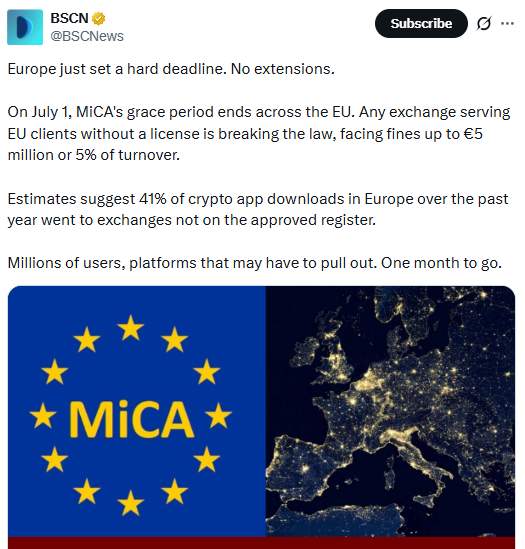
The answer might surprise you. Europe just set a hard deadline with no extensions. On July 1, 2026, the MiCA grace period — the transitional window that let crypto exchanges operate under old national rules — ends permanently across all 27 member states. Any exchange serving Europe clients without a MiCA license from that date is breaking EU law. The fines are real: up to €5 million or 5% of annual turnover, whichever is higher.
 Source: X(formerly Twitter)
One number makes this urgent for millions of everyday users. According to analysis by OKX Europe, of 18.5 million crypto app downloads in Europe between May 2025 and May 2026, roughly 7.6 million — 41% — went to exchanges that don't appear on the official MiCA-authorized register. That's nearly 1 in 2 European crypto downloads going to platforms that may have to pull out of the EU market in less than 30 days.
MiCA Deadline July 1: What Happens to Unlicensed Exchanges
MiCA stands for Markets in Crypto-Assets Regulation — the EU's comprehensive legal framework covering every company that provides crypto services to European residents.
The European Securities and Markets Authority (ESMA), the EU's financial markets regulator, confirmed on April 17, 2026 that the deadline is July 1, 2026. No ambiguity. No further extension. ESMA stated directly: non-authorized entities "will not be allowed to operate within the EU" after that date.
What does that mean practically? Three things happen to any unlicensed exchange still serving Europe's client on July 2:
National regulators can order an immediate halt to all services
Exchanges must begin client offboarding — moving user funds out of their platform
Regulators can publicly name the firm and impose administrative fines up to €5 million
Having a MiCA application already in review doesn't protect you. Niall Esler, head of regulatory and risk advisory at law firm Walkers, told Cointelegraph directly that companies still serving Europe clients without authorization after the transition ends "will be operating unlawfully and cannot expect to continue business as usual."
That's a serious statement. It means pending applications don't create a legal shield. You either have the license by July 1 — or you stop serving clients.
Which Major Exchanges Are Not MiCA Authorized Yet
This is the section that directly affects your portfolio — because two of the most widely used exchanges in Europe are not yet on the MiCA-authorized list.
Binance applied for a MiCA license in Greece through the Hellenic Capital Market Commission in January 2026. As of the publication date, Binance does not appear on the MiCA-authorized providers list compiled from ESMA and national data. Binance did not respond to Cointelegraph's requests for comment on the status of its application.
Bitget applied for a MiCA license in Austria in 2025. Its chief legal officer told the company expects regulatory approval in Q2 2026 — a window that ends June 30. Bitget confirmed it will not offer services in the European Economic Area until authorization is granted.
Several countries adopted the full 18-month transitional window — France, Malta, Luxembourg, and Estonia among them — giving exchanges the maximum runway to apply. That runway ends July 1.
Exchanges that ARE authorized under MiCA are listed on the official ESMA register at esma.europa.eu. That is the only verified source. Not community forums, not exchange press releases, not social media announcements.
What to check right now if you use a crypto exchange in Europe:
Go to esma.europa.eu and check the authorized CASP register
Search your exchange by name
If it's not listed, check whether it has a confirmed national authorization under an Europe member state's transitional regime
If neither applies, your exchange may restrict or remove Europe access before July 1
MiCA Regulation Impact: What EU Crypto Users Must Do Now
Here is the practical guidance based on verified regulatory data and market sources. No guaranteed outcomes are provided — regulatory timelines can shift.
The risk for users is not immediate fund loss. MiCA requires exchanges that exit the EU to implement client migration plans — meaning they must notify users and help them move funds before shutting down. The risk is service disruption, restricted access, and forced account closures on short notice.
Three actions every EU crypto user should take before June 30:
First — verify your exchange status on esma.europa.eu. The authorized register is updated regularly. Check it directly — not through third-party sites.
Second — withdraw funds to a self-custodial wallet if your exchange is not listed. A self-custodial wallet — one where you hold your own private keys, like MetaMask or Ledger — is not subject to MiCA. Only exchanges providing services are. Your wallet, your keys, your access regardless of what happens to the platform.
Third — watch for official emails from your exchange. Any exchange planning to restrict EU access is legally required to notify clients. If you receive a notice about account restrictions or service changes in June 2026, act immediately — don't wait.
The broader picture matters too. MiCA is also the framework that doesn't yet cover NFTs and DeFi protocols fully. Those gaps will be addressed in future regulatory updates. For now, centralized exchanges are the immediate focus.
Conclusion
The MiCA deadline on July 1, 2026 is the most significant regulatory event in European crypto this year. No extensions. No grace. Binance and Bitget are still in review. 41% of EU downloads went to unlicensed platforms in the past year. EU crypto users have less than 30 days to verify their exchange, secure their funds, and prepare for potential service changes. Check esma.europa.eu today.
YMYL Disclaimer
This article is for informational purposes only and does not constitute financial, legal, or investment advice. Regulatory data is sourced from publicly available official sources as of June 4, 2026. Exchange authorization status may change — always verify at esma.europa.eu. No guaranteed outcomes are stated. Consult a qualified advisor before making any financial decision.






