OKX Expands Globally With ICE Joint Venture and 20% Coinone Investment

OKX Makes Two Big Moves: ICE Joint Venture and Coinone Stake Explained
OKX just became a joint owner of a new venture with the parent company of the New York Stock Exchange — and grabbed a fifth of a Korean exchange in the same week.
For traders watching, this isn't just another partnership headline; it touches how crypto collateral, custody, and market access could work going forward.
Here's what actually happened, why ICE needed OKX more than the other way around, and what to watch next in crypto markets.
What Happened: OKX's Two Big Moves
Intercontinental Exchange (ICE), the parent of the NYSE, and OKX have formed a 50:50 joint venture called OKXICE. Around the same time, OKX Ventures — OKX's investment arm — acquired a 20% stake in South Korean exchange Coinone, making it a joint third-largest shareholder alongside Korea Investment & Securities.
Both moves build on an earlier $200 million strategic investment ICE made in OKX earlier this year.
OKX and ICE Form Joint Venture "OKXICE"
OKX and Intercontinental Exchange, the parent company of the New York Stock Exchange, have formed a new 50:50 joint venture called OKXICE. On the surface, it reads like a compliance win for OKX exchange — a global crypto exchange that faced serious US regulatory trouble getting backed by one of Wall Street's most established infrastructure companies.
But the deeper story is about time, not just trust. Traditional finance runs on trading days, banking hours, and settlement windows; crypto runs continuously, with no closing bell, no weekend pause, and no holiday break.
ICE built its business on being the plumbing behind markets — matching, clearing, collateral, and risk control — and that plumbing was designed around scheduled downtime.
OKXICE is essentially a live test of whether ICE's clearing and margin systems can be re-engineered for a market that never stops moving, using OKX's existing global user base, stablecoin rails, and trading infrastructure as the proving ground.
ICE previously tried building its own crypto platform, Bakkt, which struggled to gain traction because compliance alone didn't generate real trading demand — a lesson likely shaping this new approach of partnering with an exchange that already has the liquidity and habits in place.
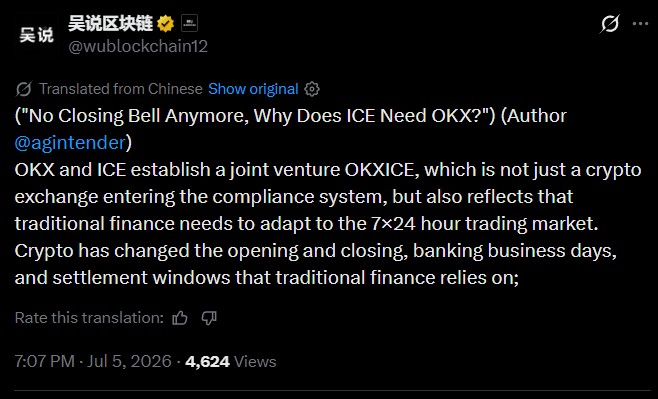
Source: Official X
OKX Ventures Buys Into South Korea's Coinone
Separately, OKX Ventures — the investment arm of OKX — has acquired an approximate 20% stake in South Korean crypto exchange Coinone. The investment, confirmed in filings from May 2026, gives OKX Ventures and Korea Investment & Securities roughly 19.6% ownership each, making them the joint third-largest shareholders behind Coinone's founder and Com2uS Holdings.
The deal isn't just a passive investment; Coinone plans to integrate OKX's matching engine, custody systems, and wallet technology into its own platform to strengthen trading infrastructure and institutional-grade services. Coinone's leadership pointed to OKX's system handling over a million orders per second during last October's sharp Bitcoin decline without interruption as a key reason for the tech partnership.
The deal offers a foothold in Korea's tightly regulated market, while Coinone gains access to globally proven infrastructure and expertise. Both companies emphasized a shared engineering-led, compliance-focused philosophy between their CEOs.
That said, local Korean users and regulators have reportedly expressed some caution about a foreign firm gaining meaningful ownership in a domestic exchange, which could shape how the partnership unfolds
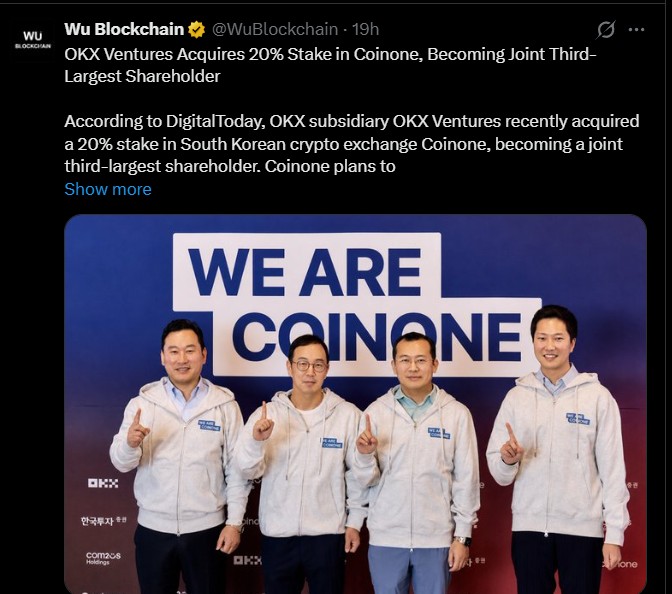
Source: Wu Blockchain
Why It Matters for Traders and Investors
Crypto markets never close, but most of the banking and clearing infrastructure behind traditional finance still runs on business-day hours. That mismatch is the real problem OKXICE is trying to solve — not simply "listing more assets."
If ICE's clearing and risk-management systems can be adapted to a market that trades 24/7, it opens the door to using tokenized traditional assets — stocks, bonds, ETFs — as collateral inside crypto-native accounts. That's a bigger structural shift than another token listing, because it changes what counts as usable collateral across both worlds.
On the Coinone side, the deal gives a mid-sized Korean exchanges access to infrastructure that OKX says handled over a million orders per second during last October's market volatility without downtime. For Korean users, that's a direct pitch about platform stability during high-volatility events.
What to Watch Next
-
Whether OKXICE publishes details on its clearing model for weekend or after-hours margin calls, since fiat settlement systems still run on banking hours.
-
Regulatory reaction in Korea, where officials and users have already voiced caution about foreign capital taking stakes in local exchanges.
-
Whether tokenized securities under OKXICE become usable as margin/collateral, not just tradable assets — this is the detail that determines whether the venture is more than a compliance wrapper.
-
Any follow-up from US regulators, given that OKX-related entities paid over $500 million in fines and forfeitures in 2025 over unlicensed money transfer activity.
Conclusion
The exchange had a genuinely busy week: a joint venture with the NYSE's parent company, a fifth of a South Korean exchange, and the latest update on OKX EU MiCA. The bigger story isn't the individual deals — it's whether traditional clearing and collateral systems can actually adapt to a market that never sleeps. That answer will show up in the details ICE publishes next, not in this week's headlines.
Disclaimer: This article is for informational purposes only and does not constitute financial or investment advice. Cryptocurrency markets are volatile; readers should do their own research and consult a licensed financial advisor before making investment decisions.
Also read:







