Open USD Stablecoin Launch 2026: Why Circle Stock Fell 16%? After OUSD


Open USD Stablecoin Launch 2026: Visa, Mastercard, Coinbase Back OUSD
A single announcement wiped nearly $9 off Circle's stock price in hours. If you hold USDC, trade stablecoins, or watch payments infrastructure, this shift could reshape where reserve yields — and market share — flow next.
Here's what most reports aren't telling you about who actually controls this new coin, and why one analyst is already calling it a risky experiment.
What Happened: Open Standard Launches OUSD
Open Standard has officially announced Open USD Stablecoin (OUSD), a consortium-governed stablecoin built for global payments and settlement. The project launched on June 30, 2026, backed by more than 140 companies spanning payments, banking, tech, and crypto platforms. Zach Abrams, co-founder and CEO of Stripe-owned Bridge, will serve as the founding CEO of Open Standard, the entity operating OUSD.
The project rests on three stated principles: businesses can mint and redeem OUSD at no cost with no volume caps; partners keep nearly all reserve earnings after a small management fee; and governance sits with a board made up of partner institutions rather than one controlling company.
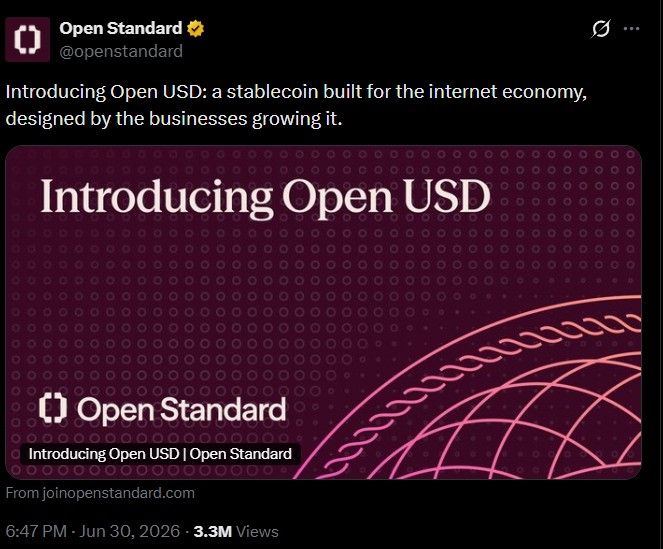
Source: OpenStandard X
Who's Involved: A Cross-Industry Coalition
The partner list is unusually broad. Payments and fintech names include Visa, Stripe, Mastercard payments, American Express, Adyen, Klarna, Affirm, Brex, and Western Union. Banking and financial institutions include BlackRock, BNY, Standard Chartered, DBS, U.S. Bank, BBVA, and Commonwealth Bank of Australia.
Big tech and commerce players include Google, Shopify, IBM, DoorDash, and Rakuten. Crypto-native firms include Coinbase, Solana, Ripple, Base, OKX, Bybit, Fireblocks, and Aptos Labs.
Aptos Labs joined shortly after Aptos revealed its own on-chain stablecoin market cap hit a record $2 billion in June 2026, reinforcing the alliance's crypto-sector credibility alongside its traditional finance backers.
Executives across these firms broadly framed the appeal in similar terms: shared governance, lower costs at scale, and infrastructure that isn't dependent on a single issuer's roadmap.
Coinbase, Shopify, Visa, Mastercard, and Stripe representatives each pointed to openness and interoperability as the differentiator versus existing stablecoins, while BlackRock and BNY executives highlighted the long-term growth potential of the broader stablecoin market.
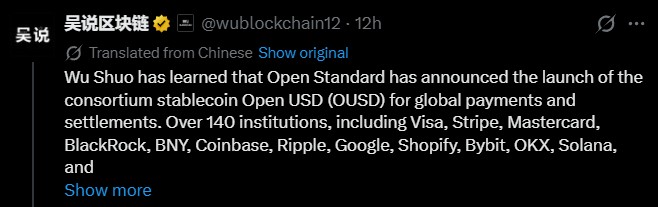
Source: Wu Blockchain X
Market Reaction: Circle Stock Drops Sharply
The announcement immediately rattled markets. Circle's stock (CRCL) dropped nearly 16% intraday, sliding to around $63.07, as traders weighed the competitive threat.
Circle CEO Jeremy Allaire responded by framing stablecoins broadly as central to the next era of internet-based money movement, while positioning USDC as the preferred institutional option. Circle says it plans to keep expanding USDC through banking and payments partnerships.
For everyday traders and institutions alike, the real story is about where stablecoin reserve yields go — currently mostly captured by issuers, but potentially shared with partner businesses under OUSD's model.
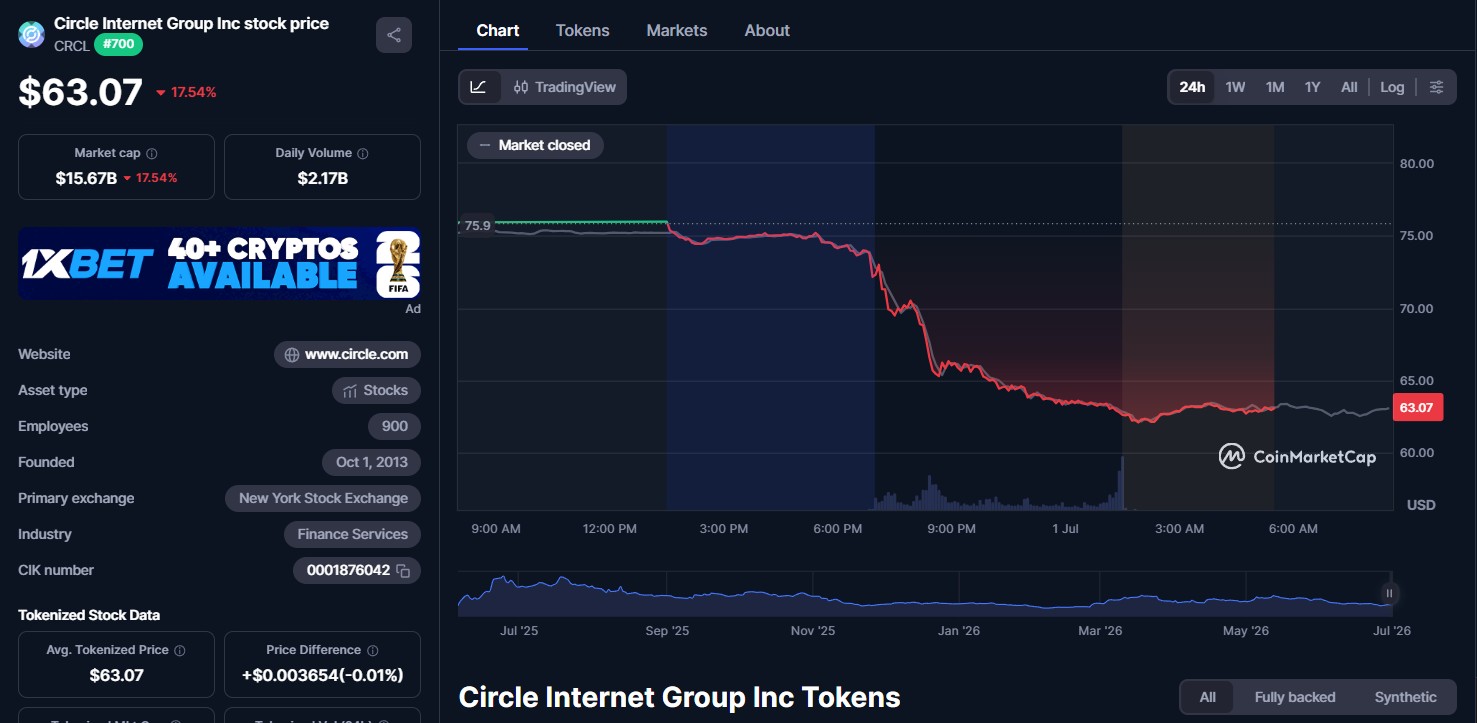
Source: CoinMarketCap
Key Details: Terms, Partners, and Timeline
-
Minting/redemption: Zero fees, with no artificial caps on issuance volume
-
Governance: Consortium board made up of partner institutions, not one company
-
Revenue split: Reserve earnings shared with partners after a small management fee
-
Launch window: Expected later in 2026, across multiple blockchains including Solana and Aptos
-
Notable additions: Aptos Labs joined as a launch partner shortly after Aptos's on-chain stablecoin market cap topped $2 billion in June
Source: X
What to Watch Next?
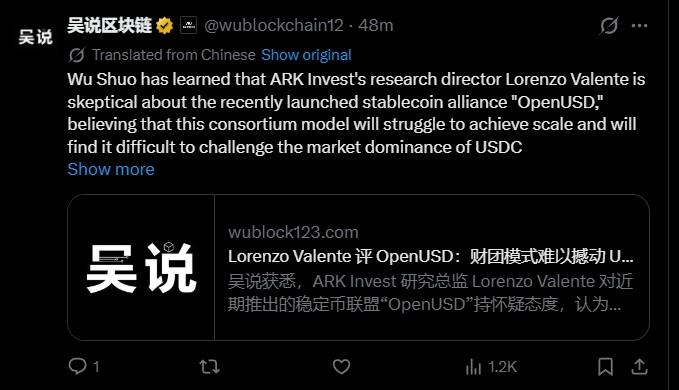
Not everyone is convinced OUSD can dethrone incumbents. ARK Invest research director Lorenzo Valente has raised doubts about whether a consortium of roughly 500 competing entities can move fast enough to compete.
Valente's concerns center on three areas: a cold-start liquidity problem, a lack of established trading pairs against major crypto assets, and governance friction from too many stakeholders at the table.
He also argues OUSD's thin fee model may leave it under-resourced to fund the kind of ecosystem incentives that helped Circle scale. His blunt assessment: shared ownership can mean nobody is clearly accountable when decisions need to happen quickly.
Conclusion
OUSD's launch marks one of the most heavily backed stablecoin efforts to date, pulling in payment giants, banks, and crypto-native firms under one roof. Whether its shared-governance model can outmaneuver Circle's and Tether's speed and liquidity advantages remains the open question heading into its full 2026 rollout.
Disclaimer: This article is for informational purposes only and does not constitute financial, investment, or trading advice. Cryptocurrency markets are highly volatile. Always conduct your own research (DYOR) and consult a licensed financial advisor before making investment decisions. CoinGabbar is not responsible for any losses incurred based on this content.
Also read:
2 months ago
ZEUS CRYPTO RECOVERY SERVICES: A Trusted Cryptocurrency Recovery Company ZEUS CRYPTO RECOVERY SERVICES is a verified cryptocurrency recovery company dedicated to helping clients recover digital assets lost through scams, hacks, and unauthorized transactions. The company uses advanced blockchain tracing tools and experienced recovery specialists to investigate cases across multiple blockchain networks while providing professional support and guidance throughout the recovery process. Website: zeusrecoveryservices .com Call/Text: +44 735 38480 36













