Ozak AI Presale Risk: The Launch Delays, Audits and Real Facts

Ozak AI Presale Risk: Scam Vs Real Debate Over It OZ TGE Delays
The Ozak AI presale has raised more than $7.5 million and sold past 99% of its token supply, yet the promised listing still has not arrived. That gap between a near sold-out sale and a missing Token Generation Event sits at the center of every Ozak AI presale risk question right now.
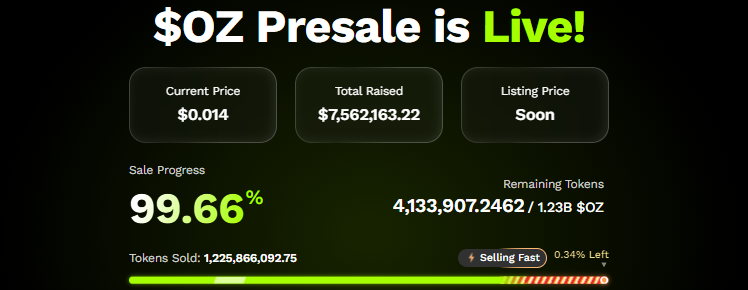
Here is what the dashboard shows today. The current $OZ price holds at $0.014. Total raised sits at $7,562,163. Sale progress reads 99.66%, with just 4,133,907 tokens left out of a 1.23 billion allocation. The listing price is still marked "Soon." That combination, a sale this close to finished with no OZ launch date attached, is exactly why users are asking hard questions.
Ozak AI Presale Risk: Where the 888 Fortune Continuous Delays
OOZ public sale never followed a single straight line. Seven presale phases closed by May 2026, raising close to $7.2 million. Two 3x bonus rounds followed and wrapped by late June.
Then came the 888 Fortune campaign, a four-week, four-wave bonus event that the team called the final push before listing.
That final wave has now stretched well past its original countdown more than once. The current version, marked "Final Wave," still carries the 3x bonus and shows roughly two days left on its own clock.

A few points explain the pattern:
The main seven-phase sale closed in May 2026, then two bonus rounds pushed the raise higher through June
The 888 Fortune campaign launched in late June with four planned weekly waves
Each wave has closed near full completion, only for a new wave to open days later
The team has not published a specific reason for any single extension, though it has tied listing readiness to platform stability at different points
None of this means the sale stopped moving. Token supply, funds raised, and user counts have all climbed steadily. What has not moved is a confirmed OZ TGE date, and that silence is the main driver behind ongoing Ozak AI presale risk discussion online.
Ozak AI Presale Risk: Can the Dual Audits Prove Real Legitimacy Here
Security audits are one of the clearest facts available for weighing risk factors, and matter for any fair Ozak AI presale fake or real assessment.
CertiK completed its review on June 16, 2025. The audit found no critical or major vulnerabilities. Medium and minor issues were flagged and resolved, and the team added stronger address checks along with a multisig wallet setup for fund management.
Sherlock ran a separate audit that closed on September 13, 2025. That review found vulnerabilities of varying severity, including some critical findings. The project states all of them were fixed, and access controls were strengthened afterward.
What Ozak AI dual audits actually prove:
The early sale smart contract and core code have been independently reviewed twice
Reported vulnerabilities were addressed rather than ignored
A single, verified contract address handles every transaction
What audits do not prove:
Whether the team will deliver on the token listing promises
Whether marketing claims about funding totals match verified on-chain figures
Business-level transparency around delay decisions
That distinction matters. A clean audit means the code is unlikely to get hacked. It says nothing about whether a launch date will actually arrive on schedule.
Ozak AI Presale Risk: What Supports the Wider Ecosystem Case
Beyond audits, a few factors add weight to the legitimacy side of the Ozak AI presale risk ledger.
EON platform: Live and free to use, with a paid premium tier, hundreds of daily trading signals, and a published track record of its own prediction accuracy against Polymarket odds
Partnership cadence: New deals have landed with names including MoonRush, 4AI, SoloBox, Nebulai, and Orion Agents, each tied to a specific technical integration rather than a vague announcement
Listed on major trackers: Ozak AI appears on both CoinGecko and CoinMarketCap, giving outside visibility into price and volume once trading begins
Growing user base: Wallet connections and verified accounts have climbed past 700,000 across the Ozak AI ecosystem
Fixed tokenomics with a 10 billion token supply
They do show a team still shipping product rather than one that has gone quiet and disappeared, which is the more common shape of an outright presale scam.
Why Legitimate Projects Delay Their Launches
Delays alone do not make a project fake, and understanding. Real teams push back launches for reasons that hold up: exchange compliance reviews, liquidity planning, or a platform that genuinely needs more testing before going live under real trading volume.
Industry patterns generally split into two camps:
Legitimate delay reasons: waiting on exchange listing agreements, finishing security work, building liquidity depth before trading opens, or holding a product back until it can handle real user load
Scam-pattern delays: repeated bonus round extensions with no fixed end date, vague statements that shift the goalpost each time, and marketing that keeps emphasizing new milestones instead of addressing the original promise
Ozak AI Presale Fake or Real: Weighing the Full Body of Evidence Now
Pulling the threads together on Ozak AI presale risk gives a clearer picture than either extreme take offers.
Signs pointing toward a legitimate, if slow, project:
Two completed third-party audits with disclosed findings and fixes
A working product, EON, generating real signals and a public accuracy record
Consistent, named partnerships with technical detail attached
Transparent tokenomics and a public, verifiable contract address
Signs that still warrant caution:
Multiple unexplained extensions to the same bonus campaign
No fixed TGE date despite months of "final wave" messaging
A $1.00 listing price target that has quietly disappeared from public materials
General crypto presale scams often use similar countdown pressure tactics, even when a specific project is not one of them
For anyone tracking Ozak AI news today, the honest answer on Ozak AI presale risk sits in the middle. This is not a project showing the classic exit-scam signature of vanishing teams and dead social accounts.
It is a project that has repeatedly missed its own internal deadlines without a clear public explanation, and that gap is a legitimate reason for caution regardless of how the underlying technology performs.
The next real test for Ozak AI roadmap credibility is simple to define even if it is hard to predict: a confirmed exchange listing with an actual date attached. Until that happens, every update, every new partnership, and every closed audit only tells part of the story.
Points To Be Noted
This information draws from the official site, audit docs, and blog, plus independent third-party coverage tracking the presale's timeline and delay pattern through August 2026. No official team statement explaining the specific cause of individual wave extensions was found—that gap is reported as a fact, not an accusation.
This is informational content, not financial advice, and worth flagging given the YMYL nature of presale investment decisions.
Also read:









