Polymarket Security Breach: Hackers Steal $3M via Third-Party Vendor


How the Polymarket Security Breach Happened Through a Vendor Attack
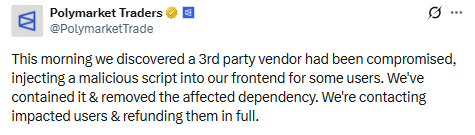
Prediction market platform Polymarket confirmed on June 25, 2026, that hackers stole approximately $3 million in user assets after malicious code was injected into its website frontend through a breached third-party vendor. Fewer than 15 accounts were affected. The vulnerability has been fixed, and Polymarket says all impacted users will be fully reimbursed.
How the Attack Unfolded
One of Polymarket's external vendors was compromised, giving attackers a way in. The hackers used that access to inject malicious code directly into Polymarket's website frontend a method known as a supply-chain attack. Because the code ran on the live site, users interacting with the platform were exposed without any warning.
Polymarket disclosed the breach via a post on X Account. The company did not name the compromised vendor and declined to comment further when contacted by Decrypt.
On-chain analysis confirmed the damage. The stolen funds were primarily made up of Polymarket's pUSD stablecoin. The hackers then swapped the pUSD for ETH — a standard move to reduce traceability before disappearing.
Who Got Hit
Fewer than 15 user accounts were directly affected, according to on-chain data. Despite the small number, the total loss reached roughly $3 million, suggesting the attackers targeted wallets holding significant balances.
Polymarket has confirmed the exploit is patched and that every affected user will receive full reimbursement. No permanent financial loss is expected for any impacted account.
The Bigger Problem: Two Breaches in Under Two Months
This is not Polymarket's first security incident this year. In May 2026, the platform suffered a separate attack in which over $520,000 with some reports citing closer to $700,000 was drained from internal operations wallets connected to rewards payouts on Polygon. That breach targeted employee-side wallets rather than user funds directly.
Two incidents in under two months is a pattern that demands attention. It raises real questions about how rigorously Polymarket vets its third-party vendors, how quickly it detects frontend tampering, and whether its current security infrastructure is built for the scale it now operates at.
Why Supply-Chain Attacks Are So Dangerous
Supply-chain attacks are difficult to defend against because they bypass a platform's own systems entirely. The attacker does not need to break into Polymarket they only need to break into someone Polymarket trusts. Once malicious code is running on the frontend, it is indistinguishable from legitimate code to most users.
For a prediction market handling real-money positions, even a short window of exposure can result in significant losses. In this case, the speed with which stolen pUSD was converted to ETH suggests the attackers had a pre-planned exit strategy ready to execute.
What to Watch Next
The incidents are unlikely to go unnoticed by regulators or the broader crypto community. A few things worth watching in the weeks ahead:
-
Security audits: Community pressure for a transparent, independent audit of Polymarket's vendor relationships and frontend infrastructure will likely grow.
-
Platform monitoring: Real-time frontend integrity checks are not yet standard across Web3 platforms. This breach may accelerate adoption.
-
User confidence: Post-breach trading volume will be the clearest signal of how much trust the platform retains.
Conclusion
Polymarket's June 25 breach is a direct result of a compromised vendor not a flaw in the blockchain itself. With fewer than 15 accounts hit and full reimbursements promised, the immediate damage is limited. But two security incidents in under two months tells a larger story about the risks that come with relying on external infrastructure. How Polymarket responds from here will matter far more than the breach itself.
Disclaimer
This article is based on publicly available information and on-chain data as reported at the time of publication. It does not constitute financial or investment advice. Always conduct your own research before engaging with any crypto platform.