RBI Crypto News: Containment Strategy Tightens Digital Asset Rules


RBI Crypto News Stablecoin Restrictions Gain Regulatory Focus in India
India's central bank isn't playing around when it comes to crypto.
The Reserve Bank of India has backed a "containment" approach. It told a parliamentary panel exactly why. Digital assets, in the RBI's view, pose real risks to financial stability and monetary policy.
What Did the RBI Actually Say?
On 2 July, RBI officials briefed Parliament's Standing Committee on Finance. They didn't hold back. The central bank pushed for what it called a "calibrated containment strategy," one that leans towards prohibition rather than open acceptance.
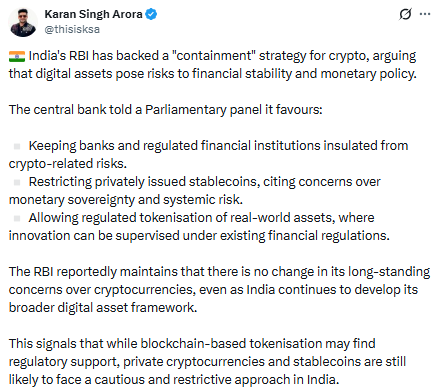
Source: X Account
Their reasoning is simple. The RBI sees crypto as speculative. It believes these assets offer no real economic benefit. On top of that, officials argued it is hard to regulate and puts monetary sovereignty at risk. Rather than legalise it formally, the Reserve Bank of India would rather ring-fence the financial system entirely, keeping it away from risks like money laundering.
So what does the Reserve Bank of India actually want? Three things, based on what it told the panel.
First, keep banks and regulated financial institutions insulated from crypto-related risks. Second, restrict privately issued stablecoins. The concern here isn't just systemic risk, it's also about protecting the country's control over its own currency and monetary policy. Third, allow regulated tokenisation of real-world assets, but only under existing financial rules.
That third point matters. It shows the RBI isn't against blockchain technology as a whole. It's specifically wary of speculative assets and private stablecoins.
Nothing New, Just Louder
This isn't a sudden U-turn. The RBI has held these concerns for years.
This briefing just puts it on record again, even as India keeps building a broader digital asset framework behind the scenes.
Translation? No ban tomorrow. But no open arms either. Tokenisation might get support down the line. Private crypto and stablecoins, though, are staying under the microscope.
The Numbers Tell Their Own Story
Despite all this caution, India already taxes crypto gains at a steep 30%.
And trading hasn't slowed down. Over 100 million users reportedly trade peer-to-peer across the country.
So two things are happening at once. The government keeps collecting tax revenue. The RBI keeps pushing for tighter control. Odd combination, but that's where things stand.
Globally, plenty of countries are building clearer rules. India's central bank seems to be walking the opposite direction, at least for now.
Meanwhile, Maharashtra has already become India's first state to legally recognize crypto as recoverable property, allowing authorities to seize and return fraud-linked assets to victims.
What This Could Look Like Down the Road
Picture this a few years from now.
Tokenised real estate, tokenised gold, even tokenised company shares, all running on blockchain rails, but fully supervised by Indian regulators. That future looks genuinely possible, based on where the RBI is leaning.
Private stablecoins and speculative tokens? That path looks far bumpier. Don't expect quick approvals or a friendly green light anytime soon.
It's an interesting split. One foot moving toward blockchain innovation, the other firmly planted on the brakes for anything resembling private digital currency.
Why This Matters for Investors and Businesses
For everyday users in India, not much changes immediately. Trading isn't banned, and taxes still apply as before. But for businesses hoping to build stablecoin products or crypto-based financial services, this is a signal worth paying attention to. Getting formal approval or a green light from regulators still looks like a long road ahead.
For anyone working on real-world asset tokenisation, though, there's a bit of good news buried in here. The RBI's openness to regulated tokenisation under existing rules leaves the door open, just not the same door crypto exchanges might be hoping for.
Final Thoughts
The RBI isn't shifting its stance anytime soon. Containment stays the strategy, not open regulation.
Tokenisation might get a nod eventually. Private crypto and stablecoins, though, are staying firmly on the RBI's watch list.
Disclaimer
This article is based on publicly reported statements made by RBI officials to a parliamentary committee. It is meant for general information only and does not count as financial, legal, or investment advice. Crypto rules can change quickly, so always check the latest official guidance before making any financial decisions.
Also read:






