Remittix Presale Sold 2M Tokens Overnight: Success Or Doubts


Remittix Presale Above 98%: $30M Raised, RTX Listing Date Close
The RTX coin presale just crossed a major line. The project has now raised over $30 million, and the team says only $2 million stands between the community and an official RTX launch date announcement.
Can it get there before the current presale round closes out?
Remittix Presale Rockets From 88% to 98% in Hours: What Happened Overnight
Just last night, the public sale progress sat at roughly 88% sold out. By morning, it had jumped past 98%. That's more than 10% completed in just a few hours, a pace that surprised even close followers of the project.
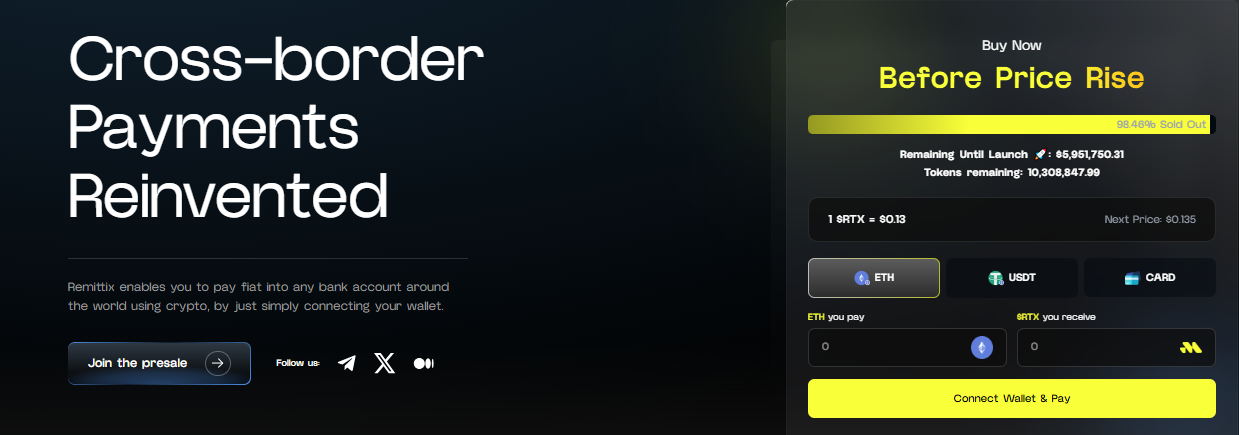
According to the live dashboard, around 10,308,847.99 $RTX tokens are still available, with roughly $5,951,750.31 remaining in total contribution capacity before the hard cap is hit. The current Remittix price sits at $0.13, and the next price tier is locked at $0.135 — a 3.85% jump that triggers the moment this final batch sells out.
Buyers right now can pay using ETH, USDT, or card. CMC, BitMart, and LBank have already been confirmed as pre-market launch partners, with Uniswap locked in as the DEX partner for listing day.
Remittix Presale Target Structure: What the $32M Milestone Unlocks
Right now, the RTX sale target structure works in two clear steps. First, the project needs to hit $32 million total raised. Once that number is reached, the team has committed to publicly revealing the official Remittix launch date.
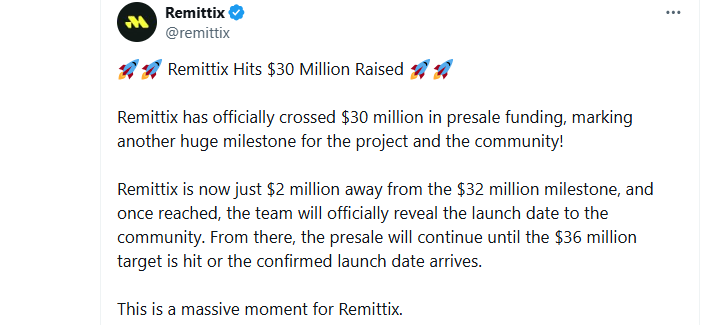
Source: Official X Announcement
After that, the presale continues until either the full $36 million target is reached or the confirmed launch date arrives, whichever comes first.
That $36 million fundraising target is the final ceiling, the hard cap on the whole raise. There is no phase after it. No restocking. No new rounds.
This is a smart structure. It gives the community a clear reason to act now rather than wait. The Remittix presale end date is essentially tied to the speed of the community itself.
Remittix Ecosystem Growth: The Silence That Made Sense
Some in the community have raised questions about delays. The marketing silence over the past few months did create noise, and a portion of holders are now aggressively claiming Remittix Scam slogans online.
Even though the project team is now seeming less active, the ecosystem developments of the project still denies that claim.
Remittix is a PayFi protocol built on Ethereum, CertiK audited, with a working iOS wallet already live on the App Store that logged over 100,000 downloads.
The product lets users send crypto and have the recipient collect local fiat directly in their bank account. It supports over 30 currencies, more than 50 crypto pairs, and charges just 0.1% per transfer – a real value generating path.
Just a few days before, the project opened a VIP membership testing for the platform and the wallet. Active testing of the live platform with the team represents working through final fixes before the public rollout.
VIP staking is also live, offering 10% to 18% annual returns for early RTX holders who lock in now.
The DeepSnitch Comparison: When a Presale Moves Too Fast to Finish
Although the working ecosystem proved the project’s legitimacy, there's another danger looming over.
Remittix presale picked up serious late-stage speed and that represents a similarity with DeepSnitch AI – one of the 2026 hardest launch crash stories.
DeepSnitch AI ($DSNT) ran a 15-stage pre-sale structure and raised $2.77 million, but demand moved so fast that the project wrapped up and listed on Uniswap having completed only 9 of its planned 15 stages.
Following the immediate TGE and Uniswap debut, early stage buyers' sell-out crashed the price to 99% within hours. Today DeepSnitch AI priced at around $0.00163 in the recovery phase.
The tension arises when both have Uniswap as their first public platform. If RTX is also rushing towards a launch, even with a vesting structure, if large numbers of investors sold at the same time, it could hurt price badly.
Here, the difference worth noting is scale and product depth. DeepSnitch ended its presale earlier than planned with a relatively small raise.
Remittix has pulled in over $30 million across a far longer campaign, with a working payment product and confirmed CEX partners already in place. A presale ending faster than expected can also signal genuine demand.
Note: This article is for information purposes only. All the information and facts are based on market present data. The article itself does not claim anything.






