SEC and CFTC Unite to Coordinate Crypto Regulation Framework


SEC and CFTC Sign MOU to Coordinate U.S. Crypto Regulation
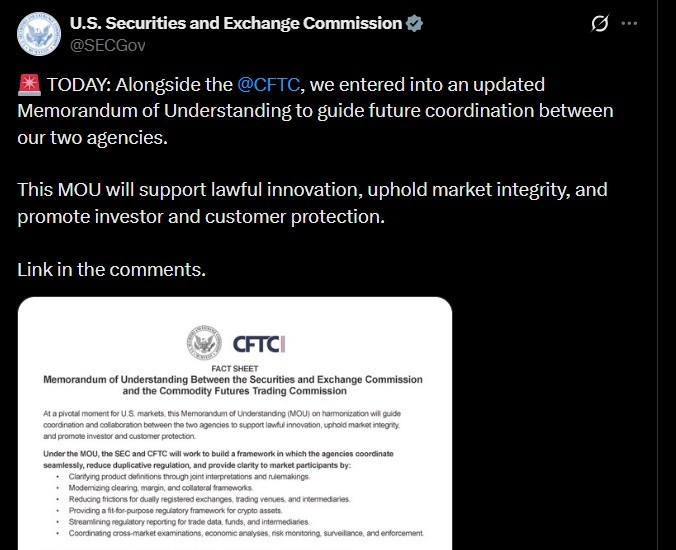
In a move that could reshape virtual assets oversight in the United States, the U.S. Securities and Exchange Commission and the Commodity Futures Trading Commission have signed a new agreement to work together on crypto regulation. The SEC and CFTC Memorandum of Understanding (MOU) aims to improve cooperation between the two agencies while supporting lawful innovation in digital assets.
Officials say the agreement focuses on protecting investors and strengthening market integrity.
Regulators also plan to develop a fit-for-purpose framework for digital asset markets.
Source: X Official
The initiative could help reduce long-standing conflicts between regulators and bring clearer rules to the rapidly evolving blockchain industry.
A Vision for the Long-Standing Regulatory Conflicts
For years, one of the biggest challenges for the American crypto sector has been unclear regulatory jurisdiction.
The SEC generally views many tokens as securities, placing them under securities law oversight.
The CFTC usually regulates commodities and derivatives markets, including crypto futures.
Because some digital assets can fall into both categories, companies have often faced confusing rules and overlapping enforcement actions. The new coordination effort by the SEC and CFTC aims to reduce these conflicts and create clearer guidance for industry participants.
Key Areas of Cooperation:
The agreement outlines several important areas where both regulators will work together.
1. Shared regulatory framework: Build a fit-for-purpose structure tailored for digital assets.
2. Product definitions: Clarify whether a token should be categorized as a security, commodity, or another asset class.
3. Market oversight: Coordinate supervision of crypto exchanges, trading platforms, and intermediaries.
4. Reporting and data sharing: Exchange insights on trading activity, market risks, and fund flows.
These coordinated actions are expected to strengthen oversight without slowing innovation across blockchain markets.
Benefits for Investors and the Crypto Industry
The collaboration could provide several advantages for market participants.
Clearer regulatory guidance for blockchain companies and digital asset projects.
Reduced legal uncertainty for exchanges and developers building financial infrastructure.
Additionally, improved coordination may lead to stronger investor protection and better market monitoring. Many industry leaders have long called for a unified regulatory approach, and the latest step by the SEC and CFTC signals progress toward that goal.
Progress Toward The Long-Awaited Policy: Clarity-Act
The development also reflects broader oversight momentum in Washington.
Lawmakers have been discussing comprehensive virtual asset legislation aimed at establishing clearer frameworks for the sector.
The new coordination effort could accelerate policy discussions that have faced delays in recent years.
Officials say the agreement demonstrates that regulators are actively working toward clearer oversight of emerging financial technologies, which could support innovation while maintaining strong safeguards for investors and markets.
Conclusion:
The partnership between the SEC and CFTC marks an important step toward coordinated digital asset oversight in the United States. By aligning regulatory efforts, the agreement could reduce confusion, strengthen investor protection, and help create a more stable environment for crypto innovation.









