September Fed Rate Decision: 5 Catalysts That Could Move Markets

September Market Volatility: How Could These Events Combine?
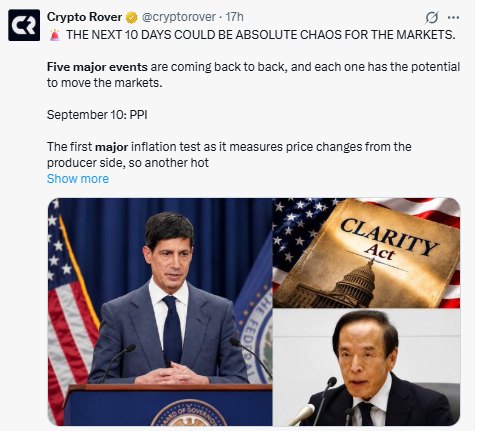
The next ten days bring five separate market-moving events back to back, anchored by the September Fed rate decision on September 15-16. Each one on its own would be significant; landing within the same compressed window is what's turning this into one of the most closely watched stretches for markets and crypto in 2026.
September 10: PPI Sets the Tone
The Producer Price Index (PPI) report lands first, measuring price changes from the producer side of the economy before they reach consumers. A hot PPI print would signal building inflationary pressure earlier in the supply chain — exactly the kind of data Federal Reserve officials watch closely heading into a policy decision. Coming a day before CPI and less than a week before the September Fed rate decision, this report sets the tone for how markets price the rest of the week.
September 11: CPI, the Bigger Test
The Consumer Price Index (CPI) report is widely viewed as the single most important data point before the Fed meets. It measures whether inflation felt directly by consumers is cooling or reaccelerating. Fed Chair Kevin Warsh has been explicit about what he's watching for: in his August Jackson Hole speech, Warsh said, "We must be confident that underlying inflation is moving to our objective, clearly and at sufficient speed. Otherwise, we have work to do."
That statement is why this specific CPI reading carries outsized weight. A downside surprise would ease pressure for tighter policy; an upside surprise could effectively lock in a rate move at the meeting that follows just days later.
September 15: The CLARITY Act's Make-or-Break Vote
This is the date crypto markets specifically are watching. The Senate holds a cloture vote on the motion to proceed to the Digital Asset Market Clarity Act (H.R. 3633) at 2:15 PM ET on September 15 — a procedural vote, not a final passage vote, but a critical gatekeeping step.
Key facts on where things stand:
Detail | Status |
Vote threshold | 60 votes needed to invoke cloture |
Republican seats | 53 — meaning at least 7 Democratic crossovers are required |
House status | Already passed, 294-134, in 2025 |
Sticking points | Ethics rules around officials profiting from crypto, banking-industry opposition, DeFi provisions |
If it fails | The bill is effectively dead for 2026, with prospects pushed into 2027 under a new Congress |
Senate Majority Leader John Thune filed cloture on August 8, just before the August recess, setting up this vote for the day after lawmakers return. Prediction markets have priced the odds of the bill actually becoming law in 2026 at under 20% even before this vote, reflecting genuine uncertainty about whether seven Democratic senators will cross over.
September 15-16: The September Fed Rate Decision
This is the week's central event. The Federal Open Market Committee meets September 15-16, with the rate decision, Chair Warsh's press conference, and updated economic projections all landing on the 16th.
Importantly, this isn't a rate-cut debate — it's a rate-hike debate, which marks a shift from how markets discussed Fed policy for much of the past two years. Context worth understanding:
Warsh's Jackson Hole speech pushed hike odds sharply higher, with CME FedWatch data showing odds around 60-66% for a quarter-point increase, up from near-70% odds of no change just before he spoke
Three FOMC members — Beth Hammack, Neel Kashkari, and Lorie Logan — already dissented in favor of a hike at the July meeting
The administration has pushed publicly for the Fed to hold or cut rates instead, with President Trump, the Vice President, and the Treasury Secretary all weighing in — an unusually broad public pressure campaign
Inflation concerns are tied partly to tariff effects and to rising energy and computing demand linked to the AI investment boom, not just conventional demand-side pressure
Whichever way the September Fed rate decision goes, Warsh's press conference and the Fed's updated projections (the "dot plot") will likely matter as much as the rate move itself for how markets position going into Q4.
September 17-18: The Bank of Japan Meets Too
Rounding out the window, the Bank of Japan holds its own policy meeting September 17-18, with a decision expected on the 18th. Japan's inflation picture has been firming: core inflation (excluding fresh food) hit 1.8% in July, its highest level since March, while wholesale inflation reached 7.2% amid rising energy costs and a weaker yen.
Prediction markets have assigned roughly 84% odds to a 25-basis-point BOJ hike at this meeting. If the BOJ does turn more hawkish while the Fed's own decision is still being digested, the interaction between the two could add real turbulence to USD/JPY — a pair with a track record of causing broader cross-market volatility when it moves sharply.
Separately, the SEC has also scheduled a 24-hour crypto trading roundtable for September 17, landing directly inside this same window and adding a sixth, crypto-specific data point to an already packed calendar.
Conclusion
PPI, CPI, the CLARITY Act vote, the September Fed rate decision, and the BOJ meeting form a five-event sequence inside just ten days — a rate of major catalysts markets don't see very often. Each event can move markets independently, but the real risk is compounding: a hot CPI print heading into a hawkish-leaning Fed decision, landing the same week as a genuinely uncertain crypto-regulation vote, is the kind of setup that can turn ordinary volatility into something sharper. The next ten days are worth watching closely, one date at a time.
Disclaimer
This article is for informational purposes only and does not constitute financial or investment advice. Details are based on official Federal Reserve, Senate, and Bank of Japan scheduling information, along with publicly available economic data and market-pricing data from prediction markets, current as of September 9, 2026. Economic data, legislative outcomes, and central bank decisions remain uncertain until they occur. Always conduct independent research before making financial decisions based on upcoming economic events.









