Stable Whitepaper 2.0 Released: New Tokenomics and AI Payments System

Stable Whitepaper Released: USDT Gas, 100B Supply and New Unlock Plan
The Updated Stable Whitepaper Released this week lays out a fresh roadmap for the USDT-powered Layer 1 network. It positions itself as institutional-grade settlement infrastructure, pairing USDT as native gas with support for PayPal's PYUSD. The document details a 100 billion token supply, a revised multi-year unlock schedule, and a growing focus on agentic and enterprise payments. Here's what the whitepaper reveals about the project's next phase.
Stable Releases 2.0 Whitepaper With USDT-Based Settlement Model
Version 2.0 of the whitepaper reaffirms the network's identity as an EVM-compatible Layer 1 chain built specifically for stablecoin settlement rather than general-purpose computation. Mainnet went live in early December 2025 after a pre-deposit campaign that reportedly drew billions of dollars from tens of thousands of wallets.
The refreshed document frames the project as infrastructure designed to carry the growing weight of the stablecoin economy, which now exceeds $300 billion in circulating value.

USDT as Native Gas and Primary Settlement Asset
Unlike most blockchains that require a separate volatile token for transaction fees, this network uses USDT itself as gas. That removes the need for users to hold and manage a second asset just to transact.
PYUSD, issued by Paxos, is also supported as a first-class settlement asset. The design lets participants choose between deep liquidity (USDT) and federally supervised issuance (PYUSD) without leaving the network or changing settlement finality.
Targeting Institutional Payments and Settlement
A major theme of the update is institutional readiness. The document describes developer-friendly APIs, predictable settlement layers, and treasury management tools aimed at banks, remittance providers, and payment processors. By removing gas-price volatility, the chain aims to offer reliability comparable to traditional financial rails while retaining blockchain-level efficiency and openness.
Token Supply Set at 100 Billion With 18% in Circulation
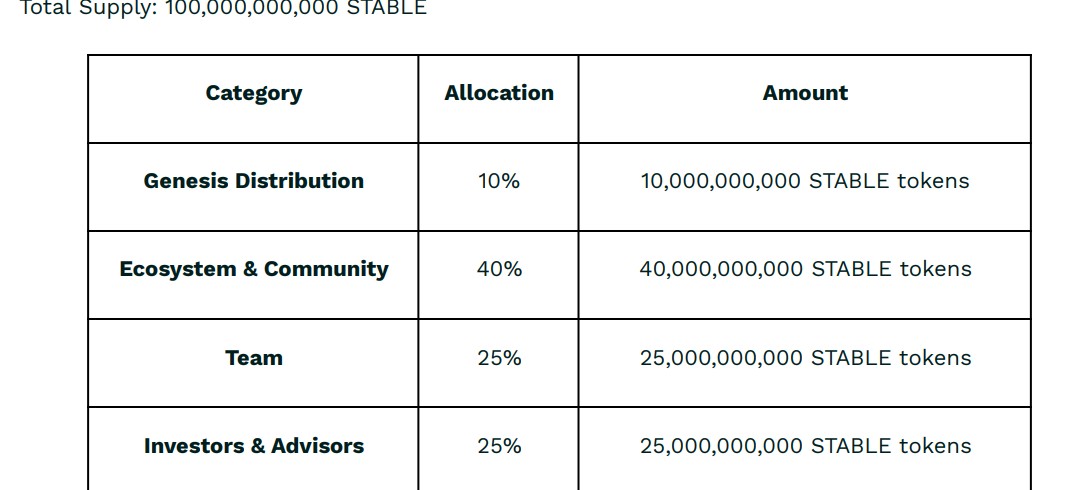
The native governance token has a fixed total supply of 100 billion, with 18% already circulating and the remaining 82% locked. The allocation breakdown:
| Allocation | Share | Tokens |
| Genesis Distribution | 10% | 10 billion |
| Ecosystem & Community | 40% | 40 billion |
| Team | 25% | 25 billion |
| Investors & Advisors | 25% | 25 billion |
| Total | 100% | 100 billion |
The token primarily functions for governance and validator coordination rather than everyday payments, meaning users never need to hold it to transact.
Multi-Phase Token Unlock Through 2029
The locked 82 billion tokens will release gradually through seven scheduled "floors" between late 2027 and late 2029:
| Date | Unlock Event |
| Dec. 8, 2027 | Floor 1 begins — 5% of locked pool |
| Mar. 8, 2028 | Floor 2 — additional 5% |
| Jun. 8, 2028 | Floor 3 — additional 10% |
| Sep. 8, 2028 | Floor 4 — additional 15% |
| Dec. 8, 2028 | Floor 5 — additional 15% |
| Mar. 8, 2029 | Floor 6 — additional 20% |
| Jun. 8, 2029 | Floor 7 — final 30% begins |
| Dec. 8, 2029 | All locked tokens released |
Each drops linearly over roughly six months, with every locked token fully released no later than December 8, 2029.
Unlocks Can Be Delayed if 30-Day VWAP Falls Below $0.025
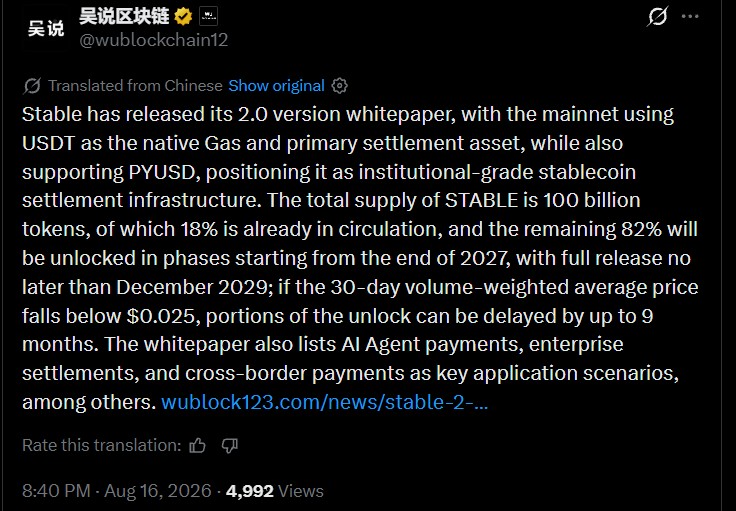
A built-in safety mechanism can defer a scheduled unlock floor. If the token's 30-day volume-weighted average price falls below $0.025 the day before a floor is set to begin, that floor is pushed back by three months. Deferrals can stack up to a maximum of nine months, though the mechanism cannot delay tokens past the final December 2029 release date, and price movements can never speed up an unlock.
AI Agents, Enterprise Settlements and Cross-Border Transfers
The whitepaper spotlights three priority use cases: AI agent payments, enterprise settlements, and cross-border transfers. For autonomous agents, a single USDT balance avoids the failure risk of running out of a separate gas token mid-transaction.
Sub-second finality is presented as essential for machine-speed, pay-per-request commerce, alongside scoped spending authority for agent budgets.
Wu Blockchain Post on X
EVM-Compatible Infrastructure for Global Dollar Settlement
Technically, the chain runs on a custom delegated proof-of-stake consensus layer offering sub-second finality, paired with a fully EVM-compatible execution layer optimized for USDT operations. The architecture also includes a dedicated storage layer and a split-path RPC network layer designed for high-throughput dApp access.
Conclusion
The Updated Stable Whitepaper 2.0 Released reinforces the project's pitch as dedicated settlement infrastructure for digital dollars, combining USDT-based gas, PYUSD support, and a structured 100 billion token model.
The multi-year unlock schedule, paired with a price-based safety, aims to balance token distribution with market stability. With AI agent payments and institutional settlement as core use cases, the roadmap through 2029 is one to watch as the stablecoin sector expands.
Disclaimer: This article is for informational purposes only and does not constitute financial, investment, or trading advice. Cryptocurrency markets are volatile and carry risk. Readers should conduct their own research and consult a licensed financial advisor before making any investment decisions.
Also read:






