US Banks Launch Tokenized Deposit Network to Challenge Stablecoins


What Is the Tokenized Deposit Network and How Does It Work?
What happens when the world's biggest banks decide stablecoins are too big a threat to ignore?
You get the largest coordinated banking move into blockchain in US history. JPMorgan Chase, Citigroup, Bank of America, Wells Fargo, and other major US banks confirmed plans to build a shared tokenized deposit network through The Clearing House — the real-time payments company they collectively own. The Wall Street Journal broke the story on June 5, 2026. Target launch: first half of 2027.
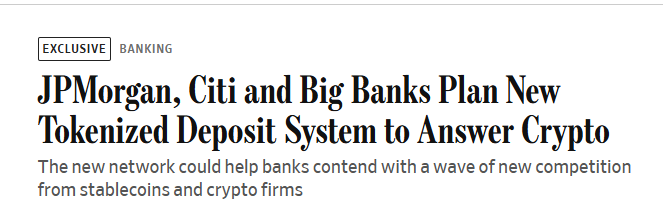 Source: The Wall Street Journal
This isn't an experiment. It's a direct counter to Tether, Circle, and every stablecoin issuer that has been quietly eating into banking's core payment business.
What Is the Tokenized Deposit Network and How Does It Work?
A tokenized deposit is exactly what it sounds like — a regular bank deposition recorded on a blockchain instead of a traditional ledger. It's not a separate digital asset. It carries the same credit risk, the same regulatory treatment, and the same accounting standards as the money already sitting in your checking account.
The network The Clearing House will operate connects existing bank payment rails with blockchain infrastructure. It allows member banks to move tokenized deposit balances instantly, 24 hours a day, seven days a week. Settlement happens on-chain — no waiting until Tuesday morning for a wire to clear.
Clearing House CEO David Watson told the Wall Street Journal this project is "a big move for the lenders" and said the industry faces a "radically different" future around on-chain payments and finance.
Three things the system does that traditional banking can't:
Instant settlement around the clock — including weekends and holidays
Programmable payments — smart contract-triggered transfers for corporate clients
Blockchain-speed money movement without removing deposits from the regulated system
The key difference from stablecoins: every dollar stays inside the banking system. No crypto wallet required. No separate token to buy.
Why Banks Are Racing to Build a Tokenized Deposit System
The threat is specific. Stablecoin firms have been pushing deeper into payments and corporate finance — territory banks have controlled for decades. The CLARITY Act, stablecoin legislation advancing in Washington, has sharpened that concern further.
Banks remain unhappy that proposed CLARITY Act rules leave room for interest-bearing features on stablecoins — products that would compete directly with bank deposit rates. A tokenized deposit system is partly a defensive play: match blockchain payment speed without letting deposits flow outside regulated channels.
Several banks already have early versions of this technology running. JPMorgan's Kinexys platform processes institutional payments via JPM Coin on its private blockchain. The bank also launched a tokenized deposit token on Base — Coinbase's public Layer 2 network — for institutional clients earlier in 2026. Citi runs Token Services, enabling real-time digital transfers between New York, London, and Hong Kong. The new shared network extends similar infrastructure across the entire US banking system.
Citi's head of services Shahmir Khaliq said the network represents "another step that effectively cements" the role banks play in financing, money management, and capital markets.
Not all banks feel equal urgency. Bank of America's head of global payments solutions Mark Monaco acknowledged that clients aren't necessarily "beating down the door" for tokenized deposits right now — but said the system positions banks for when demand builds. "With any sort of new adoption, it takes time," Monaco said.
What the Tokenized Deposit Network Means for Crypto Users
The tokenized deposit network does not directly threaten crypto holders. It targets the payment layer — specifically corporate and institutional clients who currently use stablecoins for cross-border settlements, payroll, and treasury management.
But the indirect impact is significant. If major banks offer instant 24/7 settlement with the same regulatory safety as a traditional account, the primary use case for dollar-pegged stablecoins in corporate finance weakens. Tether and Circle built their dominance on the speed and accessibility gap between traditional banking and blockchain payments. That gap just got smaller.
Three things analysts watch as this network develops — based on public market sources and assumption basis only, no guaranteed outcomes:
Institutional adoption speed: Corporate treasurers choosing between USDC and a JPMorgan digital bank will be the first real test
Stablecoin response: Circle and Tether will likely accelerate their own regulatory approvals under the GENIUS Act to compete
Retail expansion: The 2027 launch targets institutions — whether it reaches retail customers depends on regulatory decisions in 2026
All projections are speculative from public analyst sources. No guaranteed outcomes are provided.
Conclusion
The tokenized deposit network from JPMorgan, Citi, Bank of America, and Wells Fargo is the clearest sign yet that traditional finance takes the stablecoin threat seriously. Blockchain speed, 24/7 settlement, and full regulatory protection — all inside the banking system. Watch the 2027 launch date. That's when the real competition between banks and stablecoin issuers begins.
YMYL Disclaimer
This article is for informational purposes only and does not constitute financial or investment advice. All data is sourced from the Wall Street Journal, PYMNTS, and named publications as of June 5, 2026. The 2027 network launch is a stated target — not a guarantee. Always conduct your own research before making any financial decision.






