US Economic Data Week Ahead, 4 Key Releases That Move Markets


US Economic Data Week Ahead Starts With Consumer Confidence
The US market reopens Tuesday after Memorial Day—and the data calendar hits hard almost immediately.
Four major releases are packed into just three trading days. Each one carries real market-moving power on its own. Together, they could reset rate cut expectations, shake equity markets, and directly impact crypto prices before the week is out. Here is what to watch, what to expect, and why it matters.
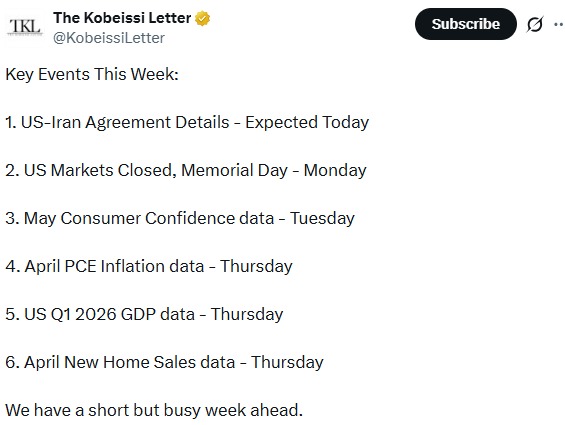
Source: X Account
Tuesday — May Consumer Confidence
The Conference Board's Consumer Confidence Index for May drops Tuesday morning—and the backdrop heading into it is already damaged.
The University of Michigan's Consumer Sentiment Index plunged to a record low of 44.8 in May 2026, revised down from a preliminary 48.2 and marking the third straight monthly decline, as Strait of Hormuz supply disruptions continued to push gasoline prices higher. The cost of living remained the top concern, with 57% of consumers spontaneously citing high prices as eroding their personal finances.
Year-ahead inflation expectations climbed to 4.8% from 4.7%, while long-run expectations rose to 3.9%—notably higher than the 2.8% to 3.2% range seen throughout 2024.
What to watch: Any Conference Board reading below 95 confirms a deteriorating consumer outlook. A beat above 100 would be a genuine surprise—and would push equities and crypto higher on risk-on sentiment.
Thursday — Triple Data Day
Thursday is the week's most important session. Three releases land simultaneously—and together they paint the fullest picture of where the US economy actually stands right now.
April PCE Inflation—Fed's Preferred Gauge
Core PCE inflation is expected to remain elevated at roughly 3.28% in April. Analysts now expect inflation to remain above the Fed's 2% target through much of 2026, while GDP growth forecasts have been revised downward.
March headline CPI already shot to 3.3% year-over-year following the energy shock from the Iran conflict—the highest since May 2024, driven by gasoline prices rising 18.9% year-over-year. April PCE will reveal whether that energy shock has spread into broader services inflation.
Why it matters: If April PCE prints above 3.5%, rate cut hopes evaporate for 2026. Bitcoin and altcoins would face immediate selling pressure. A softer print below 3% flips sentiment instantly—risk-on across all asset classes.
US Q1 2026 GDP — First Major Read
Professional forecasters see the risk of a GDP contraction this quarter at 17.8%—down from a previous estimate of 24% but still elevated. Growth forecasts have been revised downward across the board amid tariff uncertainty and energy cost pressures from the Iran conflict.
What to watch: Any print below 1% annualized growth puts recession language back on the table—bearish for equities and crypto. A 1.5%–2% print holds the range and keeps sentiment neutral.
April New Home Sales — The Housing Signal
The percentage of consumers saying interest rates over the next 12 months will be higher rose to nearly 50% in April. Plans to buy big-ticket items—including homes—continued to shift lower through the first four months of 2026.
High mortgage rates and elevated consumer uncertainty have pressured housing demand since Q4 2025. A sharp miss on new home sales confirms credit tightening is accelerating—a leading indicator that banking stress may follow.
What US Economic Data Means for Markets
Release | Bullish Scenario | Bearish Scenario |
Consumer Confidence (Tue) | Beat above 100—risk-on mood, bullish equities & crypto. | Miss below 90—risk-off, flight to safety, pullbacks. |
April PCE (Thu) | Below 3%—rate-cut hopes revive, risk assets rally. | Above 3.5%—"no cuts in 2026” narrative, pressure on crypto & growth stocks. |
Q1 GDP (Thu) | Above 1.5%—recession fears fade, confidence in the economy. | Below 1%—the recession narrative returns, volatility rises. |
New Home Sales (Thu) | Beat expectations—signals healthy credit and demand. | Sharp miss—hint of banking stress and softening economy. |
Thursday is the day that matters most this week. Three data points in one session—each capable of moving markets independently. If all three disappoint simultaneously, expect a sharp risk-off move across equities, bonds, and crypto before Thursday's close.
If PCE softens and GDP holds—that is the combination that could finally give the Federal Reserve the cover it needs to signal a rate cut path for late 2026.
Watch Thursday. Everything else this week is prologue.
Disclaimer: This article is for informational purposes only. All forecasts and expectations referenced are analyst estimates as of May 25, 2026, and subject to change upon actual data release.
Also read:








