CLARITY Act Stuck at 55% in US Senate: Why Next Chance Comes in 2030?


294 Votes Are Not Enough: Why CLARITY Act Still Fighting in Senate?
Congress is debating a bill that could change crypto forever. Banks are angry. Regulators are split. And one senator says you may wait until 2030 for another chance. Here's what's really happening — and why it matters to you right now.
Jamie Dimon Just Threw the First Punch
JPMorgan CEO Jamie Dimon didn't whisper his opposition. He shouted it. At the Reagan National Economic Forum, Dimon called Coinbase CEO Brian Armstrong "full of sh!t" — live, on Fox Business. The crowd heard it. America heard it.
This wasn't his first shot at Armstrong. The two clashed publicly at Davos in January. Now Dimon is escalating — and bringing the entire banking industry with him. He made his position crystal clear. JPMorgan and other major banks will actively fight in its current form.

Source: BSCN News X
So What Exactly Is Dimon Fighting Against?
His argument cuts to the heart of the bill. Dimon says the CLARITY Act lets crypto firms pay users returns that look and feel like bank deposit interest. But crypto firms don't carry the same protections banks must legally hold.
He also flagged serious gaps in anti-money laundering rules — known as AML — and the Bank Secrecy Act, or BSA. These are laws that stop criminals from hiding dirty money through financial systems.
In Dimon's view, the bill gives firms a free pass. Banks play by strict rules. Crypto shouldn't get a shortcut. He supports blockchain technology. He even backs stablecoins for payments. But he's firmly against this specific framework — calling stablecoins a potential "huge problem" if Washington mishandles them.
What Is the CLARITY Act, and Why Does It Matter?
The Digital Asset Market Clarity Act is crypto's proposed rulebook. Right now, the rules are murky. Companies don't know whether their token counts as a security — regulated like stocks — or a commodity, regulated like gold or oil. The CLARITY Act wants to fix that. It would:
-
Clearly define digital assets as either securities or commodities
-
Split regulatory oversight between the SEC (securities watchdog) and the CFTC (commodities watchdog)
-
Prioritize protecting customer assets if a crypto exchange collapses
The bill already cleared the House in July. It passed with a strong 294–134 bipartisan vote — meaning both Republicans and Democrats supported it.
The Senate Is Where Things Get Complicated
House approval was the easy part. The Senate is a different story. Negotiations have dragged. Prediction markets currently put the bill's chances of passing at just 55%. That's barely a coin flip.
Senator Cynthia Lummis is sounding the alarm loudly. She warns that if the CLARITY Act fails this congressional session, the next real opportunity for major crypto legislation may not arrive until 2030. That's five years of regulatory fog for investors, builders, and everyday crypto users like you.
The SEC's Bold Bet on Congress
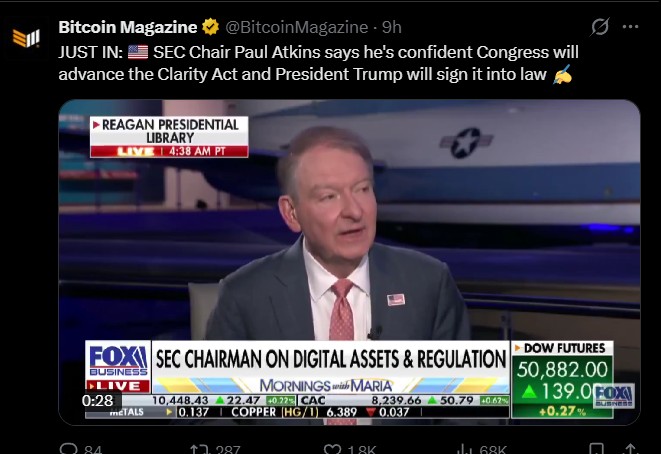
SEC Chair Paul Atkins is backing the bill publicly and confidently. He stated clearly: "I have confidence that Congress will adopt the CLARITY Act and that the US President Trump will be able to sign it."
Atkins argues the bill gives the SEC a proper legal foundation. It keeps crypto innovation happening inside America — not offshore.The Senate Banking Committee has advanced the bill toward a full Senate vote. Progress is real. But the finish line isn't guaranteed.
Source: Bitcoin Magazine X
The Hidden Problem Inside the Bill
Even supporters should pay attention to this warning.
Brookings Institution researcher Aaron Klein raised a sharp concern. The Law expands the CFTC's regulatory duties significantly — but gives the agency no extra budget, no new staff, and no added expertise to match.
The result? Regulation on paper with little enforcement in practice.
Klein also warned that splitting duties between the SEC and CFTC could reduce coordination. Two regulators sharing one market could create confusion — and open gaps that bad actors exploit.
What This Means for You as an Investor or User?
The stakes here are real and personal.
-
If the bill passes cleanly, you get clearer rules. You know what protections exist. Companies know how to operate legally. Innovation can grow with confidence.
-
If it fails or passes with major flaws, uncertainty continues. And that uncertainty costs everyone — from seasoned investors to first-time crypto buyers.
The Verdict
The CLARITY Act is the most consequential crypto bill America has seen. It has House momentum, SEC support, and bipartisan backing. But bank opposition is fierce, Senate negotiations are slow, and expert concerns about enforcement are real.
The next few months will define the crypto regulatory future in the United States. Watch closely — because the outcome affects your money directly.
Disclaimer: This article is for informational purposes only and does not constitute financial or legal advice. Crypto markets are volatile. Always conduct your own research before making investment decisions.






