Ripple RLUSD Japan: Stablecoin Lands After Luxembourg License

Ripple RLUSD Japan: How the Japan Launch and EU License Matter
Ripple just had a big week. After yesterday's XRP news on Ripple's Mastercard collaboration, Ledger AI toolkit, and ETF developments, two more major announcements dropped—and both signal the same thing: regulated crypto is gaining real ground.
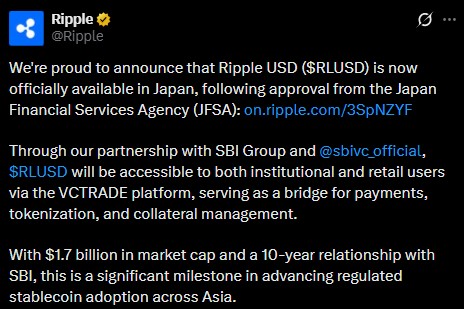
Ripple RLUSD Stablecoin Is Now Live in Japan
Japan's Financial Services Agency (JFSA) — the country's top financial regulator — officially approved Ripple USD (RLUSD) for the Japanese market.
Source: X Post
That's a huge deal. Japan has some of the strictest crypto rules in the world.
Ripple launched RLUSD in Japan through its long-standing partner, SBI Group. The stablecoin is now available on the VCTRADE platform — a trading exchange run by SBI VC Trade.
Both retail and institutional users can access it. It will serve three core purposes:
- Payments — sending and settling money across borders
- Tokenization — turning real-world assets into digital tokens
- Collateral management — using the stablecoin as a financial backstop in transactions
Ripple and SBI have worked together for 10 years. This isn't a cold partnership. It's a deep relationship that made regulatory approval in Japan much more achievable.
Ripple Secures Luxembourg CASP License for Europe
The Japan news wasn't the only headline. Ripple also locked in a preliminary Crypto Asset Service Provider (CASP) license in Luxembourg.
What does CASP mean? It's a regulatory certification under Europe's MiCA framework. MiCA — short for Markets in Crypto-Assets — is the EU's comprehensive rulebook for the crypto industry.
With this license, Ripple can now operate Ripple Payments across the full European Economic Area (EEA). That's 30 countries in one go.
It's not alone in this race, though.
Coinbase In, Binance Out: Europe's MiCA Shuffle
Coinbase has also secured a MiCA license — also through Luxembourg. That puts two of the biggest names in crypto now cleared for European operations.
Meanwhile, Binance pulled its MiCA license application in Greece. That's a notable withdrawal, given how competitive the European market is.
These moves show how fast the regulatory landscape is shifting. Some players are locking in licenses. Others are stepping back.
Can RLUSD Ever Catch USDT and USDC?
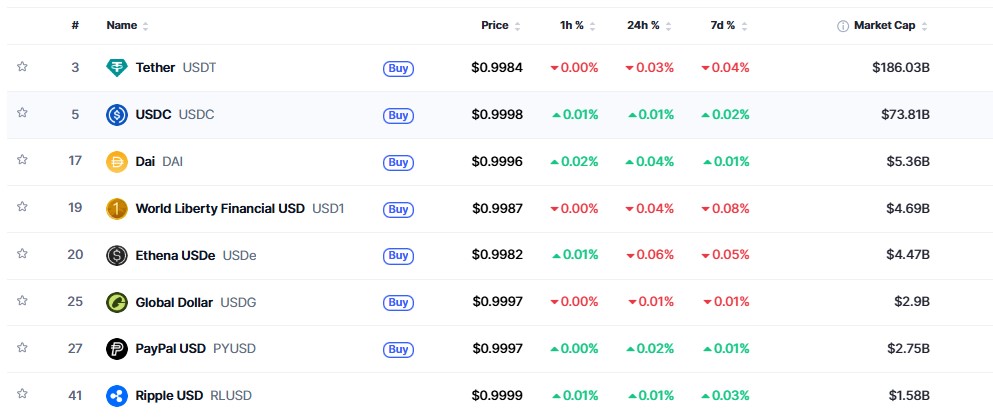
Here's where things get real. RLUSD's market cap sits at $1.58 billion. That sounds impressive — until you compare it to the competition.
Tether (USDT) leads all stablecoins with a $186.01 billion market cap. USD Coin (USDC) holds second place at $73.8 billion. RLUSD ranks #41 overall by market cap.
The gap is enormous. RLUSD would need to grow more than 100 times to reach USDT's level.
Source: CoinMarketCap Data
That said, Ripple's momentum is real. Japan approval, a European license, and the recent Gate.io listing — where RLUSD launched on June 15 with trading pairs against USDT, BTC, ETH, and XRP — all point to growing adoption.
Getting into the top 3 stablecoins is a long-term game. It's not impossible. But it won't happen overnight.
XRP Price Takes a Hit
XRP itself slipped more than 2.5% in a single day and now trades around $1.07, with a market cap of $66.69 billion. While short-term volatility continues, many investors are also tracking the broader XRP price prediction 2026 to understand whether Ripple's expanding global regulatory footprint could support long-term growth.
As all this news dropped, XRP itself slipped. The token fell over 2.5% in a single day. It's now trading around $1.07, with a total market cap of $66.69 billion.
Price crashes during big news cycles aren't unusual in crypto. The broader altcoin market has been volatile. XRP is no exception.
Conclusion
This is a defining moment in XRP News. Ripple's dual move — Japan entry and EU licensing — shows a clear strategy: go regulated, go global. RLUSD has a long road ahead to challenge USDT or USDC. But the foundation is being built, one approval at a time. Investors who are new to the ecosystem and want to participate should first learn how to buy XRP before making any investment decisions.
YMYL Disclaimer: This content is for informational purposes only. It does not constitute financial, investment, or legal advice. Cryptocurrency markets are highly volatile. The value of digital assets can go up or down rapidly, and you may lose money. Always do your own research and consult a qualified financial advisor before making any investment decisions. Past performance is not a reliable indicator of future results.


2 months ago
Mighty Hacker Recovery offers professional services in cybersecurity and digital recovery for individuals and businesses. Their services include data recovery, digital forensics, cybersecurity consulting, malware detection, and incident response. They promise experienced, confidential, and fast support while following ethical practices. Clients can contact them via their website https://mightyhackarrecovery.com/ or WhatSapp Canada +1 (343) 947-3496 for assistance. Additionally, the text poses various questions related to crypto recovery, including inquiries about stolen cryptocurrency, recovery experts, and their effectiveness. BITCOIN RECOVERY EXPERT AT MIGHTY HACKER RECOVERY USDT RECOVERY EXPERT AT MIGHTY HACKER RECOVERY ETH RECOVERY EXPERT AT MIGHTY HACKER RECOVERY CRYPTOCURRENCY FRAUD RECOVERY HACKER FOR HIRE AT MIGHTY HACKER RECOVERY WhatSapp Canada +1 (343) 947-3496