Zimbabwe Crypto Regulation S.I. 99 of 2026 Takes Effect Now


Breaking Down the Zimbabwe Crypto Regulation Rules in S.I. 99
Zimbabwe published its first-ever dedicated crypto law on June 10–12, 2026, and it took effect immediately. Statutory Instrument 99 of 2026 puts every cryptocurrency business in the country under formal government oversight, starting right now.
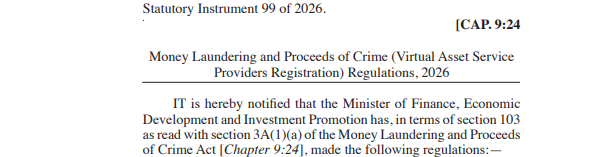
Source: Official Doc
How Zimbabwe Crypto Regulation S.I. 99 of 2026 Actually Works
The Reserve Bank of Zimbabwe's Financial Intelligence Unit – the country's main anti-money laundering body, now oversees every business that touches virtual assets. That includes exchanges, wallet providers, custodians, and even entities that control smart contracts, fund routing, or fee collection.
Every one of those businesses must register with the FIU each year. The annual fee is $500. Running a crypto business without that registration is now a criminal offence, not a fine, not a warning.
Here's what registered businesses must do to stay compliant:
Set up a legally registered local subsidiary inside Zimbabwe
Follow full AML and CFT (countering the financing of terrorism) rules
Apply the travel rule on transfers, sharing sender and receiver details
Run KYC checks on clients and report suspicious transactions
Maintain detailed financial records, held to the same standard as banks
The compliance bar here sits at the same level as traditional banking. That is a deliberate choice by the RBZ.
What S.I. 99 Means for Businesses, Users, and the Economy
Larger and well-funded cryptocurrency firms get the clearest benefit from this law. Formal registration opens doors to banking partnerships, investor confidence, and the ability to operate publicly, according to techinafrica.com.
Offshore platforms targeting Zimbabwean users without a local entity now face direct legal barriers.
Smaller and informal operators face a harder path. Compliance costs, local subsidiary requirements, and detailed record-keeping obligations will push many to either formalize quickly or shut down entirely.
For everyday users, the picture is mixed:
Consumer protections improve under formal oversight
Legal recourse becomes possible if something goes wrong
Transaction friction increases with KYC and reporting requirements
Anonymity shrinks, but accountability grows
The government also gains tax revenue and oversight over a sector that previously ran completely off the books.
Zimbabwe Shifting From Banning Crypto to Regulating It
The country's history with crypto is complicated. Back in 2018, the Reserve Bank of Zimbabwe directed banks to cut off any accounts linked to crypto activity.
However, that ban didn't stop adoption, it just pushed everything underground.
Zimbabwe's economy gave people little choice. Hyperinflation wiped out savings, the ZiG currency faced its own challenges, and millions of people turned to cryptocurrency for remittances, value storage, and payments. The government couldn't keep ignoring a market that just kept growing.
International compliance is also shaping this move. Zimbabwe wants to meet FATF (Financial Action Task Force) standards to avoid gray-listing or blacklisting.
A country on the FATF gray list loses access to global banking systems, a serious economic cost.
S.I. 99 sends a clear signal to international partners that Zimbabwe is bringing its financial sector in line.
Sub-Saharan Africa recorded between $125 billion and $205 billion in on-chain transaction volume in recent periods. Zimbabwe has consistently ranked among the higher-adoption countries in the region, without any formal legal structure until now.
Zimbabwe Joins Africa's Broader Push Toward Crypto Oversight
Zimbabwe is not the first African country to take this path. Kenya, Ghana, Rwanda, and South Africa are all building VASP registration and AML-focused frameworks.
Nigeria, despite years of restrictions, still sees some of the highest crypto adoption on the continent.
The direction across Africa is consistent, crypto bans haven't worked, so regulated oversight is replacing them.
Zimbabwe S.I. 99 isn't a pro-crypto rule. It doesn't make Bitcoin legal tender the way El Salvador did, and it doesn't launch a startup-friendly sandbox. It is a compliance-first framework designed to bring a formally invisible sector into the open.
The RBZ and FIU are expected to release further implementation guidance soon. More detailed licensing rules, potential fintech sandboxes, and possible CBDC integration could all follow if enforcement finds the right balance between oversight and market access.
Disclaimer: This article is for informational purposes only. The content does not make any claims, guarantees, or investment recommendations.