Crypto Weekly Roundup: BNB Steadies at $600 as Asia Makes Big Moves


Crypto Weekly Roundup: BNB Holds $607 as CZ Meets Kazakhstan
This Crypto Weekly Roundup covers Asia's ten biggest digital-asset developments between September 6 and September 13, 2026, as first compiled by WuBlockchain on X.
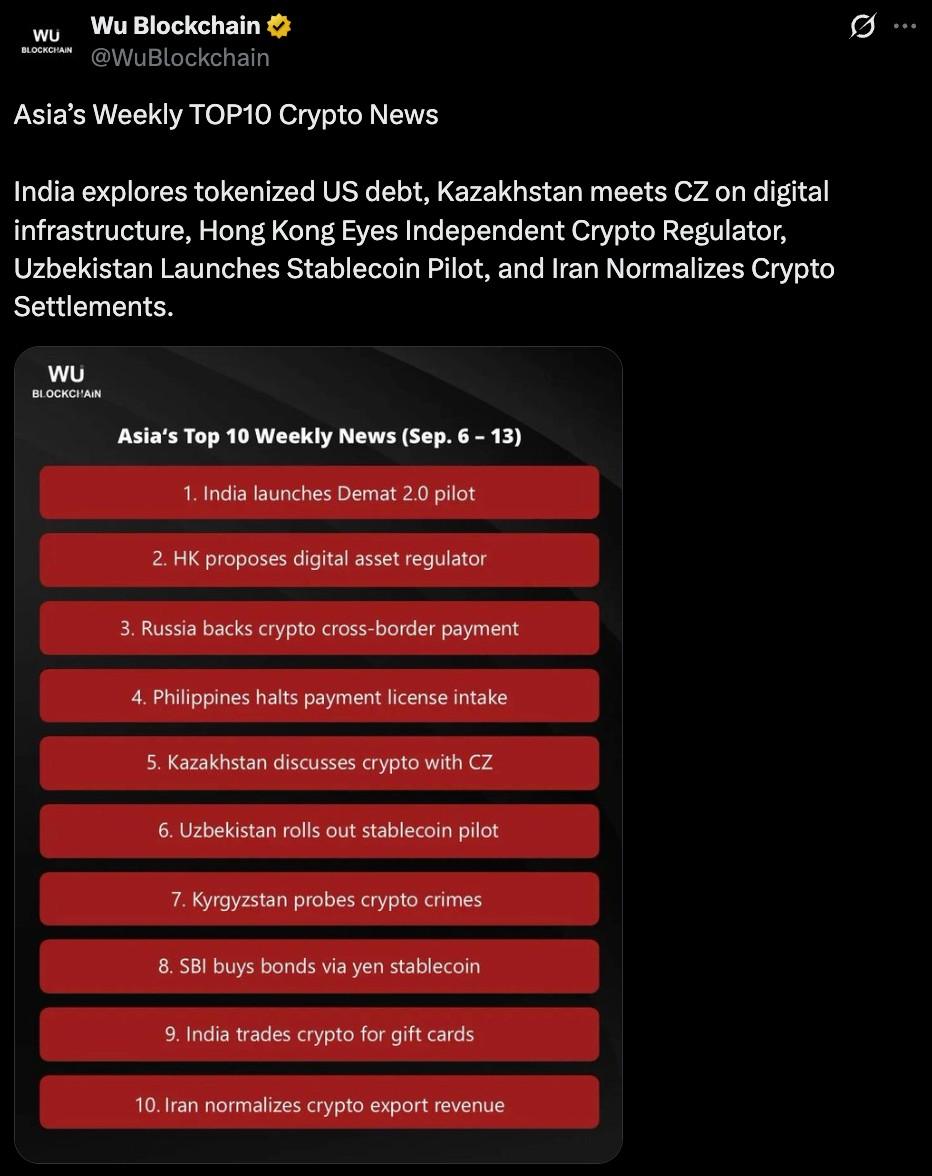
Source : WuBlockchain X Post
BNB, the token tied to Binance founder Changpeng Zhao (CZ), traded near $607 at the time of writing on September 14, 2026, according to CoinGecko data, giving added context to the Kazakhstan meeting below.
If you're following crypto news today, this roundup spans India's tokenization push, Central Asia crypto developments, and Iran's sanctions workaround.
| Country | Headline |
| India | Demat 2.0 tokenized bond pilot |
| Hong Kong | Independent digital asset regulator proposal |
| Russia | Crypto cross-border payments backed |
| Philippines | Payment license intake halted |
| Kazakhstan | Deputy PM meets CZ |
| Uzbekistan | HUMO stablecoin pilot launched |
| Kyrgyzstan | 90 crypto crime probes opened |
| Japan | SBI buys bonds via yen stablecoin |
| India | Crypto-to-gift-card spending route |
| Iran | Crypto export revenue normalized |
What Did India's Demat 2.0 Pilot Achieve in Its First Week?
SEBI and the RBI launched Demat 2.0, tokenizing corporate bonds and settling them through the wholesale digital rupee.
REC, Larsen & Toubro, and IIFL Finance together raised ₹1,025 crore ($107 million). CoinGabbar covered this tokenization push earlier this week in detail.
Why Is Hong Kong Proposing an Independent Crypto Regulator?
Legislator Duncan Chiu wants Hong Kong's Securities and Futures Commission to form a standalone digital-asset division covering tokenized stocks, RWAs, and stablecoins, targeting a global hub status by 2032.
Eleven virtual-asset spot ETFs are already approved. Whether the plan becomes formal policy is still undecided.
What Did Russia Say About Crypto for Cross-Border Trade?
Presidential advisor Boris Titov told Bits.media that crypto remains nearly the only workable settlement route for Russian imports amid Western banking blockades, calling the trend relevant for the next two to three years.
Russia's federal crypto-oversight law took effect September 1.
Why Did the Philippines Pause New Payment License Applications?
The Bangko Sentral ng Pilipinas proposed a 12-month suspension on new Operator of Payment Systems registrations to review licensing rules, per its own consultation draft.
It also wants tighter monitoring of virtual-asset merchant transactions. The proposal is still open for public comment.
What Happened in the Kazakhstan CZ Binance Meeting?
Deputy PM Zhaslan Madiyev met CZ on September 4 to discuss stablecoin issuance, digital infrastructure, and Binance Pay bank partnerships.
Two memorandums were signed covering Kazakhstan crypto taxation and judicial frameworks. Alatau CryptoCity and Data Center Valley were both presented during talks.
What Is Uzbekistan's New Stablecoin Pilot About?
Uzbekistan's central bank and NAPP launched a HUMO stablecoin pilot, pegging 1 HUMO to 1 sum and backing it with government securities.
More than 20 merchants will test the token over an initial 12-month run, extendable up to three years total.
How Many Crypto Crime Cases Has Kyrgyzstan Opened?
Interior Minister Ulan Niyazbekov told Akchabar that authorities opened 90 criminal cases tied to crypto fraud and laundering this year, including a TRON wallet holding over $3 million linked to a fraud ring.
How Is SBI Using Its Yen Stablecoin for Bond Purchases?
SBI Shinsei Trust & Banking directed part of JPYSC's reserves into short-term Japanese government bonds, an initial ¥1 billion tranche.
JPYSC's outstanding supply reached roughly ¥20.1 billion as of September 7, plus ¥6.9 billion in lending.
Why Are Indians Using Crypto to Buy Gift Cards?
Per the Economic Times, offshore platforms let Indian users convert USDT into India-redeemable gift cards for groceries, fuel, and gold.
One platform issued over 16 million cards, drawing regulatory scrutiny over forex and AML rules.
How Has Iran Normalized Crypto for Export Payments?
According to the Financial Times, Iran's central bank quietly eased forex controls, letting exporters repatriate funds via USDT and BTC through local exchanges. TRM Labs estimated Iran's 2025 crypto volume near $10 billion.
Expert Opinion
Analysts tracking this week's crypto news note a consistent pattern: governments across Asia are formalizing rather than banning digital assets
The Kazakhstan-CZ talks and Hong Kong's regulator proposal suggest institutional infrastructure is advancing faster than retail rules, while Iran and parts of Russia show crypto increasingly filling sanctions-driven payment gaps.
Disclaimer: This article is for informational purposes only and does not constitute financial or investment advice. Crypto asset prices, including BNB, are volatile and may change significantly after publication. Readers should conduct independent research before making financial decisions.