EU India Trade Deal Nears Historic $2 Billion Market Milestone

EU India Trade Deal Reaches Key Stage Before Final Approval
India is on the verge of locking in what could become one of its biggest economic wins in decades.
The European Commission has officially asked EU member governments to approve the signing of the EU India Trade Deal, pushing a nearly two-decade-long negotiation to its final stretch.
Before diving into the details of this landmark agreement, here's a quick note for readers who follow markets closely: alongside crypto news today, this trade story is one of the bigger economic developments worth tracking this week, given how much weight it carries for both regions.
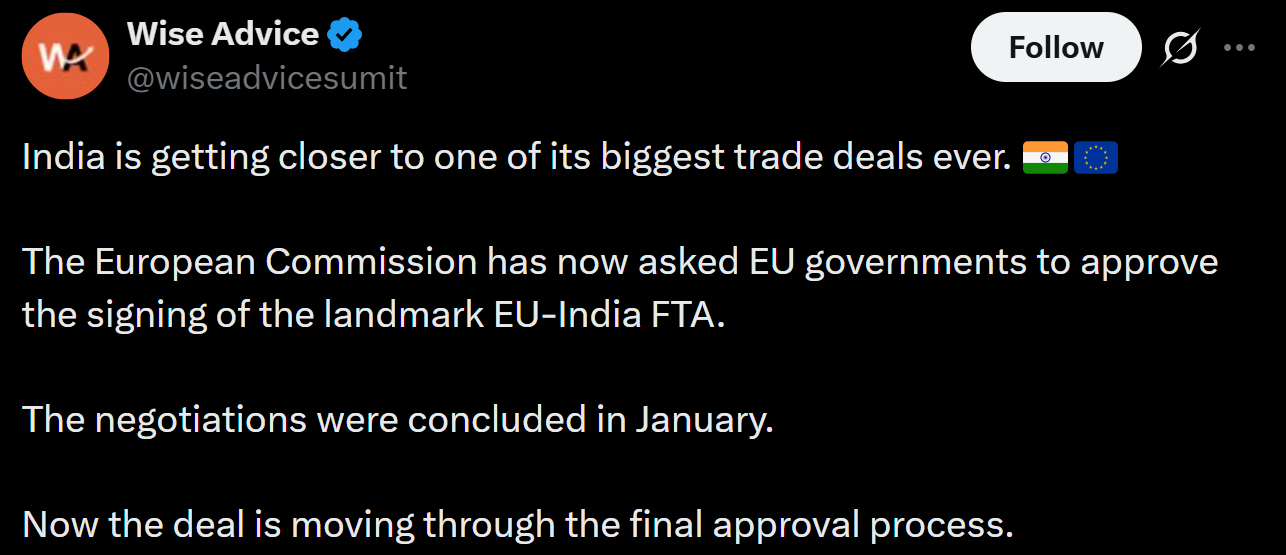
Source: Wise advice sumit on X
What the European Commission Just Did
According to the European Commission's official, the Commission has formally submitted its proposals to the Council of the EU, seeking authorization for the signature and conclusion of the Free Trade Agreement between the European Union and India.
This is a specific, procedural step that comes after negotiations themselves were already wrapped up, meaning the substance of the deal is done, and now it just needs formal approval to move forward.
A Long Road to Get Here
This isn't a deal that came together overnight. The EU and India actually first began negotiating this agreement back in 2007, but talks were suspended in 2013 before being relaunched in 2022.
It took until January 2026 for both sides to finally conclude negotiations successfully.
That's nearly two decades of on-and-off effort finally reaching a real milestone.
| Timeline Event | Year |
| Negotiations first began. | 2007 |
| Talks suspended | 2013 |
| Negotiations relaunched. | 2022 |
| Negotiations concluded. | January 2026 |
| Submitted to Council for signature | September 2026 |
Why This EU India Trade Deal Is Being Called Historic
Once formally approved, this pact is expected to stand as the largest trade agreement either side has ever concluded.
Trade Commissioner Maroš Šefčovič described it as bringing together two of the world's largest economies, representing a combined market of around 2 billion people and roughly a quarter of global GDP.
That scale alone is why this deal has drawn so much attention, since agreements of this size don't come around often, and the potential ripple effects touch nearly every major industry across both regions.
What Actually Changes for Businesses
The practical impact of this deal is significant, and it's worth breaking down what businesses on both sides stand to gain:
-
Tariffs will be removed or reduced on 96% of EU goods exports entering India
-
European exporters are expected to save roughly EUR 4 billion annually in customs duties
-
The EU and India already trade more than EUR 180 billion worth of goods and services every year
-
This existing trade relationship already supports close to 800,000 jobs across the EU
-
The agreement is designed to improve market access, cut unnecessary trade barriers, and create more predictable rules for both trade and investment
Beyond the core trade agreement itself, the EU and India are also working on parallel agreements covering geographical indications and investment protection, which would add additional layers of economic cooperation once finalized.
What Happens Next
With the proposal now sitting in front of the Council, the next step is formal authorization from EU member governments before the agreement can actually be signed and concluded.
Šefčovič emphasized that timing has been a priority throughout this final stretch, noting that the Commission is following through with its proposals in record time specifically so that businesses and citizens can start feeling real benefits as quickly as possible.
Based on current expectations, the agreement is projected to come into force sometime later this year or during the first half of 2027, depending on how quickly the remaining approval steps move.
Conclusion
The EU India Trade Deal has cleared a major hurdle by reaching the Council for formal signature, putting the finish line in sight after nearly two decades of negotiations, suspensions, and relaunches.
With tariff reductions on the vast majority of EU exports, billions in annual savings on the table, and a combined market representing a quarter of the world's GDP, this agreement is shaping up to be one of the most consequential trade deals either side has ever signed, and the coming months will determine exactly when businesses and consumers start feeling its effects.
YMYL Disclaimer: This article is intended for informational and educational purposes only. The information provided is based on publicly available sources and is subject to change as new developments emerge. Readers should independently verify important details before making any financial, investment, business, or other decisions based on this content.
Also read:









