Firo Price Prediction 2026–2030: What Could Drive $FIRO Higher?

FIRO trades near $1.13 as of 13:13 IST (07:43 UTC) on September 20, 2026, down roughly 6-7% on the day. The trend sits inside a descending channel on the daily chart, yet trading stays above the 100-day EMA of $0.7583.
That's a mixed picture. Immediate support holds at $0.9143, and immediate resistance sits at $1.3733. The scenarios below, built from current price prediction models, aren't guarantees. They're structured ranges based on where FIRO trades right now.
Firo Price Prediction: What Is Happening Now?
FIRO's market cap stands near $21.68M, down about 7.43% alongside the price drop. Trading volume over 24 hours reads $205.1K, itself down 31.45%, a sign that today's move isn't backed by heavy participation.
Circulating supply sits at 19.05M FIRO against a max supply of 21.4M FIRO. Fully diluted valuation comes in near $24.35M. That gap between market cap and FDV matters. It's small here, which means dilution risk from future issuance stays limited.
The 52-week range, drawn from the daily chart, runs from a low of $0.5876 to a high of $1.5477. FIRO recently spiked toward that high before pulling back, and it's still trading well above where it sat for most of the summer. Current data comes from live market tracking, and it updates constantly, so treat any single snapshot as a moment in time, not a fixed reading.
FIRO Technical Analysis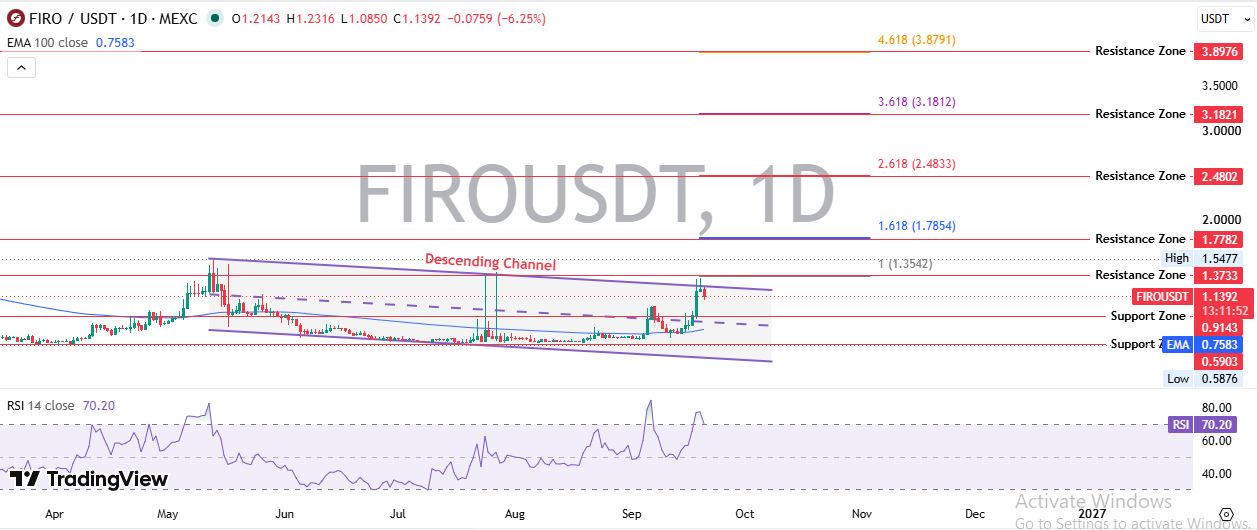
RSI reads 70.20 on the 14-day setting. That's right at the edge of overbought territory. Momentum has been strong, but a reading this high often precedes cooling off.
MACD sits at 0.1019, above its signal line of 0.0598, with a positive histogram of 0.0421. That's a bullish setup on paper. The crossover happened recently, and follow-through hasn't been fully confirmed yet.
Price trades above the 100-day EMA near $0.76, a longer-term bullish marker. But it's still boxed inside a descending channel that's held since spring, visible on the daily chart structure. Two signals pulling in different directions. That's exactly where $FIRO sits today.
Volume has thinned even as price whipsawed. That's a caution flag on any breakout attempt.
FIRO Support and Resistance Levels to Watch
Key $FIRO Support Zones
Immediate support sits at $0.9143. This is where dip buyers have stepped in during recent pullbacks.
Major support comes in lower, around $0.5903, close to the 52-week low near $0.5876. A break below this zone would undo most of the year's gains.
A breakdown level below $0.59 would open the channel's lower boundary. And once support that old gives way, the next real floor isn't close.
Key $FIRO Resistance Zones
Immediate resistance sits at $1.3733, just above where $FIRO trades now. $FIRO already cleared the psychological $1 level earlier this year, so that mark now works as a support reference rather than a ceiling.
The next major breakout resistance clusters at $1.7782, then $2.4802 further out. Clearing $1.3733 with real volume would be the first sign the descending channel is breaking down, not just being tested.
FIRO Price Prediction for October 2026
Short-term direction depends on whether $FIRO holds above $0.9143 while testing $1.3733. Traders watching upcoming market events and catalysts will want confirmation from volume before trusting any breakout.
Bullish Scenario
A close above $1.3733 with volume expanding past the current $205K daily average would open a run toward $1.5477 and then $1.7782. RSI would need room to run past 70 without immediately reversing, and MACD's histogram would need to keep expanding, not just stay positive.
Base Scenario
$FIRO chops between $0.9143 and $1.3733. This is the most likely outcome given thin volume. Price holds the descending channel's shape without a decisive break in either direction.
Bearish Scenario
A drop below $0.9143 on rising volume would signal that the recent bounce failed. That would put $0.5903 back in play as the next real target, and RSI slipping toward 40 would confirm momentum has flipped.
Firo Price Prediction for 2026
Scenario | $FIRO Range | Required Conditions | Invalidation |
Bear | $0.55–$0.75 | Support failure, weak volume, broad risk-off | Recovery above $0.91 |
Base | $0.90–$1.35 | Range holding, steady volume | Break below $0.59 |
Bull | $1.40–$1.80 | Resistance breakout with volume confirmation | Failed breakout, close back under $1.37 |
Firo Price Prediction 2027–2030
FIRO Price Prediction 2027
By 2027, valuation depends on whether $FIRO holds its market cap above current levels while liquidity improves. Using an estimated 20 million circulating supply, a $1.00 price implies roughly $20M in market cap.
2027 Scenario | $FIRO Price | Implied Market Cap* |
Bear | $0.70–$0.90 | $14M–$18M |
Base | $1.00–$1.30 | $20M–$26M |
Bull | $1.40–$1.80 | $28M–$36M |
The base case would require $FIRO to hold key support while trading activity improves. The bull case at $1.80 needs a $36M valuation, meaningfully more demand than today.
FIRO Price Prediction 2028
Circulating supply could reach roughly 20.4M FIRO by 2028 under the current emission schedule.
2028 Scenario | FIRO Price | Implied Market Cap* |
Bear | $0.85–$1.10 | $17.3M–$22.4M |
Base | $1.20–$1.60 | $24.5M–$32.6M |
Bull | $1.70–$2.20 | $34.7M–$44.9M |
The bull case at $2.20 implies a $44.9M market cap. That would still leave $FIRO well below larger privacy-focused coins.
FIRO Price Prediction 2029
Assuming close to 20.8M FIRO circulating by 2029, market cap becomes the key reality check on higher targets.
2029 Scenario | $FIRO Price | Implied Market Cap* |
Bear | $1.00–$1.30 | $20.8M–$27.0M |
Base | $1.40–$1.90 | $29.1M–$39.5M |
Bull | $2.00–$2.70 | $41.6M–$56.2M |
Whether the bull case becomes realistic hinges on user growth, liquidity, and how the broader privacy-coin sector performs. Weak adoption keeps the base or bear range more relevant.
FIRO Price Prediction 2030
By 2030, $FIRO could be approaching its 21.4M supply cap, ahead of a tail-emission phase specified in the project's tokenomics. Using an estimated 21.2M circulating supply for the math:
2030 Scenario | $FIRO Price | Implied Market Cap* |
Bear | $1.10–$1.50 | $23.3M–$31.8M |
Base | $1.60–$2.20 | $33.9M–$46.6M |
Bull | $2.50–$3.20 | $53.0M–$67.8M |
Reaching $3.20 would need roughly $67.8M in market cap, considerably more than today's size. For context, one automated model from CoinCodex currently places its 2030 estimate near $1.31, well below this bull case. That gap alone says something about how wide the range of outcomes really is.
Market-cap formula: $FIRO Market Cap = FIRO Price × Circulating Supply
*Figures above are scenario calculations, not guaranteed forecasts. Circulating-supply assumptions make the math transparent, nothing more.
What Could Drive $FIRO Higher?
Confirmed developments: $FIRO recently went multichain, with rsFIRO live on Rosen Bridge, opening access on Ethereum and BNB Chain rather than a handful of exchanges, per the official FIRO announcement. DEX volume for rsFIRO reportedly reached 16% of native $FIRO trading volume within days of launch. Firominer v1.4.0 also shipped, restoring AMD support and improving mining reliability with zero developer fees.
Potential catalysts: Broader privacy-coin demand, stronger Bitcoin trends pulling altcoins higher, and expanded liquidity through new exchange listings could all add fuel. Community distribution programs, often tracked through crypto airdrop listings, sometimes accompany bridge expansions like rsFIRO and could widen the holder base further.
Here's the thing: none of this guarantees price appreciation. Adoption and speculation are different forces.
What Could Push $FIRO Lower?
Bitcoin weakness would likely drag $FIRO down with it; privacy coins tend to move with broader risk appetite, not against it. Liquidity deterioration is a real risk too. Today's volume already sits well below typical levels.
A failed breakout at $1.3733 would confirm the descending channel stays intact. Loss of the $0.9143 support would be the more serious signal. Regulatory pressure on privacy-focused coins remains an ongoing risk across the sector, and weak adoption of rsFIRO beyond its early numbers would undercut one of the year's main bullish stories.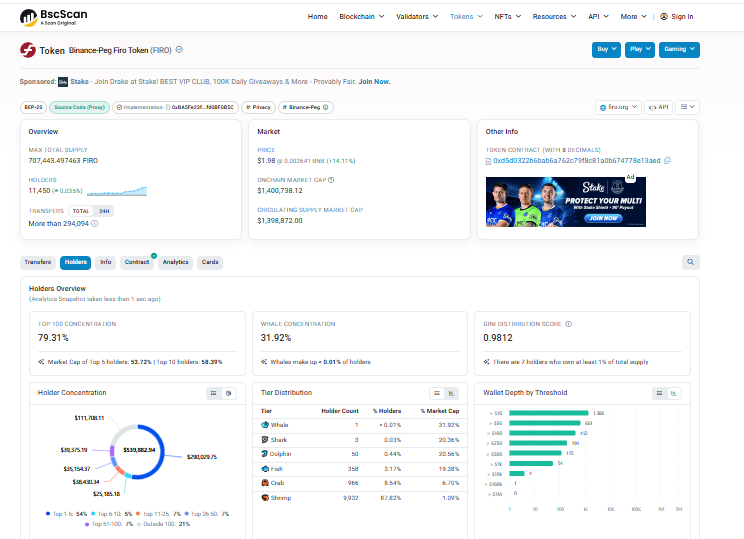
Whale concentration adds another layer of risk. On the Binance-Peg version of the token, the top holder distribution shows meaningful concentration among the largest wallets. Concentrated holdings can mean sharper moves in either direction when large holders act.
$FIRO Market Cap Scenarios
Every price target above ties back to the same formula: price multiplied by circulating supply. That's deliberate. A $3.20 target sounds modest as a number, but it implies close to $68M in market cap by 2030, more than triple today's valuation.
Treating price targets without market cap context is how forecasts drift into fantasy. $FIRO's cap near $21.68M sets the real starting line here.
Firo Price Prediction: What Would Invalidate the Forecast?
Bullish invalidation: A failed close above $1.3733, followed by a drop back under $1.20 on rising volume, would suggest the breakout attempt lacked real demand.
Base-case invalidation: A break below $0.9143 that holds for multiple sessions would move the base case toward the bear range.
Bearish invalidation: A reclaim of $1.3733 with volume above the recent 24-hour average would undercut the bearish thesis fairly quickly.
Technical confirmation, in every direction, needs volume. Price alone moving through a level without participation tends to reverse.
Trader Takeaway: What Should $FIRO Traders Watch Next?
Price level: $0.9143 support and $1.3733 resistance are the two levels that matter most right now.
Volume condition: Daily volume needs to move meaningfully above $205K to validate any breakout or breakdown.
RSI condition: A reading near 70 means momentum is stretched; watch for a reversal or a push through 75.
MACD condition: The histogram staying positive and expanding would support continued upside.
BTC condition: Bitcoin's trend sets the tone for most altcoins, $FIRO included.
Breakout confirmation: A volume-backed close above $1.3733.
Breakdown confirmation: A volume-backed close below $0.9143.
Disclaimer
This article is for informational purposes only and does not constitute financial, investment, or trading advice. Cryptocurrency markets, including $FIRO, are highly volatile, and all price scenarios discussed above are illustrative, not guarantees of future performance. Readers should conduct independent research and consult a qualified financial advisor before making investment decisions.